
Quad IPMDA: Strengthening Maritime Security in a Free, Open and Secure Indo-Pacific
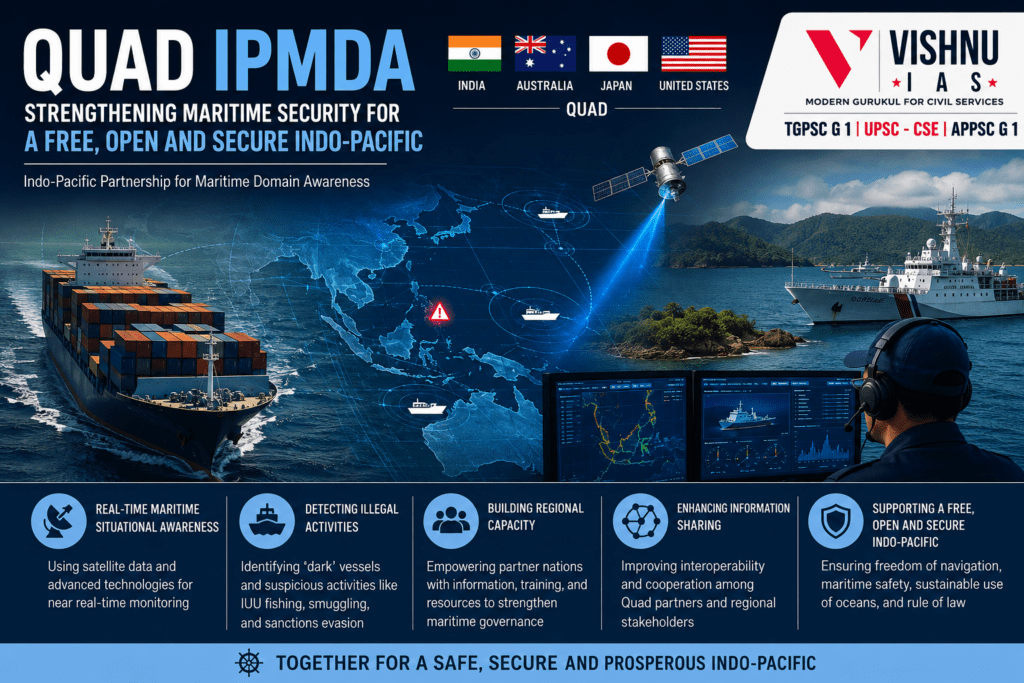
The Quad IPMDA (Indo-Pacific Partnership for Maritime Domain Awareness) seeks to strengthen maritime security in the Indo-Pacific by providing regional partners with near-real-time maritime information to detect illicit activities, improve maritime safety and strengthen a free, open and secure Indo-Pacific.
The Indo-Pacific constitutes a critical maritime artery of global trade, connecting energy-producing regions and consumer markets across the world. It contains or connects major maritime chokepoints such as the Strait of Malacca, Sunda and Lombok Straits. In this context, the Indo-Pacific Partnership for Maritime Domain Awareness (IPMDA), launched by the Quad in 2022, seeks to provide regional partners with near-real-time maritime information to detect illicit activities, improve maritime safety and strengthen a free, open and secure Indo-Pacific.
Maritime Security Challenges in the Indo-Pacific
1. Strategic Importance of Sea Lines of Communication
The Indo-Pacific carries a substantial share of global maritime trade and connects major energy, manufacturing and consumption centres. Disruption of chokepoints such as Malacca, Hormuz or Bab-el-Mandeb can therefore generate cascading effects on energy prices, shipping costs and global supply chains.
2. Maritime Surveillance Deficit
The vastness of the Indo-Pacific makes continuous monitoring difficult, particularly for smaller coastal and island states with limited surveillance capabilities. Vessels switching off their Automatic Identification System (AIS), or “going dark”, can facilitate sanctions evasion, smuggling, illegal fishing and other illicit activities.
3. Rise of Grey-Zone Activities
State and non-state actors increasingly employ coercive activities below the threshold of conventional armed conflict, including maritime militia operations, harassment of vessels and coercive activities in disputed waters. Such actions can undermine freedom of navigation and the rules-based maritime order without necessarily triggering a conventional military response.
4. Illegal, Unreported and Unregulated Fishing
IUU fishing threatens marine ecosystems, coastal livelihoods and food security, particularly in developing island and littoral states. Limited surveillance and enforcement capabilities make such activities difficult to detect and prosecute.
IPMDA as a Mechanism for Maritime Domain Awareness
1. Technology-Enabled Maritime Surveillance
Launched by the Quad - India, Australia, Japan and the United States in 2022, IPMDA seeks to provide partners with access to near-real-time maritime domain awareness data. It uses commercially available technologies such as satellite-based tracking and other maritime information to improve the visibility of activities at sea.
2. Identifying “Dark” Vessels
IPMDA can help identify vessels that deliberately switch off or manipulate AIS signals, enabling participating countries to investigate suspicious movements. This strengthens the ability of states to detect activities such as illegal fishing, smuggling and sanctions evasion.
3. Building Regional Maritime Capacity
IPMDA is particularly valuable for capacity-constrained maritime states, as it enables them to access sophisticated maritime information without independently developing expensive satellite and surveillance infrastructure. This strengthens the collective ability of regional states to monitor their maritime zones.
4. Strengthening Information-Sharing
Maritime domain awareness is most effective when information from different sources is integrated and shared. IPMDA therefore promotes greater interoperability and information-sharing among participating countries, creating a more comprehensive picture of maritime activity.
Contribution of IPMDA to a Free, Open and Secure Indo-Pacific
1. Protecting Freedom of Navigation
Improved maritime awareness enables states to identify activities that threaten Sea Lines of Communication and freedom of navigation. By increasing transparency around maritime activity, IPMDA supports the uninterrupted movement of commercial and energy supplies.
2. Securing Global Supply Chains
Continuous maritime monitoring can help identify potential disruptions to shipping routes and chokepoints. Recent disruptions around Bab-el-Mandeb and the Red Sea have demonstrated how regional conflicts can affect global shipping and supply chains.
3. Combating IUU Fishing and Maritime Crimes
Sharing maritime information enables coastal states to identify suspicious fishing and vessel activity more effectively. This can strengthen action against IUU fishing, trafficking, smuggling and other transnational maritime crimes.
4. Deterring Grey-Zone Coercion
Transparency can act as a form of deterrence by making coercive maritime activities more visible. A shared maritime picture makes it more difficult for actors to exploit surveillance gaps while maintaining plausible deniability.
5. Strengthening Maritime Safety and Disaster Response
Maritime domain awareness has applications beyond traditional security, including search and rescue, disaster response, maritime safety and environmental monitoring. Thus, IPMDA contributes to both the security and resilience of the Indo-Pacific.
India's Role in IPMDA
1. Strategic Geographical Position
India's central location in the Indian Ocean places it at the intersection of major east-west maritime trade routes. This gives India a natural role in monitoring maritime activity across the Indian Ocean.
2. Information Fusion Centre–Indian Ocean Region
The Information Fusion Centre–Indian Ocean Region (IFC-IOR), established by India in 2018 at Gurugram, provides an important institutional mechanism for maritime information-sharing with partner countries. It complements IPMDA by strengthening India's role as a provider of maritime domain awareness in the Indian Ocean.
3. Complementarity with SAGAR
IPMDA complements India's vision of SAGAR—Security and Growth for All in the Region, which emphasises a secure, stable and rules-based maritime environment. It also strengthens India's objective of acting as a net security provider in the Indian Ocean Region.
4. Strengthening India–US Maritime Cooperation
IPMDA provides a practical avenue for India–US cooperation in maritime surveillance, information-sharing and technology. It can deepen existing cooperation in areas such as white-shipping information exchange and maritime security.
Limitations and Challenges
1. Data Sovereignty and Security Concerns
Maritime information-sharing raises concerns regarding data protection, sovereignty and the handling of sensitive information. Participating states therefore require appropriate safeguards and mutually agreed protocols.
2. Uneven Capacity Among Partners
Providing maritime data alone may not be sufficient for smaller states. They also require trained personnel, analytical capabilities, coast guard assets and legal mechanisms to translate information into effective action.
3. Surveillance–Enforcement Gap
Detecting a suspicious vessel does not automatically enable enforcement. Effective action requires coordination among navies, coast guards, fisheries authorities, customs agencies and judicial institutions.
4. Coordination with Existing Mechanisms
IPMDA must complement rather than duplicate existing regional mechanisms such as IFC-IOR, IORA, ReCAAP and ASEAN-led maritime initiatives. Greater institutional interoperability would improve its effectiveness.
Way Forward
1. Expand Regional Participation
The Quad shall encourage greater participation of ASEAN members, Indian Ocean littoral states and Pacific Island countries, particularly states with limited maritime surveillance capabilities. This would transform IPMDA from a Quad initiative into a broader regional public good.
2. Integrate Emerging Technologies
Greater integration of satellite imagery, AIS, radar, radio-frequency data, artificial intelligence and data analytics can create a more comprehensive and near-continuous maritime picture.
3. Strengthen Capacity-Building
Technology transfer should be accompanied by training, institutional development and maritime law-enforcement capacity. Initiatives such as the Maritime Initiative for Training in the Indo-Pacific (MAITRI) can support this objective.
Conclusion
The Indo-Pacific is increasingly the maritime circulatory system of the global economy, but its openness cannot be taken for granted amid geopolitical competition, grey-zone coercion, IUU fishing and disruptions to critical maritime routes. Thus, IPMDA represents a shift from reactive maritime security towards preventive, technology-enabled and information-driven cooperation. For India, IPMDA complements SAGAR, IFC-IOR and its role as a net security provider, while providing an avenue for deeper cooperation with Quad partners.