
Introduction:
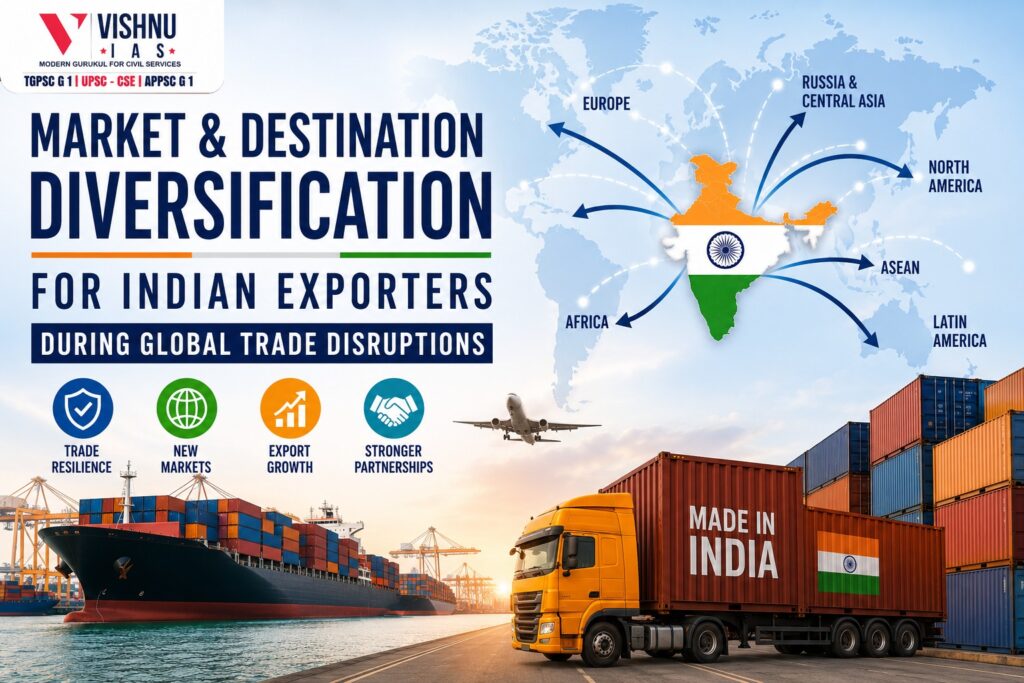
- Market and destination diversification refers to the strategy of expanding exports across a wider range of products, geographies, and consumer markets to reduce dependence on a limited set of trading partners and thereby enhance trade resilience.
- In an era marked by geopolitical conflicts, supply-chain fragmentation, protectionist barriers, and repeated global shocks—from the COVID-19 pandemic to the Red Sea and West Asia disruptions diversification has emerged as a strategic necessity rather than a commercial choice.
- India’s merchandise exports touching around $43.6 billion in April 2026, with nearly 14% year-on-year growth, alongside 9% growth in non-oil exports, reflects the growing importance of this strategy. Simultaneously, the rising share of services exports, now approaching nearly half of total exports, underlines the broadening base of India’s external sector and its structural transformation.
Body:
1. Strategic importance of market and destination diversification in an uncertain global trade environment
(a) Enhances resilience against geopolitical and regional shocks
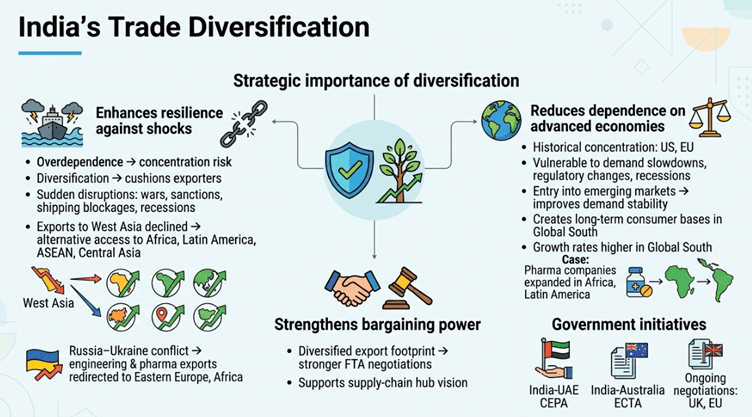
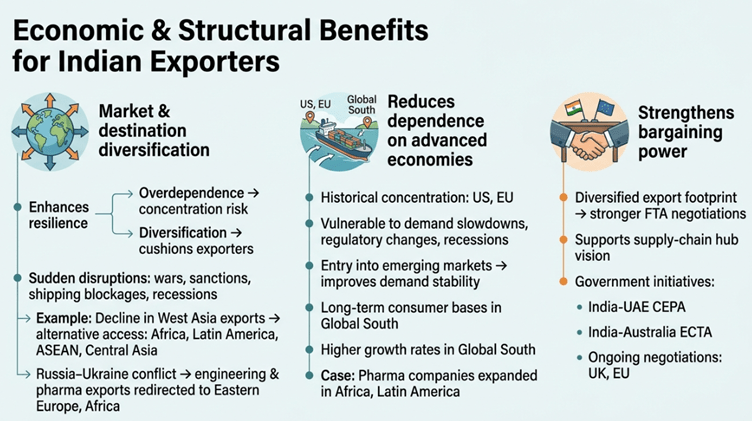
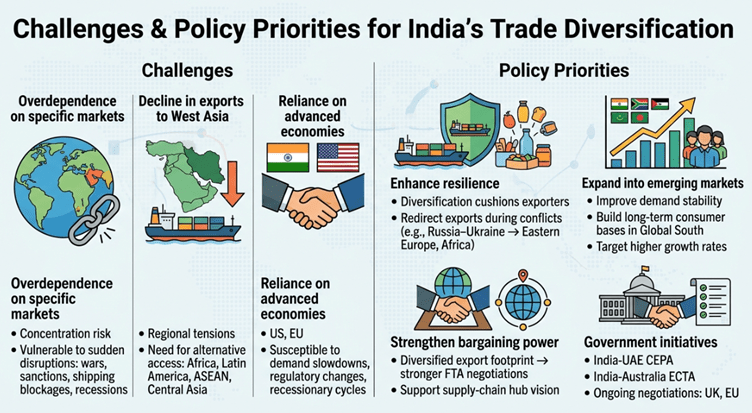
- Overdependence on specific markets creates concentration risk; diversification cushions exporters against sudden disruptions caused by wars, sanctions, shipping blockages, or regional recessions.
- India’s recent decline in exports to West Asia due to ongoing regional tensions demonstrates how alternative access to Africa, Latin America, ASEAN, and Central Asia can prevent severe trade losses.
- Example: During the Russia–Ukraine conflict, Indian exporters redirected portions of engineering and pharmaceutical exports toward Eastern Europe and Africa, limiting sectoral damage.
(b) Reduces dependence on traditional advanced economies
- Historically, India’s exports were concentrated in the US and EU, making them vulnerable to demand slowdowns, regulatory changes, and recessionary cycles in developed economies.
- Entry into emerging markets improves demand stability and creates long-term consumer bases in Global South economies, where growth rates are relatively higher.
- Case Study: Indian pharmaceutical companies expanded aggressively into Africa and Latin America, reducing excessive reliance on Western regulated markets.
(c) Strengthens India’s bargaining power in global trade diplomacy
- A diversified export footprint improves India’s ability to negotiate Free Trade Agreements (FTAs) from a position of strength.
- Wider trade engagement supports India’s vision of becoming a trusted global supply-chain hub under changing global manufacturing patterns.
- Government Initiative: Agreements such as the India-UAE CEPA, India-Australia ECTA, and ongoing negotiations with the UK and EU are directly linked to destination diversification goals.
2. Economic and structural benefits for Indian exporters
(a) Encourages sectoral expansion and product competitiveness
- New markets incentivize firms to innovate in quality standards, packaging, branding, and product adaptation, improving long-term competitiveness.
- Export diversification has benefited sectors such as engineering goods, electronics, chemicals, pharmaceuticals, and handloom products, which have expanded their international reach.
- Example: Indian handloom exports entering dozens of new markets strengthens both export earnings and preservation of traditional livelihoods.
(b) Supports MSMEs and regional export inclusion
- Smaller firms often suffer from dependence on one buyer or one region; diversification opens multiple revenue channels and lowers business risk.
- It promotes inclusion of district-level products into global value chains.
- Government Initiative: The Districts as Export Hubs programme integrates local products—such as Moradabad brassware and Banarasi textiles—into global markets.
(c) Improves foreign exchange stability and macroeconomic balance
- Broader export destinations stabilize export earnings, helping manage the current account deficit and exchange-rate volatility.
- Stronger non-oil exports reduce vulnerability to global crude-price swings.
- Case Study: India’s sustained growth in non-petroleum exports has helped partially offset external vulnerabilities caused by volatile energy imports.
3. Challenges and policy priorities for sustaining diversification
(a) Diversification must be matched by cost competitiveness
- Entering new markets is insufficient unless Indian exports remain competitive in price, logistics, and delivery reliability.
- High logistics costs—estimated at a larger share of GDP than many competitor economies—remain a structural disadvantage.
- Government Initiative: The PM Gati Shakti National Master Plan and National Logistics Policy aim to reduce supply-chain inefficiencies.
(b) Quality and standards compliance are critical
- Developed and emerging markets increasingly impose non-tariff barriers, including sustainability, safety, and digital compliance standards.
- Without quality upgrading, market diversification can remain shallow and temporary.
- Example: The EU’s Carbon Border Adjustment Mechanism (CBAM) poses new compliance challenges for Indian steel and aluminium exporters.
(c) Need to diversify beyond goods into high-value services and technology
- Services now account for an increasingly large share of exports, especially IT, consulting, finance, and digital platforms.
- However, rapid advances in Artificial Intelligence may disrupt India’s traditional software advantage unless skills are upgraded.
- Government Initiative: Digital India, IndiaAI Mission, and expanded semiconductor incentives aim to future-proof export competitiveness.
Conclusion:
- Market and destination diversification has become a central pillar of India’s external economic strategy because it converts vulnerability into strategic resilience. While recent export performance shows encouraging adaptation, sustaining this momentum requires deeper reforms in quality, scale, logistics efficiency, innovation, and trade diplomacy.
- If India successfully combines diversification with competitiveness, it can move from being merely a large exporter to becoming a globally trusted trade and supply-chain leader, supporting the long-term aspiration of becoming a $5 trillion-plus economy with stronger integration into global commerce.