
Introduction:
- Supply-chain diversification refers to the strategic distribution of sourcing, production, logistics and market linkages across multiple geographies and partners to reduce concentration risk and improve resilience. In the contemporary global order marked by geoeconomic competition, de-risking, and weaponisation of interdependence it has emerged as a critical instrument of strategic autonomy, defined as a state’s ability to pursue independent national choices without excessive external dependence.
- The post-pandemic disruptions, the Russia–Ukraine conflict, Red Sea shipping disruptions, semiconductor shortages, and growing US–China strategic rivalry have accelerated the shift from “just-in-time” efficiency to “just-in-case”
- For India, now among the world’s fastest-growing major economies and projected to remain a major driver of global growth, supply-chain diversification has become central not only to economic growth but also to preserving decision-making sovereignty in a fragmented world.
Body:
· 1. Supply-chain diversification as a pillar of India’s strategic autonomy
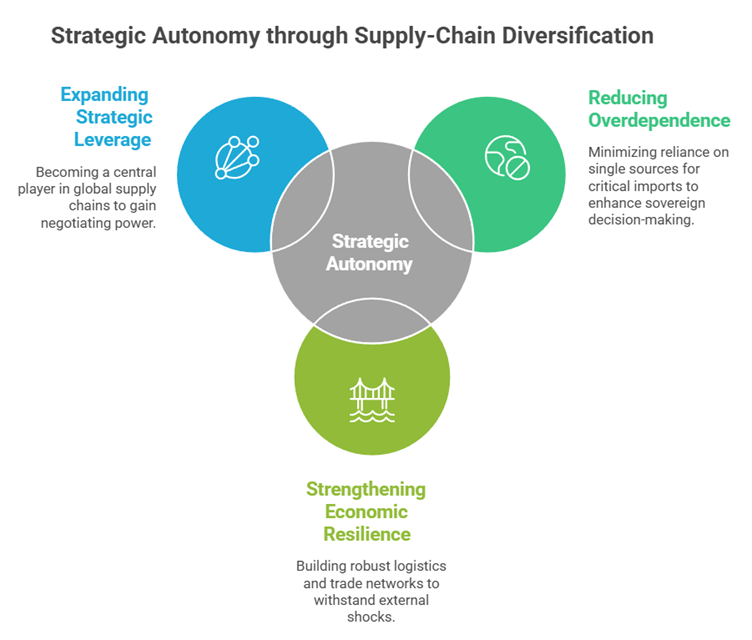
(a) Reducing overdependence and enhancing sovereign decision-making
- Excessive dependence on one country for critical imports—such as electronics components, APIs, solar modules, or rare earths—creates strategic vulnerabilities and limits diplomatic flexibility.
- Diversified sourcing reduces risks of economic coercion, allowing India to avoid strategic compromise during crises.
- Example: India’s effort to reduce dependence on Chinese APIs through the Production Linked Incentive (PLI) scheme and bulk drug parks aims to secure pharmaceutical sovereignty.
- Case Study: During COVID-19, disruptions in Chinese supply chains exposed India’s dependence on imported pharmaceutical inputs, prompting domestic manufacturing reforms.
(b) Strengthening economic resilience against external shocks
- Diversified logistics corridors and multiple trade partners cushion the economy from shocks such as pandemics, sanctions, wars, and maritime disruptions.
- Supply resilience directly supports macroeconomic stability, inflation management and industrial continuity.
- India’s rise in global manufacturing attractiveness rankings reflects growing trust in its resilience.
- Example: India’s diversification of crude imports—buying from West Asia, Russia, the US and Africa—helped manage energy inflation during the Ukraine conflict.
(c) Expanding strategic leverage through geoeconomic relevance
- Countries central to global supply networks gain negotiating power, diplomatic weight and rule-shaping ability.
- Supply-chain centrality transforms India from a passive market into a strategic production hub.
- This aligns with the vision of becoming a trusted alternative manufacturing ecosystem.
- Case Study: India’s inclusion in the Indo-Pacific Economic Framework (IPEF) supply-chain pillar enhances its role in shaping regional economic architecture.
2. Key dimensions through which supply-chain diversification supports India
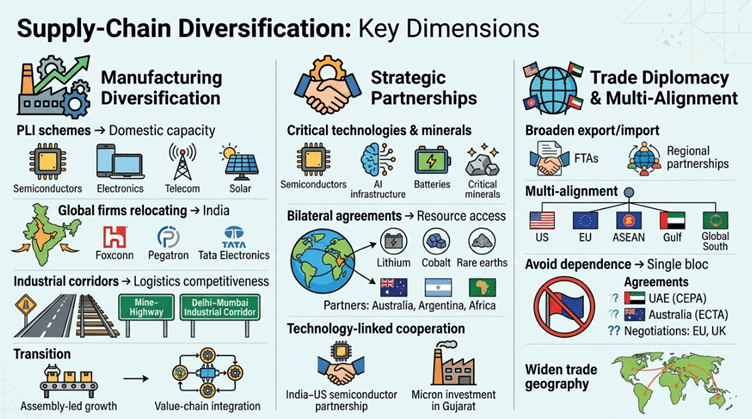
(a) Manufacturing diversification and industrial deepening
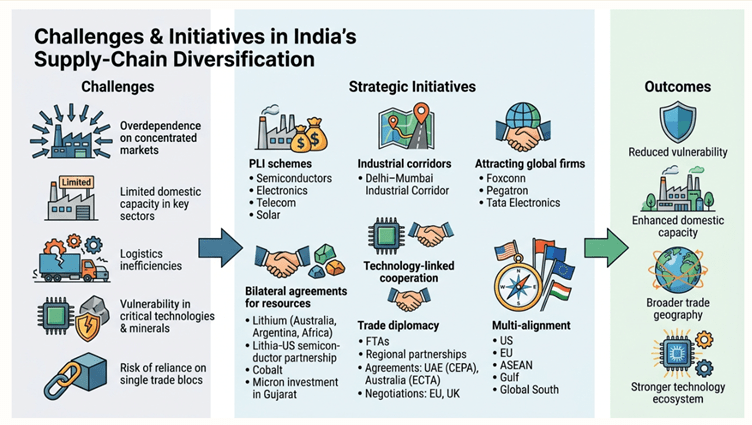
- PLI schemes across semiconductors, electronics, telecom and solar aim to build domestic capacity and attract global firms relocating from concentrated markets.
- Industrial corridors such as Delhi–Mumbai Industrial Corridor improve logistics competitiveness.
- This supports the transition from assembly-led growth to value-chain integration.
- Example: Apple’s expanding manufacturing ecosystem in India through Foxconn, Pegatron and Tata Electronics reflects the China+1 strategy.
(b) Strategic partnerships in critical technologies and minerals
- Control over semiconductors, AI infrastructure, batteries and critical minerals increasingly defines power.
- India has pursued bilateral agreements for lithium, cobalt and rare earth access with Australia, Argentina and African nations.
- Such diversification prevents vulnerability in future technology competition.
- Case Study: The India–US semiconductor partnership and Micron’s investment in Gujarat demonstrate technology-linked strategic cooperation.
(c) Trade diplomacy and multi-alignment
- Diversification requires broadening export destinations and import sources through FTAs and regional partnerships.
- India’s strategy reflects multi-alignment, engaging simultaneously with the US, EU, ASEAN, Gulf and Global South.
- This avoids dependence on any single bloc.
- Example: Agreements with UAE (CEPA), Australia (ECTA) and negotiations with the EU and UK widen India’s trade geography.
3. Challenges and the way ahead for effective diversification
(a) Domestic structural bottlenecks
- High logistics costs, skill gaps, land constraints and regulatory complexity can reduce India’s attractiveness as an alternative supply base.
- Despite improvements, manufacturing’s share in GDP remains below desired levels.
- Supply-chain leadership requires deeper reforms in ease of doing business and contract enforcement.
- Government Initiative: PM Gati Shakti integrates infrastructure planning to reduce logistics inefficiencies.
(b) Balancing openness with strategic security
- Over-securitisation may lead to protectionism, undermining competitiveness.
- India must avoid replacing one dependence with another through excessive alignment with any single bloc.
- Strategic autonomy requires calibrated integration, not isolation.
- Example: India’s approach to trusted telecom vendors balances security concerns with market openness.
(c) Building innovation and institutional credibility
- Long-term diversification needs strong R&D ecosystems, intellectual property creation and trusted governance.
- Investors increasingly value predictable regulation, digital trust and democratic stability.
- Institutional strength enhances India’s credibility as a long-term partner.
- Case Study: Digital Public Infrastructure—including Aadhaar, UPI and ONDC—has positioned India as a provider of trusted digital systems globally.
- Government Initiative: National Quantum Mission, Semicon India Programme, and National Logistics Policy support this transition.
Conclusion:
- Supply-chain diversification has moved beyond an economic strategy to become a central instrument of strategic autonomy in the 21st century. For India, it offers a historic opportunity to convert global demand for resilient and trusted production networks into long-term national capability.
- If supported by continued reforms, stronger institutions and sustained competitiveness, India can emerge not merely as an alternative node in global supply chains, but as a system-shaping power—one that protects its autonomy while amplifying its developmental and geopolitical ambitions.