
Introduction:
- Energy transition refers to the structural shift from fossil fuel-based systems to renewable and low-carbon energy sources, ensuring sustainability, reliability, and affordability. India’s power sector is witnessing rapid solar expansion, with solar accounting for nearly 28% of installed capacity by 2026, up from about 15% in 2022.
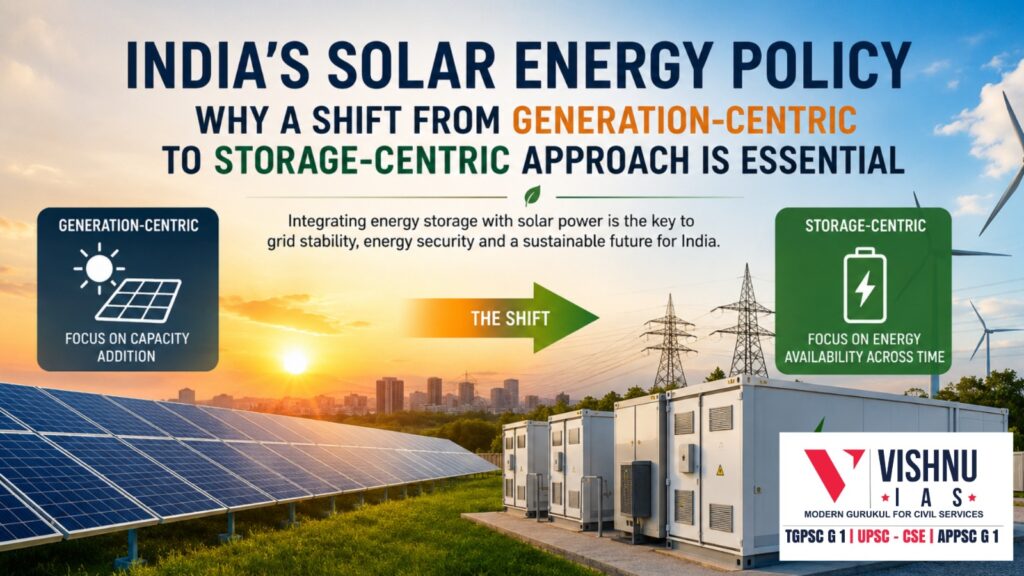
- However, despite achieving a record peak demand of 256.1 GW, solar contributed only around 8% of daily generation and negligible evening supply, revealing a critical mismatch between installed capacity and usable energy. This gap underscores the need to move from a ‘generation-centric’ model (focused on capacity addition) to a ‘storage-centric model’ (focused on energy availability across time), especially amid rising climate variability and demand volatility.
Body:
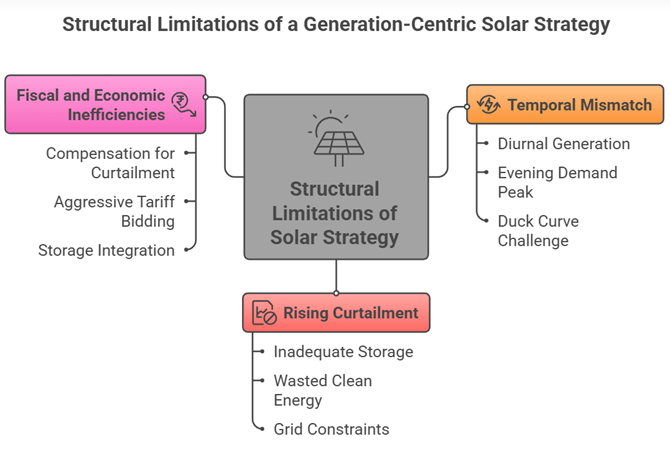
1. Structural Limitations of a Generation-Centric Solar Strategy
a) Temporal mismatch between generation and demand
- Solar energy generation is inherently diurnal, peaking during midday while demand increasingly peaks in the evening hours, creating a duck curve challenge.
- Despite high midday contribution (over one-fifth of load), solar meets almost none of post-sunset demand, necessitating reliance on coal or gas.
- Example: Peak demand days show strong solar output in the afternoon but near-zero contribution after sunset, exposing grid vulnerabilities.
b) Rising curtailment and inefficiency
- Inadequate storage leads to curtailment of excess solar power, where generation is deliberately reduced to maintain grid stability.
- India witnessed significant solar curtailment (over 2 TWh in 2025), indicating wasted clean energy and inefficiency in system design.
- Case Study: Solar Curtailment in Western and Southern States – High solar-producing states like Rajasthan and Tamil Nadu have been forced to halt supply due to grid constraints.
c) Fiscal and economic inefficiencies
- Power purchase agreements often require compensation for curtailed electricity, imposing a burden on public finances.
- Excess focus on capacity addition through aggressive tariff bidding has led to financially stressed projects lacking storage integration.
- Example: Ultra-low tariffs discovered in solar auctions face viability issues when storage costs and intermittency are considered.
2. Imperative for a Storage-Centric Energy Framework
a) Ensuring grid stability and reliability
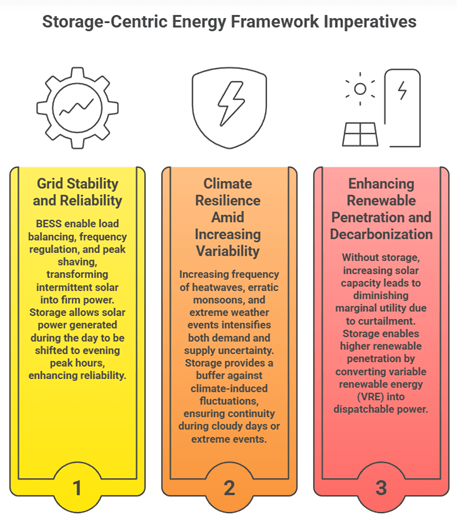
- Battery Energy Storage Systems (BESS) enable load balancing, frequency regulation, and peak shaving, transforming intermittent solar into firm power.
- Storage allows solar power generated during the day to be shifted to evening peak hours, enhancing reliability.
- Example: Countries like Australia have successfully deployed grid-scale batteries to stabilize renewable-heavy grids.
b) Climate resilience amid increasing variability
- Increasing frequency of heatwaves, erratic monsoons, and extreme weather events—as indicated by forecasts from the India Meteorological Department—intensifies both demand and supply uncertainty.
- Storage provides a buffer against climate-induced fluctuations, ensuring continuity during cloudy days or extreme events.
- Case Study: Heatwave-induced Power Surges in India – Rising temperatures drive air-conditioning demand, requiring reliable peak-time supply beyond solar hours.
c) Enhancing renewable penetration and decarbonization
- Without storage, increasing solar capacity leads to diminishing marginal utility due to curtailment.
- Storage enables higher renewable penetration by converting variable renewable energy (VRE) into dispatchable power.
- Example: Integration of storage is key to achieving India’s 500 GW non-fossil capacity target by 2030, ensuring actual energy delivery rather than nominal capacity.
3. Policy, Technological and Institutional Pathways for Transition
a) Policy reorientation towards storage integration
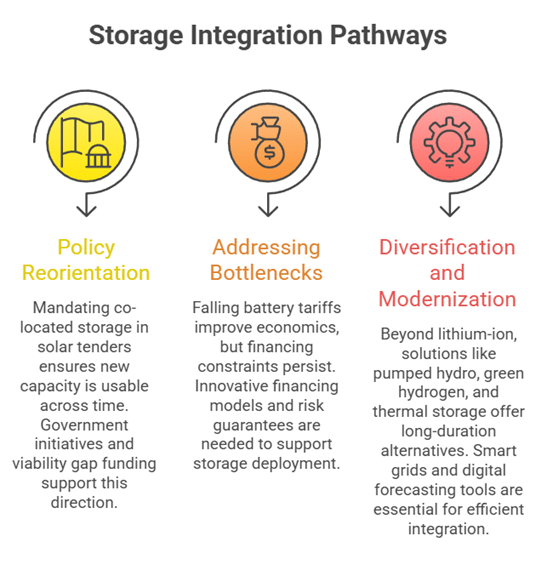
- Mandating co-located storage in solar tenders ensures that new capacity additions are usable across time.
- Government initiatives like the National Framework for Energy Storage Systems and viability gap funding for BESS are steps in this direction.
- Example: Recent bids linking solar with storage capacity signal a shift toward hybrid procurement models.
b) Addressing financial and execution bottlenecks
- Falling battery tariffs—from over ₹2 lakh/MW/month to significantly lower levels—indicate improving economics, but financing constraints persist.
- Need for innovative financing models, including green bonds, blended finance, and risk guarantees to support storage deployment.
- Case Study: Delays in Battery Deployment Projects – Despite tenders, actual operational capacity remains under 1 GWh, highlighting execution gaps.
c) Diversification of storage technologies and grid modernization
- Beyond lithium-ion batteries, solutions like pumped hydro storage, green hydrogen, and thermal storage offer long-duration alternatives.
- Investment in smart grids, demand response systems, and digital forecasting tools is essential for efficient integration.
- Example: Pumped storage projects in states like महाराष्ट्र and Andhra Pradesh demonstrate scalable long-duration storage potential.
Conclusion:
- India’s solar journey has reached a stage where capacity expansion alone cannot guarantee energy security or sustainability. The transition to a storage-centric paradigm is not merely a technological upgrade but a systemic transformation ensuring grid reliability, economic efficiency, and climate resilience.
- With battery costs declining and policy momentum building, integrating storage with renewable expansion can unlock the full potential of solar energy. Aligning infrastructure, finance, and policy toward storage deployment will enable India to convert its impressive renewable capacity into round-the-clock clean power, supporting both developmental needs and climate commitments.