
Introduction:
- Inequality refers to the unequal distribution of income, wealth, consumption opportunities, assets, employment security, and access to public services among individuals and social groups. In India, the debate on inequality has gained renewed significance amid rapid urbanisation, changing labour structures, and evolving welfare policies.
- The Household Consumer Expenditure Survey (HCES) 2023-24 estimates India’s consumption expenditure inequality, measured through the Gini Index, at around 29, indicating higher disparity than several official projections.
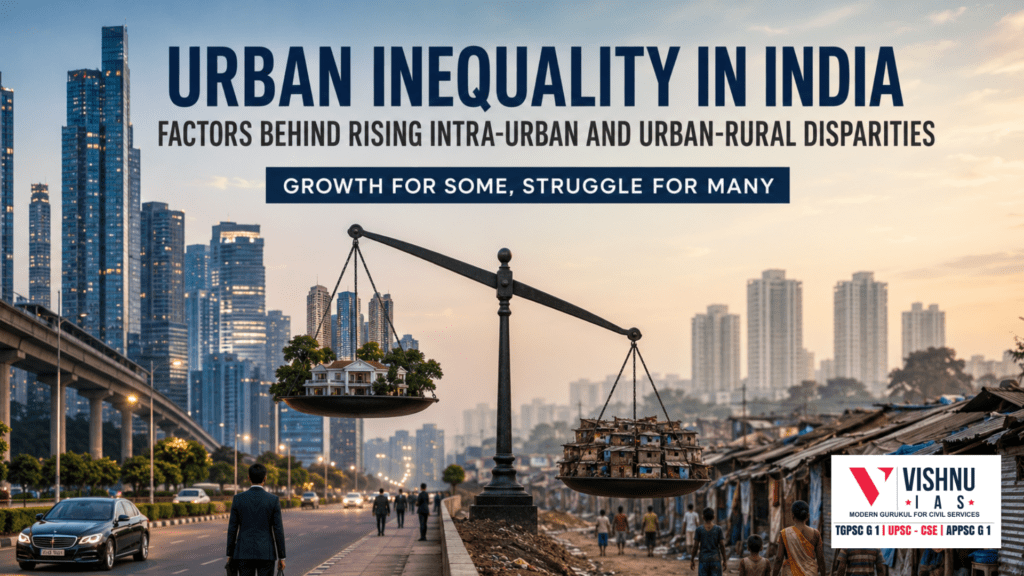
- Simultaneously, urban India has emerged as the principal driver of growth, consumption, and capital accumulation, yet this prosperity has been accompanied by widening disparities both within urban areas and between urban and rural India.
Body:
1. Structural Drivers of Rising Urban and Urban–Rural Inequality
(a) Urban-Centric Growth Model and Sectoral Transformation
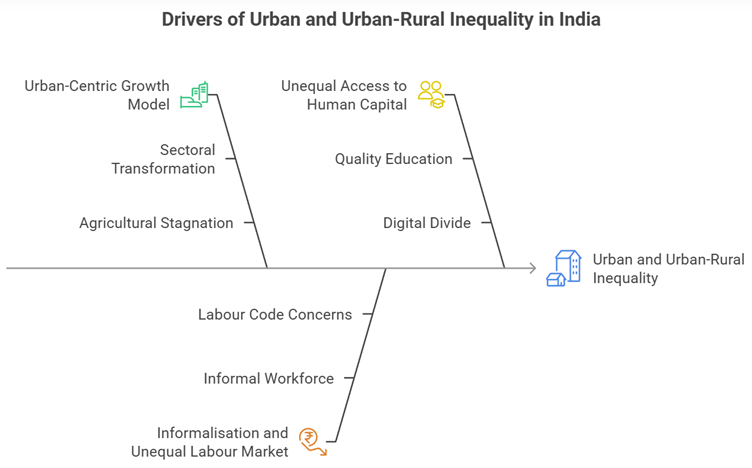
- India’s post-liberalisation growth has been driven primarily by services, finance, technology, real estate, and urban manufacturing clusters, which are concentrated in metropolitan regions such as Bengaluru, Mumbai, and Hyderabad. These sectors generate high incomes for skilled workers while excluding large sections lacking formal education or digital capabilities.
- Agricultural growth has remained comparatively volatile due to fragmented landholdings, climate stress, low productivity, and disguised unemployment, widening the income gap between rural producers and urban professionals. The divergence becomes visible in higher urban Monthly Per Capita Expenditure (MPCE), especially in non-food consumption.
- Example – IT-led Urban Prosperity: The expansion of India’s IT sector created globally competitive urban middle classes with high purchasing power, whereas rural regions dependent on subsistence agriculture witnessed slower income mobility.
(b) Informalisation and Unequal Labour Market Outcomes
- Despite economic expansion, nearly 90% of India’s workforce remains informal, characterised by low wages, insecure contracts, absence of social security, and poor bargaining power. Urban growth has therefore generated prosperity unevenly, benefiting capital owners and highly skilled professionals disproportionately.
- The implementation of the new Labour Codes has triggered concerns regarding dilution of labour protections, increased contractualization, and weakened collective bargaining mechanisms, particularly affecting migrant workers, gig workers, construction labourers, and domestic workers.
- Case Study – COVID-19 Reverse Migration: The mass migration of informal workers from cities during the pandemic exposed the vulnerability of urban labour markets and highlighted the absence of adequate urban social protection systems despite decades of urban growth.
(c) Unequal Access to Human Capital and Public Services
- Urban residents with access to quality private education, healthcare, digital connectivity, English-language skills, and financial services are better positioned to participate in high-growth sectors. Conversely, migrants and slum populations remain trapped in low-productivity employment cycles.
- The digital economy has widened opportunity gaps as access to online education, e-commerce, digital payments, and platform-based employment remains uneven across socio-economic groups and regions.
- Government Initiative – PM eVIDYA and Digital India: While these programmes improved digital outreach, unequal internet penetration and device ownership limited their transformative impact among poorer urban and rural households.
2. Factors Contributing to Widening Intra-Urban Disparities
(a) Concentration of Wealth and Consumption at the Top
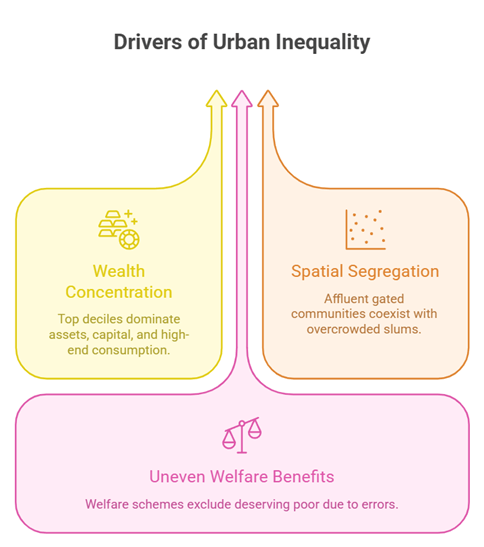
- Urban inequality is increasingly driven by the concentration of assets, capital ownership, and high-end consumption among upper-income deciles. Studies indicate that the top urban deciles account for a disproportionately high share of non-food expenditure such as luxury housing, healthcare, education, transport, and financial investments.
- The rise of financialization and asset inflation, especially in urban real estate and equity markets, has amplified wealth inequality. Those owning urban property and financial assets have experienced rapid wealth accumulation compared to wage earners.
- Example – Real Estate Boom: Premium residential zones in cities such as Gurugram and Pune witnessed enormous appreciation in property values, while low-income groups faced rising rental burdens and housing exclusion.
(b) Spatial Segregation and Unequal Urbanisation
- Indian cities increasingly exhibit spatial inequality, where affluent gated communities coexist with overcrowded slums lacking sanitation, clean water, and secure housing tenure. Unequal urban planning intensifies social exclusion.
- Rapid urbanisation without adequate affordable housing has expanded informal settlements. Migrants often settle in peripheral or environmentally vulnerable areas with limited public infrastructure.
- Case Study – Dharavi Redevelopment Debate: Redevelopment efforts in Mumbai reflect tensions between commercial urban expansion and the livelihood security of informal residents dependent on location-specific economic networks.
(c) Uneven Benefits from Welfare and Social Protection
- Welfare schemes often suffer from targeting errors, exclusion errors, portability issues, and documentation barriers, particularly for migrants and urban informal workers. This weakens redistribution within cities.
- Evidence suggests that even some economically better-off households access subsidised benefits due to identification errors, while deserving urban poor remain excluded from food security or housing schemes.
- Government Initiative – One Nation One Ration Card: This reform improved portability for migrant workers, yet implementation gaps persist due to biometric failures, digital exclusion, and uneven state capacities.
3. Broader Socio-Economic Dimensions Deepening Urban–Rural and Intra-Urban Inequality
(a) Class, Caste, Gender, and Regional Disparities
- Economic inequality intersects with caste hierarchies, gender discrimination, and regional imbalances, producing multidimensional deprivation. Marginalised communities are overrepresented in low-paid informal occupations.
- Women face lower labour force participation, wage discrimination, unpaid care burdens, and concentration in precarious employment, limiting equitable access to urban prosperity.
- Example – Sanitation and Manual Labour: Historically disadvantaged communities continue to dominate hazardous informal occupations such as sanitation work, reflecting persistence of structural inequalities despite urban economic growth.
(b) Debt-Led Consumption and Financial Vulnerability
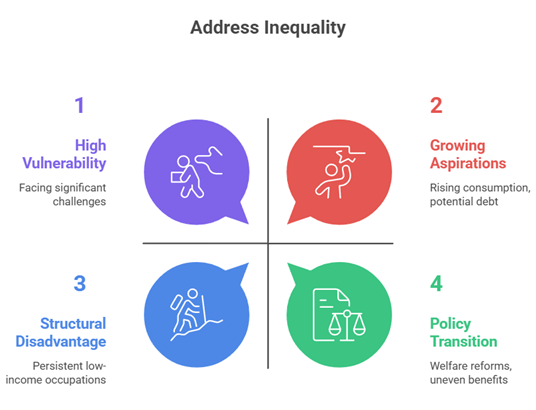
- Rising urban aspirations and consumption patterns have encouraged dependence on consumer credit, microfinance, app-based loans, and informal borrowing, particularly among lower-middle and working-class households.
- While urban consumption has expanded, much of it is sustained through indebtedness rather than stable income growth. Economic shocks therefore disproportionately affect vulnerable groups.
- Case Study – Microfinance Stress in Urban Peripheries: Several low-income households in peri-urban regions experienced debt distress following income disruptions during the pandemic, revealing fragility beneath apparent consumption growth.
(c) Policy Shifts and Welfare Transition
- The transition from rights-based welfare approaches toward targeted or productivity-linked welfare mechanisms has generated concerns regarding long-term social security, especially in rural India.
- Reforms replacing broad employment guarantees with skill-linked or productivity-oriented programmes may weaken income stability for vulnerable rural households if adequate safeguards are absent.
- Government Initiative – National Rural Livelihoods Mission (NRLM): While self-help groups and livelihood diversification have improved women’s empowerment and rural entrepreneurship, employment generation remains uneven across states.
- Example – Southern States vs BIMARU Regions: States with stronger human development indicators and diversified economies have benefited more from growth, whereas poorer states continue to experience outward migration and agrarian distress.
Conclusion:
- India’s urban sector has undoubtedly become more prosperous, technologically advanced, and globally integrated, but this affluence has been accompanied by deepening inequalities across income groups, classes, and regions.
- The coexistence of high-end consumption with insecure informal labour, premium urban infrastructure with expanding slums, and rising wealth alongside debt vulnerability underscores the complex nature of India’s development process.
- A sustainable growth trajectory requires shifting from merely high-growth urbanisation toward inclusive and distributive urban transformation through stronger labour protections, universal social security, affordable housing, quality public education and healthcare, rural revitalisation, and employment-intensive growth.