
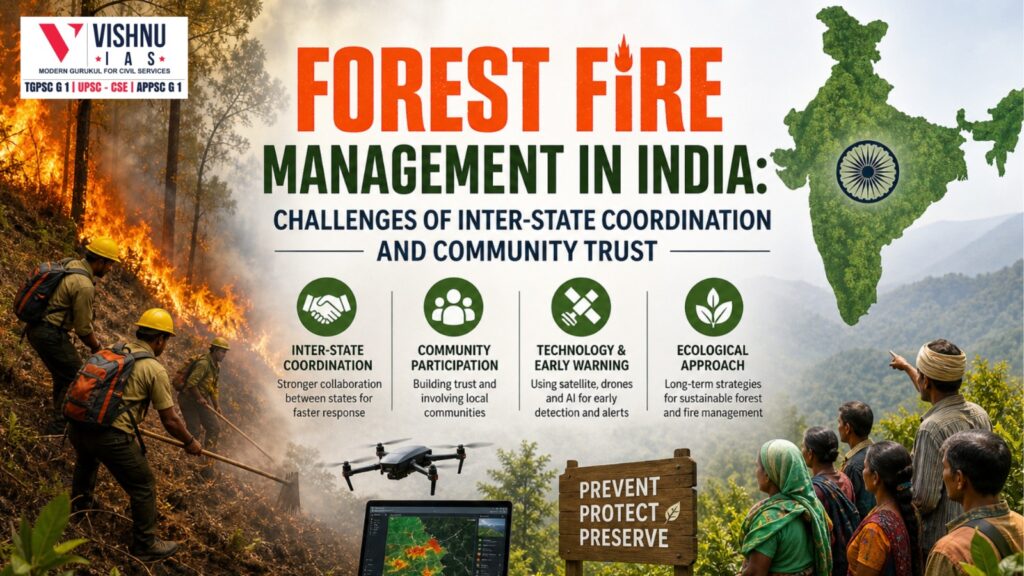
Introduction:
- Forest fires are uncontrolled burning of vegetation in forests, often triggered by a combination of natural factors (temperature, wind, fuel load) and anthropogenic causes. India witnesses recurring seasonal fires, particularly between February and May, with nearly 36% of forest cover prone to fires as indicated by the Forest Survey of India (FSI).
- Recent intense fires in the Nilgiris landscape highlight how climate variability, inter-state coordination gaps, and community-linked practices complicate fire management, raising questions about institutional effectiveness and governance mechanisms.
Body:
1. Structural and Institutional Challenges in Forest Fire Management
1.1 Inter-State Coordination Deficit
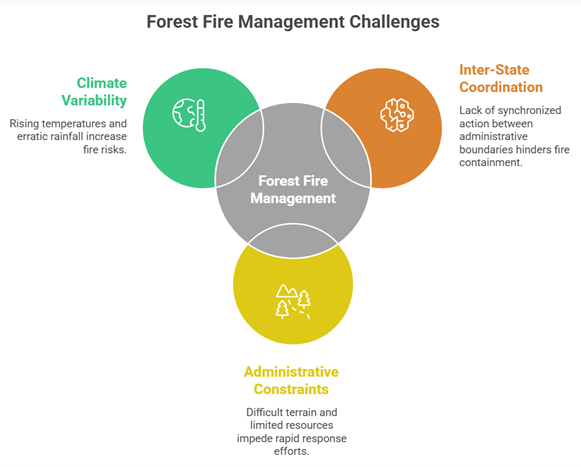
- Forest ecosystems like the Western Ghats landscape span multiple administrative boundaries, requiring synchronized action, but fragmented jurisdiction leads to operational delays.
- Example: Fire spread from Kerala into Tamil Nadu forests due to uncoordinated controlled burning, showing gaps in real-time communication protocols.
- Case Study: In the Similipal Biosphere Reserve fire (2021), lack of coordination between central and state agencies delayed containment efforts.
1.2 Administrative and Logistical Constraints
- Difficult terrain, poor road access, and limited aerial firefighting capacity hinder rapid response in regions like the Nilgiris.
- Despite tools like Forest Fire Alert System (FAST 3.0) using satellite data, last-mile response capacity remains weak.
- Example: Fires in Parsons Valley and Pykara burned longer due to delayed access and inadequate manpower deployment.
1.3 Climate Variability and Policy Gaps
- Rising temperature anomalies and erratic rainfall patterns have increased fuel dryness, intensifying fire risks beyond traditional preparedness levels.
- Policies often focus on short-term containment rather than long-term landscape-level fire ecology management.
- Example: High heat and strong winds in southern India created a “conducive fire environment”, overwhelming pre-existing firelines.
2. Role of Anthropogenic Factors and Community Disconnect
2.1 Livelihood-linked Fire Practices
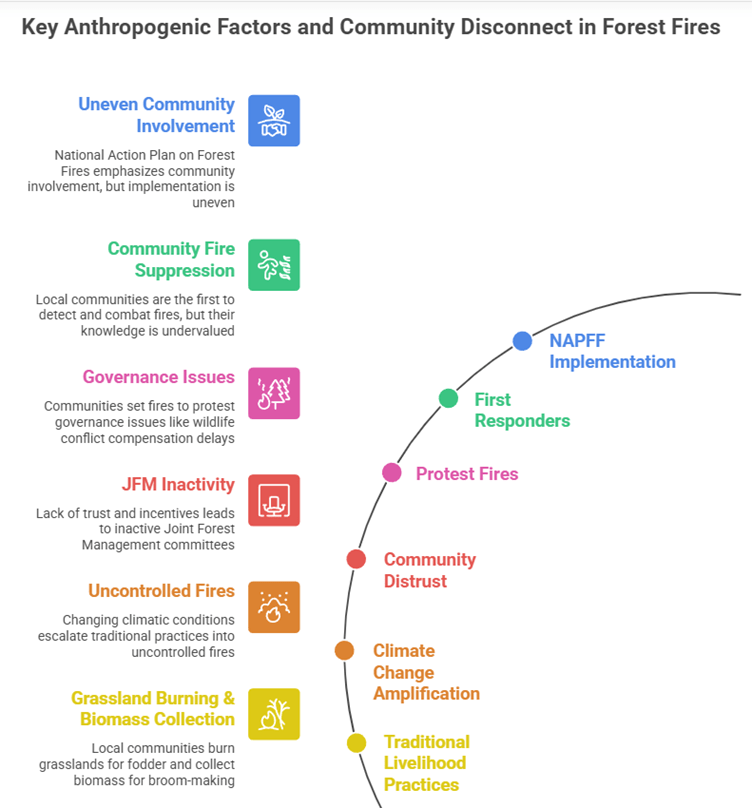
- Activities like grassland burning for fodder regeneration and collection of biomass for broom-making are deeply embedded in local economies.
- These practices, though traditional, can escalate into uncontrolled fires under changing climatic conditions.
- Example: Fires in Nilgiris linked to herders burning dry grasslands.
2.2 Lack of Community Trust and Participation
- Communities often perceive forest departments as restrictive rather than collaborative, reducing willingness to cooperate.
- Case Study: In parts of central India, Joint Forest Management (JFM) committees became inactive due to lack of incentives and trust deficits.
- Suspicion of intentional fire-setting as protest against governance issues (e.g., wildlife conflict compensation delays) reflects institutional distrust.
2.3 Communities as First Responders Yet Undervalued
- Local communities are often the first to detect and combat fires, but their knowledge is underutilized in formal systems.
- Example: Tribal communities in Nilgiris actively engage in fire suppression despite limited formal recognition.
- Schemes like National Action Plan on Forest Fires (NAPFF) emphasize community involvement, but implementation remains uneven.
3. Government Initiatives and Way Forward for Holistic Management
3.1 Technological and Institutional Measures
- Forest Fire Prevention and Management Scheme (FPM) provides financial assistance to states for fire control.
- Use of remote sensing, drones, and AI-based alerts has improved early detection but requires integration with ground action.
- Example: FAST 3.0 provides near real-time alerts but depends on state-level responsiveness.
3.2 Strengthening Cooperative Federalism
- Establishing inter-state fire management protocols, joint task forces, and shared databases can enhance coordination.
- Case Study: The Western Ghats Ecology Expert Panel recommendations emphasized landscape-level governance, which remains partially implemented.
- Regular joint mock drills and communication channels between neighbouring states can reduce delays.
3.3 Community-Centric and Ecological Approaches
- Promoting alternative livelihoods (e.g., eco-tourism, non-timber forest produce value chains) can reduce dependence on fire-linked practices.
- Revitalizing Joint Forest Management with financial incentives and participatory governance can rebuild trust.
- Example: In Odisha, community-managed forests have shown lower fire incidence due to strong local stewardship.
- Adopting controlled ecological burning under scientific supervision can reduce fuel load while respecting traditional knowledge.
Conclusion:
- Forest fire management in India is increasingly challenged by the convergence of climate variability, governance gaps, and socio-economic dependencies. While technological advancements and policy frameworks have improved detection and preparedness, their effectiveness is undermined by weak inter-state coordination and insufficient community integration.
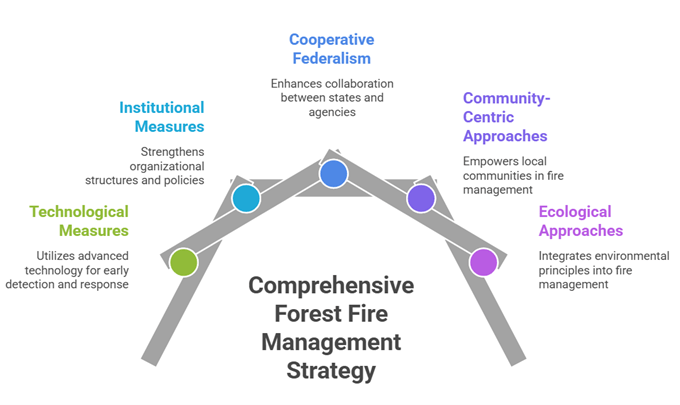
- Strengthening cooperative federalism, enhancing community trust through participatory governance, and shifting towards long-term ecological fire management strategies are essential.
- With projections indicating rising fire-prone areas due to warming trends, integrating local knowledge with scientific management offers a sustainable pathway to mitigate future risks while ensuring ecological and livelihood security.