Digital Governance in Public Distribution System: Transforming Food Security in India
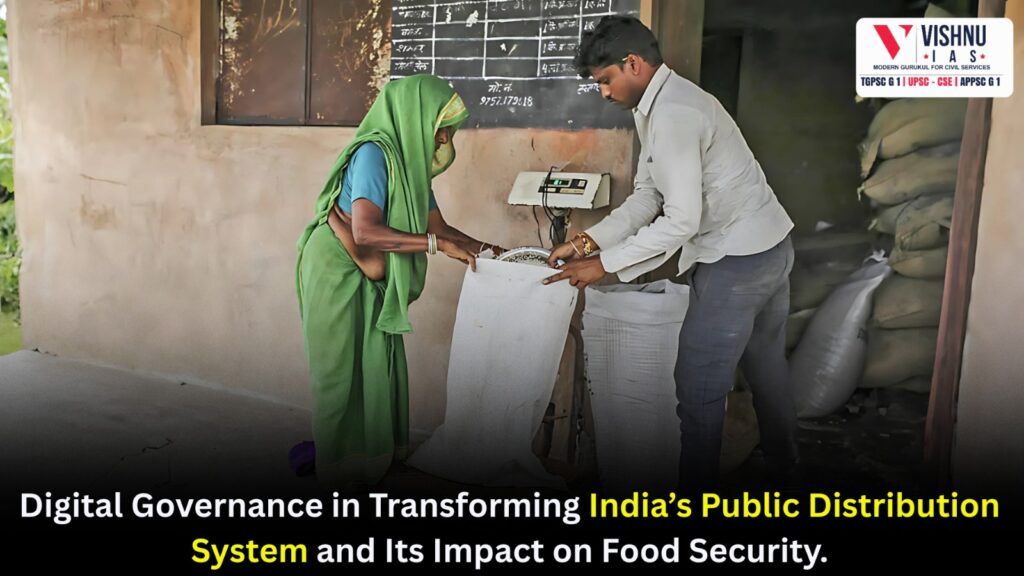
Digital governance in Public Distribution System has become a transformative tool for ensuring food security in India. By using Aadhaar-enabled authentication, e-PoS devices, ONORC portability, and real-time monitoring, the PDS is evolving into a transparent and accountable system that supports millions of beneficiaries across the country.
Introduction
Food security, as defined by the FAO, refers to a situation where all people, at all times, have physical, social, and economic access to sufficient, safe, and nutritious food to meet dietary needs for a healthy life. In India, the Public Distribution System (PDS) has historically been the backbone of food security, covering over 800 million beneficiaries under the National Food Security Act, 2013 (NFSA). However, inefficiencies like leakages, diversion of grains, and ghost beneficiaries plagued the system.
In the past decade, digital governance tools—such as Aadhaar-enabled Public Distribution System (AePDS), electronic Point of Sale (e-PoS) devices, real-time dashboards, and the One Nation One Ration Card (ONORC) scheme—have significantly transformed PDS delivery.
According to the UN’s State of Food Security and Nutrition in the World 2025, India reduced undernourishment from 14.3% (2020–22) to 12% (2022–24), contributing to a global decline in hunger. This highlights how digital reforms have strengthened India’s fight against food insecurity, though challenges remain.
Strengthening Efficiency and Transparency through Digital Governance
Curbing Leakages and Diversion
- Aadhaar-enabled biometric authentication has helped identify genuine beneficiaries, reducing ghost/fake ration cards. For instance, Jharkhand’s PDS reforms linked Aadhaar with ration cards and reportedly eliminated over 10 lakh bogus cards.
- GPS tracking of trucks carrying food grains, as implemented in states like Chhattisgarh, has minimized diversion during transportation.
- Case Study – Chhattisgarh PDS Model: Widely recognized for transparency, Chhattisgarh’s PDS leverages digital stock registers and citizen monitoring, ensuring grain reaches intended households.
Portability and Inclusiveness
- The ONORC scheme (2019) ensures migrant workers can access rations anywhere in India, a crucial step during the COVID-19 pandemic, benefiting over 80 crore people.
- As per NITI Aayog 2023 evaluation, ONORC reduced distress migration costs and enhanced dignity for seasonal workers.
- Example: A migrant worker from Bihar working in Surat can now draw subsidized rice/wheat in Gujarat, ensuring uninterrupted access.
Real-Time Monitoring and Grievance Redressal
- Digital dashboards provide real-time visibility of food stocks, allocation, and distribution.
- In states like Andhra Pradesh, mobile apps enable citizens to register complaints, improving accountability.
- Example: Tamil Nadu’s Smart Ration Card system integrates beneficiary details with real-time grievance redressal, reducing pilferage.
Enhancing Food Security Outcomes
Ensuring Coverage during Emergencies
During the COVID-19 pandemic, digital platforms enabled rapid expansion of food transfers under the Pradhan Mantri Garib Kalyan Anna Yojana (PMGKAY), covering 800 million beneficiaries. Direct Benefit Transfer (DBT) pilots in Chandigarh and Puducherry showcased efficient cash-based transfers, though challenges in price inflation persisted. Example: PMGKAY’s digital integration allowed extension of additional free grain distribution till December 2022, cushioning households against inflationary shocks.
Improved Targeting of Beneficiaries
Integration with Socio-Economic Caste Census (SECC) data and Aadhaar reduced exclusion/inclusion errors. Example: Rajasthan’s Jan Aadhaar platform created a unified family ID for streamlined benefit delivery across schemes, including PDS. However, critics note risks of exclusion errors—e.g., reports of Aadhaar authentication failures in Jharkhand leading to denial of rations.
Shifting Focus from Calories to Nutrition
Digital reforms are gradually linking PDS with nutrition-sensitive schemes. For example, fortified rice distribution under PDS is being scaled up to cover all districts by 2024, addressing hidden hunger. Integration with PM POSHAN (midday meal scheme) ensures convergence between PDS and child nutrition programs. Example: Odisha’s Millet Mission—leveraging digital procurement platforms—integrates nutrient-rich millets into PDS baskets.
Challenges and Criticisms of Digital Governance in PDS
- Exclusion Risks and Digital Divide: Biometric failures due to poor connectivity or worn-out fingerprints (particularly among elderly and manual labourers) have led to ration denial. Example: Jharkhand (2017 starvation deaths cases) highlighted risks of strict Aadhaar dependency.
- Nutrition and Affordability Gap: While PDS ensures calorie sufficiency, over 60% of Indians cannot afford a healthy diet (FAO 2025). Heavy cereal focus persists; limited diversification to pulses, oils, and micronutrient-rich foods. Example: Global Hunger Index 2023 ranks India at 111 out of 125, reflecting persistent child stunting (35%) and wasting (18%).
- Administrative and Implementation Challenges: Inter-state portability under ONORC still faces technical glitches, particularly in Northeastern states with weak digital infrastructure. Variations in state-level capacities mean uneven outcomes—Kerala has near-universal Aadhaar integration, while Bihar struggles with authentication failures. Dependence on private tech vendors raises data privacy concerns in food governance.
Conclusion:
Digital governance in Public Distribution System has undeniably transformed India’s food security framework from a leak-prone, paper-driven model into a data-driven, transparent, and accountable structure. Initiatives like ONORC, Aadhaar-enabled authentication, and fortified food integration demonstrate how technology enhances coverage, efficiency, and resilience.
Yet, the FAO’s 2025 report underlines that the real challenge lies beyond access to calories—ensuring affordable, diverse, and nutritious diets for all. Over-reliance on digital systems without addressing exclusion errors, affordability of healthy diets, and nutrition diversification risks undermining these gains. With five years left to achieve SDG-2 (Zero Hunger), India’s digital PDS model can serve as a global template, provided it shifts from “feeding population” to “nourishing population” while safeguarding inclusiveness and resilience.
Recap: