
Institutional and Governance Challenges in Agricultural Research in India
Agricultural research in India has historically been the cornerstone of the country’s food security and rural transformation. The Green Revolution of the 1960s, led by pioneers like M.S. Swaminathan, Norman Borlaug, and C. Subramaniam, helped India transition from dependence on PL-480 grain imports to self-sufficiency in food production. Today, achieving the vision of “Viksit Bharat @2047” demands renewed scientific and institutional innovation, particularly in the face of climate change, water scarcity, soil degradation, and the rise of digital agriculture. However, India faces significant governance challenges in agriculture and institutional constraints that hinder progress.
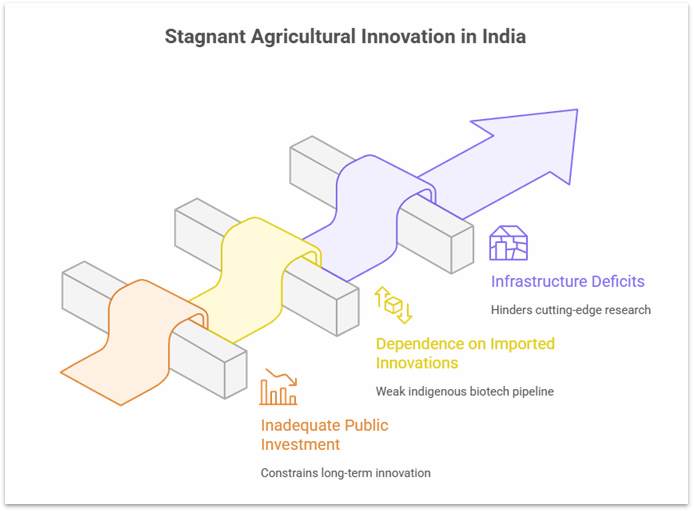
Institutional Funding and Infrastructure Gaps
Inadequate Public Investment in R&D
- India’s public agricultural R&D expenditure is less than half of China’s, limiting long-term innovation.
- Underfunding restricts adoption of emerging technologies like CRISPR gene editing, climate-resilient crops, and AI-driven precision farming.
- Example: Brazil’s EMBRAPA invests over 1.8% of agri-GDP in research, contributing to global leadership in soybean productivity.
Dependence on Donor or Imported Innovations
- The Green Revolution relied on Borlaug’s Mexican wheat seeds and Rockefeller Foundation support.
- India still depends on ICAR-CIMMYT collaborations and multinational seed companies for GM traits.
- Case Study: Bt Cotton increased yields but highlighted weak indigenous biotech development.
Infrastructure Deficits in Research Institutions
- Outdated labs, poor digital infrastructure, and limited field-testing facilities hinder innovation.
- Contrast: China’s CAAS has high-throughput genomics labs, while many Indian state agricultural universities face faculty shortages.
- Government Initiative: National Agricultural Higher Education Project (NAHEP) modernizes infrastructure, though progress is uneven.
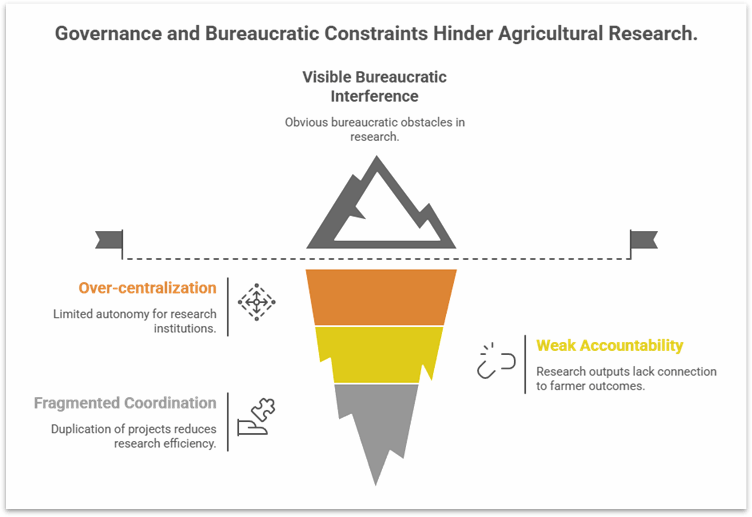
Governance and Bureaucratic Constraints
Over-centralization and Limited Autonomy
- ICAR and SAUs face bureaucratic interference in recruitment, promotions, and project approvals.
- China grants research institutes autonomy to form global partnerships and recruit international experts.
Weak Accountability and Monitoring Mechanisms
- Research outputs are often disconnected from farmer outcomes.
- Example: GM Mustard trials experienced long delays due to governance indecision.
Fragmented Coordination Between Research Bodies
- Duplication of projects across ICAR, CSIR, DBT, and SAUs reduces efficiency.
- Global Benchmark: USDA-ARS integrates research with extension services efficiently.
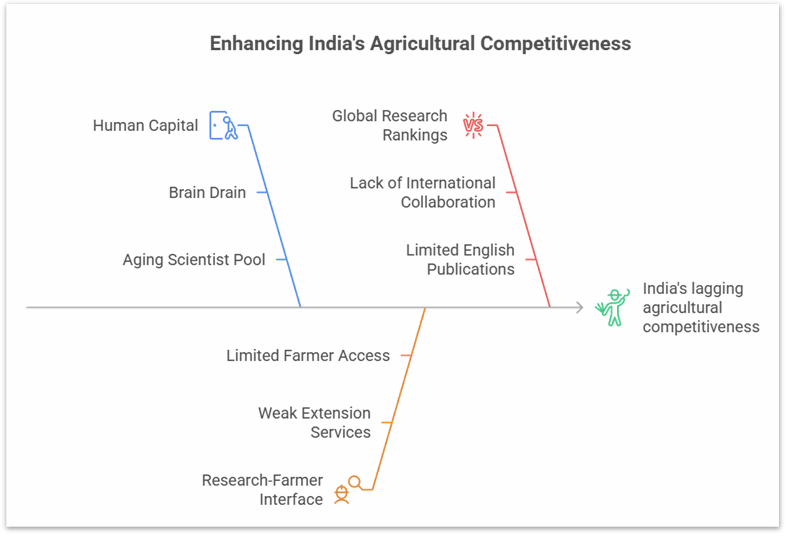
Human Capital, Farmer Linkages, and Global Competitiveness
- Brain Drain: Skilled agricultural scientists often migrate abroad due to lack of incentives.
- Weak Research-Farmer Interface: Only 10% of farmers have formal extension access (NSSO 2019).
- Lagging Global Rankings: No Indian agricultural university is in QS Top 200; global collaborations remain limited.
Way Forward
- Raise R&D investment to at least 1% of agricultural GDP.
- Grant greater autonomy to ICAR and SAUs with transparent governance.
- Strengthen farmer–scientist linkages through digital platforms and participatory research.
- Build global-class institutions via international collaborations and talent recruitment.
Conclusion
India’s agricultural research journey—from the Green Revolution to current challenges—shows that while past success was possible, replicating it under today’s climate-stressed and globally competitive environment requires bold reforms. By addressing institutional and governance challenges, India can ensure agricultural research plays a transformative role for Viksit Bharat 2047, turning obstacles into opportunities for global leadership.
Recap: