

Introduction:
- The Right to a Speedy Trial is an integral component of the Right to Life and Personal Liberty under Article 21, ensuring that no individual is deprived of liberty except through a fair, just and reasonable procedure.
- While special legislations such as the Unlawful Activities (Prevention) Act (UAPA) impose stringent statutory restrictions on the grant of bail to safeguard national security and combat terrorism, prolonged incarceration without commencement or completion of trial raises serious constitutional concerns.
- With India’s prison population continuing to comprise a large proportion of undertrial prisoners, the issue highlights the constitutional challenge of balancing collective security with individual liberty under the rule of law.
Body:
I. Constitutional Basis of the Right to a Speedy Trial under Article 21
1. Speedy trial as an indispensable component of personal liberty
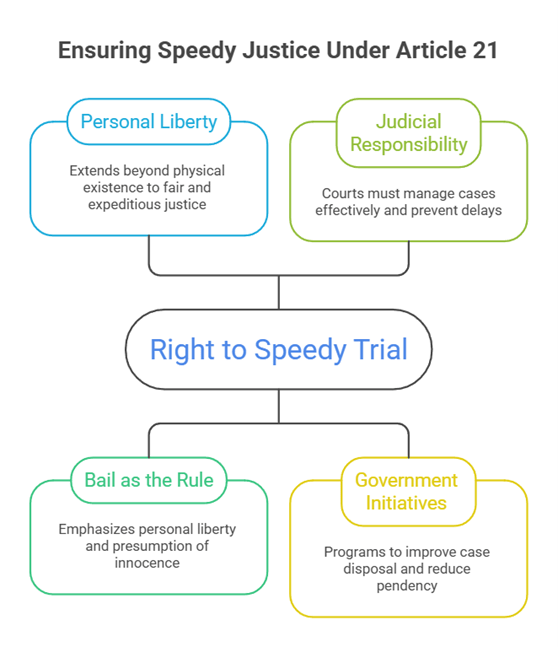
- Article 21 extends beyond mere physical existence to guarantee fair, reasonable and expeditious criminal justice, making undue delay constitutionally impermissible.
- The judiciary has consistently held that prolonged pre-trial detention transforms the judicial process itself into punishment, undermining the presumption of innocence.
- Example: Constitutional courts have repeatedly recognized that unreasonable delay in criminal proceedings violates the dignity and liberty protected under Article 21.
2. Bail as the rule and jail as the exception
- Bail jurisprudence is founded on the principles of personal liberty, presumption of innocence, and ensuring the accused’s presence during trial rather than imposing pre-conviction punishment.
- Excessive delay weakens the legitimacy of continued detention, especially where trials remain stalled due to systemic deficiencies rather than the conduct of the accused.
- Case Study: Several accused persons across terrorism-related cases have spent many years in custody before eventual acquittal, highlighting the irreversible consequences of delayed justice.
3. Judicial responsibility to ensure timely justice
- Courts bear the primary responsibility for preventing procedural delays through effective case management, timely framing of charges and continuous trial.
- Structural issues such as judicial vacancies, voluminous evidence and procedural complexities cannot indefinitely curtail constitutional freedoms.
- Government Initiative: Expansion of Fast Track Special Courts, e-Courts Mission Mode Project, and digital judicial infrastructure seeks to improve case disposal and reduce pendency.
II. Interaction between Article 21 and Statutory Bail Restrictions under Special Laws
1. Rationale behind stringent bail provisions
- Laws such as the UAPA prescribe rigorous bail conditions owing to the exceptional nature of offences involving terrorism, national security, and organized extremist activities.
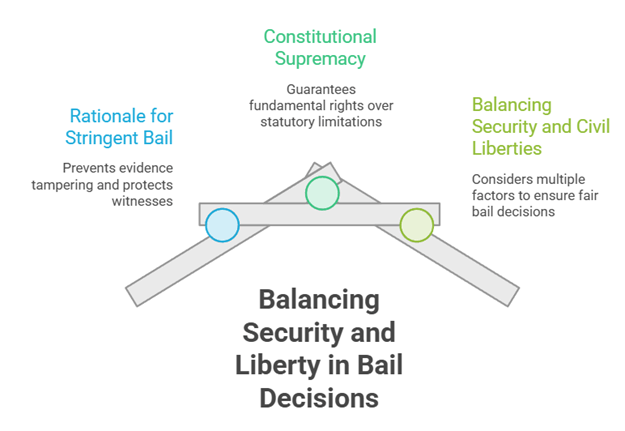
- The objective is to prevent tampering with evidence, safeguard witnesses and mitigate risks to public order during investigation and trial.
- Example: Parliament has adopted stricter evidentiary thresholds for bail in terrorism-related offences compared to ordinary criminal law.
2. Constitutional rights remain superior to statutory limitations
- Statutory restrictions operate within the framework of the Constitution and cannot extinguish fundamental rights guaranteed under Article 21.
- Where incarceration becomes disproportionately long and trial remains substantially delayed, constitutional courts have increasingly invoked Article 21 to grant relief notwithstanding statutory embargoes.
- Example: Courts have emphasized that constitutional guarantees cannot be rendered illusory merely because an allegation falls under a special statute.3. Need for balancing security concerns with civil liberties
- Courts examine multiple factors including gravity of allegations, length of incarceration, progress of trial, likelihood of witness intimidation, and risk of absconding before deciding bail.
- A purely allegation-based approach risks converting preventive detention into prolonged punitive detention without conviction.
- Case Study: Judicial decisions across different special law cases have demonstrated the evolving attempt to balance national security interests with the constitutional commitment to personal liberty.
III. Challenges, Judicial Trends and the Way Forward
1. Inconsistent judicial approach creates uncertainty
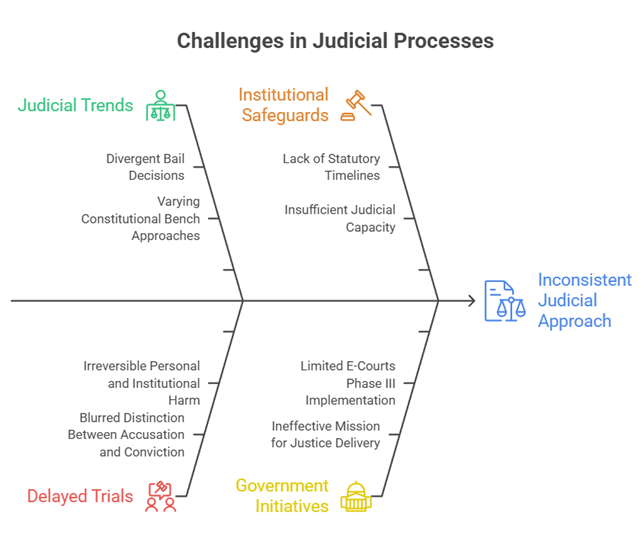
- Divergent bail decisions in comparable circumstances have generated uncertainty regarding the constitutional threshold for prolonged incarceration.
- Absence of uniform standards weakens predictability and may affect public confidence in equal application of the law.
- Example: Different constitutional benches have adopted varying approaches while weighing prolonged custody against statutory restrictions.
2. Delayed trials risk erosion of constitutional values
- If serious allegations alone justify indefinite incarceration, the distinction between accusation and conviction becomes blurred.
- Extended detention without adjudication affects livelihood, family life, reputation and democratic participation even if eventual acquittal follows.
- Case Study: Internationally, wrongful long-term imprisonment has demonstrated that delayed justice causes irreversible personal and institutional harm.
3. Strengthening institutional safeguards
- Establish statutory timelines for commencement of trials under special laws, subject to judicially recorded reasons for extension.
- Expand judicial capacity through additional special courts, greater prosecutorial efficiency, witness protection and technology-enabled evidence management.
- Government Initiative: Measures including the National Mission for Justice Delivery and Legal Reforms, continued e-Courts Phase III, virtual hearings and digital case monitoring can reduce procedural delays while preserving fair trial guarantees.
Conclusion:
- The interaction between Article 21 and statutory bail restrictions is not a contest between liberty and security but an exercise in constitutional balancing. While special laws legitimately impose higher thresholds to address extraordinary threats, constitutional guarantees ultimately remain paramount whenever prolonged incarceration without a meaningful trial renders detention arbitrary and disproportionate.
- Strengthening judicial capacity, ensuring time-bound trials and developing consistent constitutional standards can simultaneously uphold national security, rule of law, and the foundational promise that justice must be both fair and timely.
- Such an approach reinforces public confidence in democratic institutions while preserving the constitutional commitment to both individual liberty and collective security.