

Introduction:
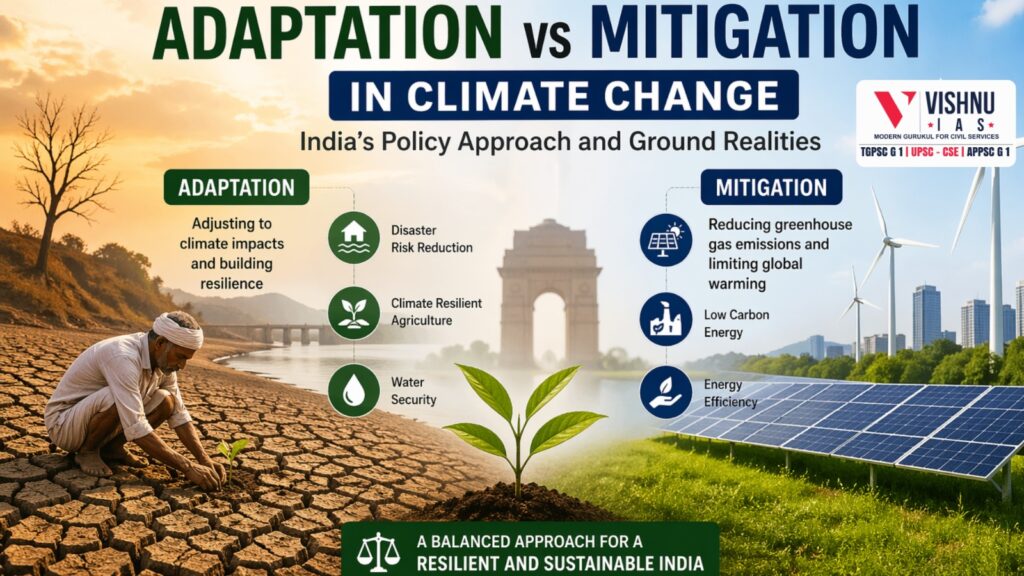
- Climate change adaptation refers to the process of adjusting ecological, social, or economic systems in response to actual or expected climatic stimuli and their effects, while mitigation focuses on reducing greenhouse gas emissions. The debate between prioritising adaptation versus mitigation is particularly relevant for developing countries like India, which, despite contributing relatively less to historical emissions, faces disproportionate climate risks. India has experienced over 430 extreme weather events between 1995 and 2024, leading to economic losses exceeding $170 billion and affecting more than 3 billion people, highlighting the urgency of strengthening resilience. In this context, India’s evolving Nationally Determined Contributions (NDCs) increasingly emphasise integrating adaptation into development planning, reflecting ground-level vulnerabilities and developmental imperatives.
Body:
1. Rationale for Prioritising Adaptation in Developing Countries
a) High Climate Vulnerability and Development Deficits
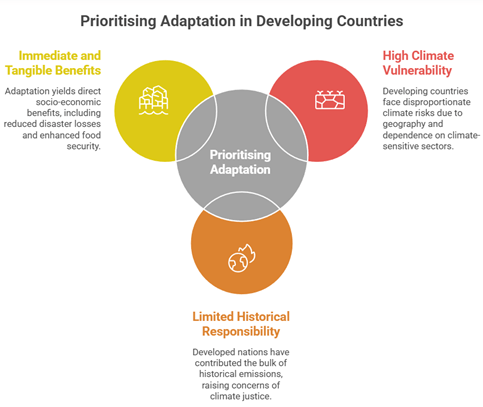
- Developing countries face disproportionate exposure to climate risks due to geography, population density, and dependence on climate-sensitive sectors like agriculture.
- India’s agrarian economy, with a large share of small and marginal farmers, is highly vulnerable to erratic monsoons, heatwaves, and floods, necessitating immediate adaptive responses.
- Example: The National Innovations in Climate Resilient Agriculture (NICRA) by ICAR, covering 448 villages across 151 vulnerable hotspots, focuses on drought-resistant crops and water-use efficiency, demonstrating adaptation as a livelihood safeguard.
b) Limited Historical Responsibility and Equity Concerns
- Developed nations have contributed the bulk of historical emissions, while developing countries like India account for a much smaller per capita footprint.
- Prioritising mitigation alone may constrain growth and poverty alleviation efforts, raising concerns of climate justice and equity.
- Case Study: India’s stance in international negotiations consistently emphasises Common But Differentiated Responsibilities (CBDR), arguing that adaptation finance must be scaled up to support vulnerable economies.
c) Immediate and Tangible Benefits of Adaptation
- Adaptation yields direct socio-economic benefits, including reduced disaster losses, enhanced food security, and livelihood stability.
- Studies indicate that every unit invested in adaptation can generate multiple-fold returns by avoiding future losses, making it economically rational.
- Example: Coastal protection measures under the National Cyclone Risk Mitigation Project (NCRMP) have significantly reduced fatalities in cyclone-prone states like Odisha.
2. India’s Climate Policy: Balancing Adaptation and Mitigation
a) Increasing Integration of Adaptation in Policy Frameworks
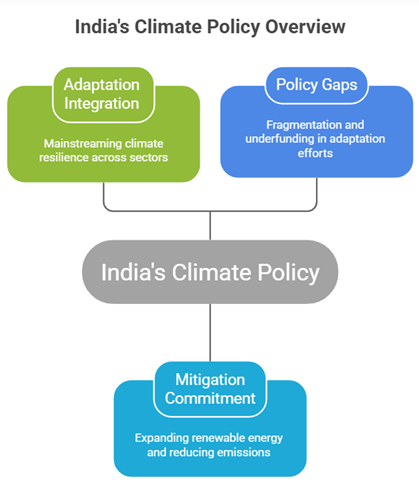
- India’s updated NDCs for the 2030–2035 period emphasise mainstreaming climate resilience across sectors such as infrastructure, biodiversity, and livelihoods.
- Programmes like the National Adaptation Fund for Climate Change (NAFCC) and State Action Plans on Climate Change (SAPCCs) institutionalise adaptation planning.
- Example: The Tamil Nadu Climate Resilient Villages (CRV) programme integrates water management, renewable energy, and livelihood diversification across vulnerable districts.
b) Continued Commitment to Mitigation Obligations
- India has made significant progress in mitigation through renewable energy expansion, targeting 500 GW of non-fossil fuel capacity by 2030 and achieving emissions intensity reduction.
- Initiatives like the International Solar Alliance (ISA) and National Solar Mission underline India’s proactive mitigation role.
- This reflects a balanced approach, where adaptation is strengthened without abandoning global mitigation commitments.
c) Policy and Institutional Gaps in Adaptation Focus
- Despite policy intent, adaptation efforts remain fragmented and underfunded, with budgetary allocations often skewed towards mitigation projects.
- India’s Climate Finance Taxonomy (Draft 2025) remains largely mitigation-centric, limiting clarity in adaptation financing flows.
- Case Study: Many states have outdated SAPCCs, and only a few have revised them in line with updated climate goals, indicating institutional gaps.
3. Challenges and the Way Forward for Adaptation-Centric Approach
a) Financing Constraints and Need for Innovative Mechanisms
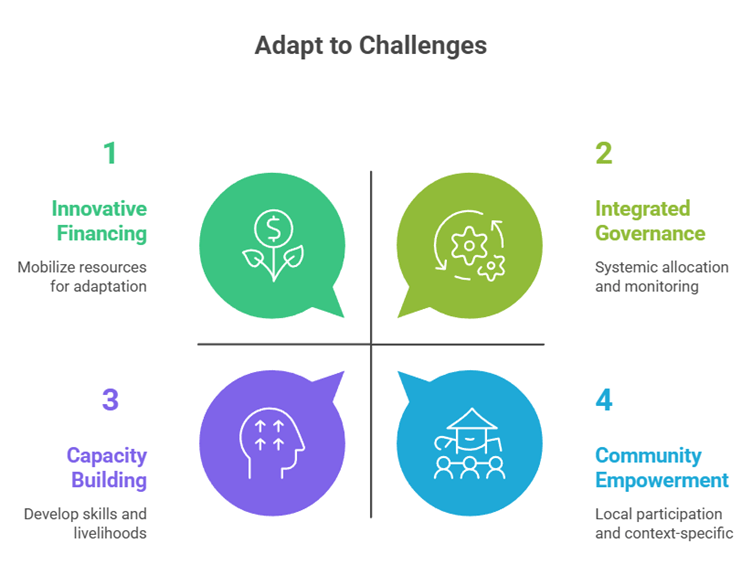
- Developing countries face a global adaptation finance gap estimated at hundreds of billions annually, making resource mobilisation critical.
- India requires a clear typology of adaptation finance, including sector-wise prioritisation and measurable outcomes.
- Example: State-level adaptation facilities can identify bankable projects, attracting private and international investment.
b) Need for Institutionalisation and Multi-level Governance
- Effective adaptation requires integration from national to grassroots levels, including urban local bodies and Panchayati Raj Institutions.
- Climate budgeting and tracking within State budgets can ensure systematic allocation and monitoring.
- Case Study: Kerala’s decentralised disaster management approach during floods highlights the importance of local governance capacity in adaptation.
c) Promoting Locally Led and Inclusive Adaptation
- Locally Led Adaptation (LLA) ensures that communities participate in planning, implementation, and monitoring, making interventions context-specific.
- Adaptation must go beyond infrastructure to include skill development, alternative livelihoods, and social protection.
- Example: Expansion of the MGNREGA to include climate-resilient assets like water conservation structures supports both adaptation and employment.
Conclusion:
- While mitigation remains essential to address the root causes of climate change, the realities of developing countries necessitate a strategic prioritisation of adaptation to safeguard lives, livelihoods, and development gains.
- India’s evolving policy framework reflects this shift, but achieving resilience requires enhanced financing, institutional coherence, and grassroots participation. With global commitments to significantly scale up adaptation finance by 2035 and evidence suggesting high economic returns on resilience investments, a whole-of-system approach integrating adaptation into development planning offers a pragmatic and equitable pathway forward.