
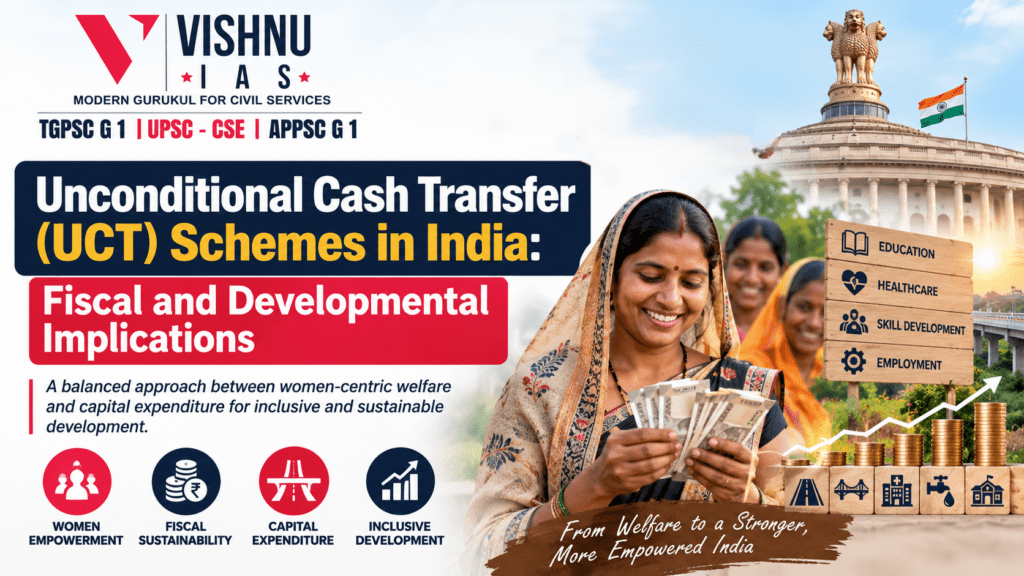
Unconditional Cash Transfer (UCT) Schemes in India: Fiscal and Developmental Implications
Unconditional Cash Transfer (UCT) schemes have emerged as an important instrument of women-centric welfare in India, providing regular financial assistance directly to eligible women. Schemes such as Magalir Urimai Thittam in Tamil Nadu, Lakshmir Bhandar in West Bengal, and Gruha Lakshmi in Karnataka reflect the growing role of direct income support in social protection.
Introduction:
Unconditional Cash Transfer (UCT) schemes have emerged as an important instrument of women-centric welfare in India, providing regular financial assistance directly to eligible women. Schemes such as Magalir Urimai Thittam in Tamil Nadu, Lakshmir Bhandar in West Bengal, and Gruha Lakshmi in Karnataka reflect the growing role of direct income support in social protection.
Body:
I. Developmental rationale and benefits of expanding UCTs
1. Income security and poverty reduction
- UCTs provide predictable income support to households facing irregular incomes, particularly those dependent on informal employment.
- Regular cash assistance can improve expenditure on food, healthcare, education, debt repayment and other essential consumption needs.
- Example: Kalaignar Magalir Urimai Thittam provides 1,000 per month to eligible women in Tamil Nadu.
2. Women's economic and social empowerment
- Direct transfers into women's accounts can strengthen their control over household resources and enhance their bargaining power within families.
- UCTs can also recognise the economic value of unpaid domestic and care work, which is consistent with SDG 5.4, which calls for recognition and valuation of unpaid care and domestic work.
3. Consumption smoothing and local demand
- Cash transfers enable vulnerable households to maintain consumption during periods of income insecurity.
- Higher household purchasing power can generate local demand for food, consumer goods and services, creating indirect economic activity.
II. Fiscal implications of expanding UCTs at the expense of capital expenditure
1. Rising recurring fiscal commitments
- Unlike one-time expenditure, monthly UCTs create a continuing fiscal obligation for State governments.
- Once beneficiaries begin depending on regular transfers, withdrawal or reduction becomes politically difficult, potentially converting temporary welfare measures into permanent expenditure commitments.
- Example: The Economic Survey 2025-26 estimates that States would spend around ₹1.7 lakh crore on UCTs in 2025-26, with women being a major target group.
2. Crowding out of capital expenditure
- When fiscal resources are limited, greater spending on recurring transfers can reduce the resources available for capital expenditure.
- Lower capital expenditure can constrain investments in roads, irrigation, transport, water supply, schools, hospitals and industrial infrastructure.
3. Pressure on fiscal deficits and debt sustainability
- If UCT expenditure expands faster than State revenues, governments may face higher revenue deficits and borrowing requirements.
- Persistent revenue expenditure financed through borrowing can reduce fiscal flexibility and increase future debt-servicing obligations.
- The Economic Survey has highlighted concerns regarding the fiscal sustainability of expanding UCT commitments, particularly among States already experiencing revenue deficits.
4. Opportunity cost for employment generation
- Capital expenditure can generate direct construction employment and stimulate private investment through better infrastructure.
- Excessive diversion of resources towards unconditional transfers may therefore address current income insecurity without adequately addressing the structural causes of unemployment and low productivity.
III. Developmental trade-offs
- UCTs should be treated as a social protection floor, rather than a substitute for expenditure on infrastructure and human capital. The objective should be to protect vulnerable households while simultaneously creating conditions for them to become economically self-reliant.
- Governments can complement unconditional transfers with programmes linked to desirable developmental outcomes such as education, healthcare, skill development and employment. Such programmes can create benefits beyond immediate income support.
a. Example: Tamil Nadu's Pudhumai Penn scheme provides financial assistance to eligible girl students pursuing higher education, combining income support with human-capital development.
- Women's economic participation depends not only on income but also on access to childcare, healthcare, safe transport, sanitation, drinking water and education. Investment in such public infrastructure can reduce women's unpaid care burden and release their time for education and paid employment.
- Targeted UCTs face difficulties in identifying beneficiaries, as informal-sector incomes are difficult to measure accurately. This creates inclusion errors where ineligible households receive benefits, exclusion errors where eligible households are denied benefits. Such errors can reduce both welfare effectiveness and public trust.
a. Case Study: Kalaignar Magalir Urimai Thittam initially covered around 1.13 crore women, while subsequent expansion attempted to address grievances from women who believed they had been wrongly excluded.
Way forward
- Governments shall disclose the medium-term fiscal cost of UCT schemes before expanding their coverage or transfer amounts.
- Independent evaluation should assess whether additional expenditure produces measurable improvements in nutrition, education, women's labour-force participation and household welfare.
- Outcome budgeting and medium-term fiscal planning can prevent welfare commitments from undermining essential capital expenditure.
- Fiscal savings from better-targeted UCTs can be redirected towards women's skills, credit, entrepreneurship and livelihood creation, thereby converting welfare dependence into economic capability.
a. Example: DAY-NRLM uses women's SHGs, financial inclusion and livelihood support to promote sustainable income generation; by 2026, it had mobilised nearly 10 crore women into SHGs.
Conclusion:
UCTs represent an important component of India's evolving social protection architecture. They can strengthen women's financial autonomy, household consumption, social protection and recognition of unpaid care work. However, their expansion at the expense of capital expenditure can create a difficult trade-off between short-term welfare gains and long-term productive capacity. The appropriate approach is therefore not to choose between welfare and development, but to integrate them through fiscally sustainable UCTs, productive public investment, outcome-oriented welfare and women's economic empowerment.