
Bay of Bengal Geopolitical Pivot of the Indo-Pacific: Critical Analysis for UPSC 2026
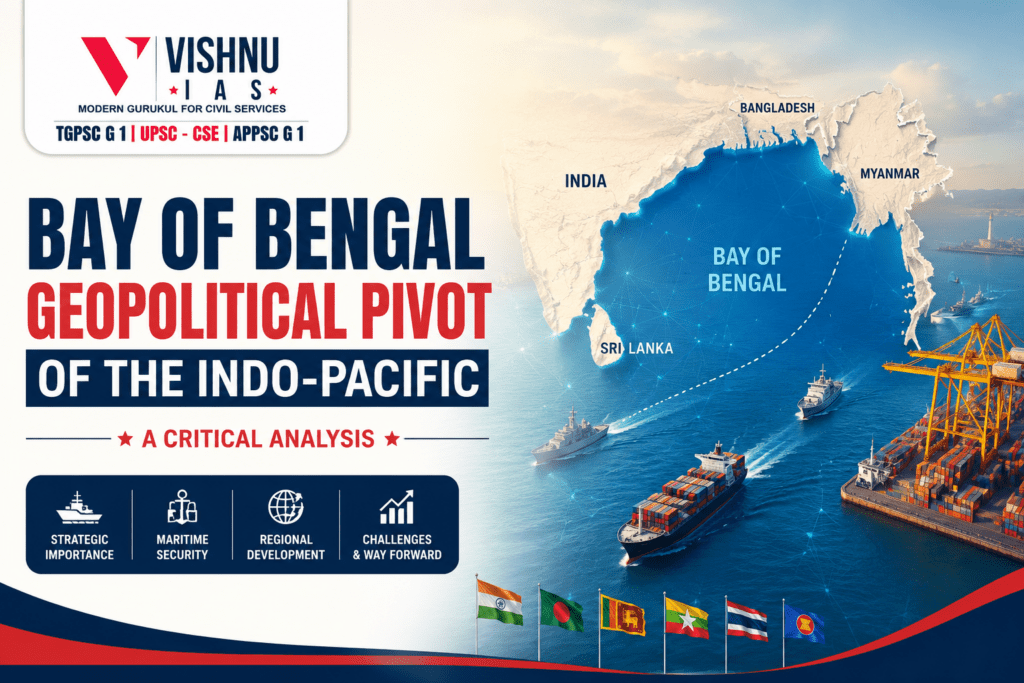
Bay of Bengal Geopolitical Pivot has emerged as one of the most significant themes in contemporary international relations and UPSC preparation. The Bay of Bengal lies at the intersection of the Indian Ocean and the Pacific, making it central to global trade, maritime security, India's Indo-Pacific strategy, and regional connectivity. This article critically analyses why the Bay of Bengal has become the geopolitical pivot of the Indo-Pacific, its strategic significance, challenges, and the way forward.
Introduction
The Bay of Bengal, historically a cradle of maritime commerce and civilisational exchange linking South and Southeast Asia, has re-emerged as one of the most consequential geopolitical spaces in the Indo-Pacific. Situated at the intersection of the Indian Ocean and the western Pacific, it connects India's eastern seaboard with ASEAN, the Malacca Strait, and major global energy and trade routes.
Currently, the convergence of great-power competition, maritime trade, connectivity initiatives, non-traditional security threats, and blue economy opportunities has transformed the Bay from a peripheral maritime space into the strategic pivot of the Indo-Pacific. However, despite its growing centrality, the region continues to face institutional fragmentation, political instability, and geopolitical contestation, limiting its potential as a coherent regional security architecture.
I. Bay of Bengal – The Geopolitical Pivot of the Indo-Pacific
1. Strategic Maritime Geography Connecting Two Oceans
- The Bay of Bengal occupies a pivotal location linking the Indian Ocean with the Pacific through the Malacca Strait, one of the world's busiest maritime chokepoints. Nearly all maritime traffic between East Asia, Europe, and West Asia traverses this region, making it indispensable for global trade and energy security.
- For India, the Bay operationalises the Act East Policy while providing maritime access to ASEAN, the Western Pacific, and the broader Indo-Pacific. It simultaneously enables India's eastern naval presence and complements its Indo-Pacific Oceans Initiative (IPOI).
- Example: The Andaman and Nicobar Command overlooks the western approaches to the Malacca Strait, providing India with unmatched maritime situational awareness and strategic leverage.
2. Geopolitically Relevant
- The Bay has increasingly become an arena where strategic interests of India, China, the United States, Japan, Australia and ASEAN converge.
- China's expanding naval deployments, dual-use port infrastructure, Belt and Road Initiative (BRI), and growing maritime presence seek to overcome its "Malacca Dilemma" by securing alternative sea lines of communication. Consequently, the region has become central to balancing influence in the Indian Ocean.
- India, in response, has shifted from merely safeguarding its maritime interests to shaping regional maritime governance through initiatives such as SAGAR, MAHASAGAR and the recently announced SHANTI framework.
- Example: Development of Kyaukpyu Port in Myanmar, Chittagong in Bangladesh and China's expanding naval footprint have significantly increased strategic competition in the region.
3. Economic Gateway of the Indo-Pacific
- The Bay of Bengal connects some of the world's fastest-growing economies and supports expanding regional value chains.
- India's eastern ports including Visakhapatnam, Paradip, Haldia and Chennai have witnessed steady growth in cargo throughput, while multimodal connectivity initiatives increasingly integrate South Asia with Southeast Asia.
- The region is therefore emerging as the principal maritime corridor supporting regional production networks, trade diversification and resilient supply chains.
- Example: The BIMSTEC Maritime Transport Cooperation Agreement seeks to harmonise customs procedures, facilitate multimodal transport and reduce transaction costs across member states.
4. Centre of Emerging Blue Economy Opportunities
- The Bay of Bengal contains abundant fisheries, offshore renewable energy potential, seabed minerals, shipping routes and coastal tourism resources.
- As countries increasingly view oceans as engines of sustainable development, the region has become central to achieving blue economy objectives while balancing ecological sustainability.
- India's Blue Economy Policy framework and Maritime India Vision 2030 recognise the Bay of Bengal as a critical growth corridor.
5. Epicentre of Non-Traditional Maritime Security Challenges
- Unlike traditional naval rivalries alone, the region increasingly faces interconnected transboundary challenges including:
- Climate-induced disasters
- Cyclones and storm surges
- Illegal, Unreported and Unregulated (IUU) fishing
- Marine pollution
- Human trafficking
- Piracy
- Cyber threats to ports
- Undersea cable vulnerabilities
- Supply chain disruptions
- These challenges cannot be addressed through unilateral action, making regional governance indispensable.
- Example: Cyclone Amphan (2020), Cyclone Mocha (2023) and repeated humanitarian crises have demonstrated the need for coordinated disaster response mechanisms.
6. Bay of Bengal Has Become Central to India's Neighbourhood Diplomacy
- India increasingly views the Bay as the principal platform for regional integration after SAARC's stagnation.
- BIMSTEC bridges South Asia and Southeast Asia, enabling India to deepen cooperation without being constrained by traditional political deadlocks.
II. Bay of Bengal and Regional Development
- Recognising that maritime security extends beyond naval deterrence, India has gradually evolved its maritime vision from strategic presence towards cooperative governance.
- SAGAR (2015) articulated the principle of Security and Growth for All in the Region by emphasising inclusive development and maritime cooperation.
- MAHASAGAR (2025) expanded this vision across the wider Indo-Pacific and the Global South by recognising the interconnected nature of contemporary security challenges.
- Building upon both, SHANTI (Securing Holistic Advancement through Norms, Trust and Integrity), announced during India's campaign for the 2028–29 UNSC term, provides the normative architecture for governing shared maritime commons.
- Unlike traditional security doctrines centred on military competition, SHANTI emphasises norms, trust, integrity, demand-driven cooperation, resilience, and institution-building.
- Rather than projecting dominance, India seeks to position itself as a preferred security partner and first responder capable of strengthening collective maritime governance.
- The July 2026 BIMSTEC National Security Advisers' Meeting adopted common principles for maritime law enforcement, Humanitarian Assistance and Disaster Relief (HADR), and maritime cooperation.
III. Critical Analysis: Why Bay of Bengal Is Not Yet the Geopolitical Pivot
1. Weak Regional Economic Integration
- Although geographically connected, intra-BIMSTEC trade remains significantly below its potential.
- Trade barriers, poor logistics integration, non-tariff measures and inadequate multimodal connectivity continue to constrain regional economic interdependence.
- Even the proposed BIMSTEC Free Trade Agreement remains pending.
2. Persistent Geopolitical Instability
- Regional political instability undermines collective action.
- The continuing civil conflict in Myanmar has disrupted connectivity projects and regional security cooperation.
- Examples:
- Kaladan Multi-modal Transit Transport Project
- India–Myanmar–Thailand Trilateral Highway
- Similarly, political transitions in Bangladesh and evolving India–Bangladesh relations have periodically slowed regional momentum.
- Border disputes between Bangladesh and Myanmar further complicate regional cooperation.
3. Institutional Fragmentation
- The Bay suffers less from the absence of institutions than from the coexistence of multiple overlapping mechanisms with limited coordination.
- BIMSTEC, IORA, ASEAN-led institutions, IPOI, Colombo Security Conclave and bilateral arrangements often operate independently without an integrated governance framework.
- This weakens implementation despite growing diplomatic engagement.
4. Expanding Chinese Influence
- China's infrastructure financing and port development provide littoral countries with attractive investment opportunities.
- Many smaller states seek strategic autonomy by balancing India and China rather than aligning exclusively with one partner.
- Consequently, the Bay of Bengal reflects strategic competition alongside cooperation.
5. India's Own Implementation Challenges
- India's normative leadership requires corresponding investments in maritime capacity.
- Experts have argued that India should accelerate development of the Andaman and Nicobar Islands as a regional maritime hub, modernise eastern ports and deepen institutional capacity within BIMSTEC.
- Without stronger domestic maritime capabilities, India's regional leadership risks remaining largely declaratory.
IV. Way Forward
- The Bay of Bengal's long-term stability depends upon institutional rather than purely military responses.
- India should strengthen BIMSTEC by operationalising the Maritime Transport Cooperation Agreement, concluding the BIMSTEC Free Trade Agreement, institutionalising regular maritime security exercises, expanding White Shipping Information Sharing, and developing integrated disaster response mechanisms.
- Investment in resilient ports, digital maritime infrastructure, coastal connectivity, blue economy partnerships and climate adaptation should complement naval cooperation.
- Transforming the Andaman and Nicobar Islands into a regional logistics, HADR and maritime security hub would significantly enhance India's strategic credibility.
Conclusion
The Bay of Bengal has evolved from a peripheral water body into the geopolitical centre of the Indo-Pacific, where strategic competition, economic connectivity, maritime governance and climate resilience increasingly intersect. Yet, its future importance depends less on naval power alone. It lies on the ability of regional states to build trusted institutions capable of governing shared maritime commons. India's evolving maritime vision from SAGAR to MAHASAGAR and now SHANTI reflects this transition from protecting maritime spaces to shaping maritime governance.