
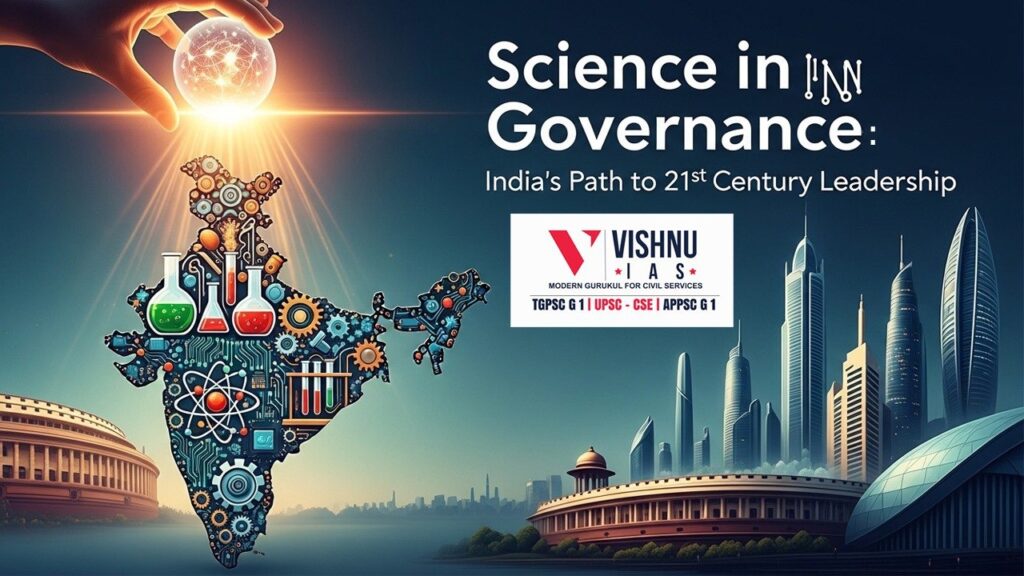
Indian Scientific Service and Scientific Governance: Bridging the Administrator–Scientist Divide in 21st Century India
Indian Scientific Service has emerged as a significant proposal in debates on scientific governance and administrative reform in India. Scientific governance refers to the systematic integration of scientific evidence, technical expertise, and risk assessment into public decision-making to ensure sustainable and effective policy outcomes. India’s governance model after Independence relied heavily on generalist administrators, which was essential for maintaining unity and institutional stability in a newly independent nation.
However, the nature of governance has fundamentally changed. According to national science indicators, India’s Gross Expenditure on Research and Development (GERD) remains around 0.6–0.7% of GDP, significantly lower than technologically advanced economies, even as India manages complex domains such as climate change, biotechnology, artificial intelligence, and space exploration. Institutions like Indian Space Research Organisation and Council of Scientific and Industrial Research demonstrate India’s strong scientific capacity, yet their expertise is not consistently embedded into governance structures.
In this context, the proposed Indian Scientific Service (ISS) could help bridge the structural gap between administrative authority and scientific expertise, enabling a balanced synergy between administrative efficiency and scientific rigor, though its effectiveness depends on careful design and complementary institutional reforms.
1. Nature and extent of the ‘administrator–scientist’ divide in India
A. Historical dominance of generalist administrative structures
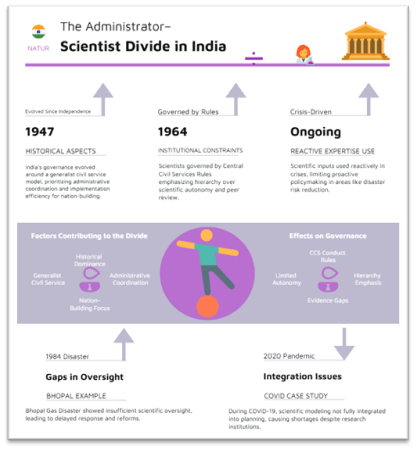
India’s governance evolved around a generalist civil service model, prioritizing administrative coordination, neutrality, and implementation efficiency, which was suitable for nation-building but less equipped for handling specialized technological challenges such as AI regulation and climate modelling.
Example: Bhopal Gas Disaster (1984) demonstrated gaps in regulatory science capacity, where insufficient scientific oversight and risk assessment contributed to delayed emergency response and regulatory reforms.
Case Study: During the COVID-19 pandemic, scientific inputs on epidemiological modelling were sometimes not fully integrated into administrative planning, contributing to shortages of oxygen and hospital infrastructure despite India having strong public health research institutions.
B. Institutional and service rule constraints limiting scientific autonomy
Scientists in government institutions remain governed by Central Civil Services (Conduct) Rules, 1964, which emphasize hierarchy and discipline rather than scientific autonomy, peer review, and open critique, essential for evidence-based decision-making.
Example: Environmental clearance processes involving technical bodies such as the Genetic Engineering Appraisal Committee (GEAC) have witnessed controversies over the adoption of GM crops, highlighting tensions between scientific evidence and administrative caution.
Case Study: Scientific warnings regarding land subsidence in Joshimath (Uttarakhand) were reported by technical institutions years before the crisis, but the absence of institutional mechanisms to integrate these warnings into policy resulted in delayed preventive action.
C. Reactive rather than proactive use of scientific expertise in governance
Scientific inputs are often used reactively during crises, rather than as part of continuous policymaking, limiting long-term strategic planning in areas such as disaster risk reduction and climate adaptation.
Example: The Intergovernmental Panel on Climate Change (IPCC) repeatedly warned about increased extreme weather risks, yet India continues to experience recurring disasters such as floods and heatwaves requiring emergency responses rather than preventive measures.
Case Study: Coastal erosion along India’s eastern coast had been studied by marine scientists for decades, but integrated coastal zone management policies were implemented gradually and unevenly, highlighting delayed translation of scientific findings into governance.
2. Potential benefits of creating an Indian Scientific Service (ISS)
A. Strengthening evidence-based policymaking and scientific risk assessment
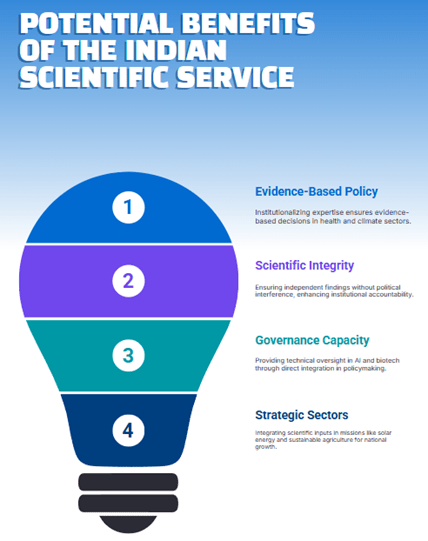
A dedicated ISS cadre would institutionalize scientific expertise within ministries, ensuring continuous integration of evidence into decisions involving public health, climate, and emerging technologies.
Example: The success of Indian Space Research Organisation in missions like Chandrayaan and Mangalyaan demonstrates how specialized scientific cadres with operational autonomy can achieve world-class outcomes efficiently.
Case Study: The National Disaster Management Authority has improved disaster preparedness through hazard mapping and scientific modelling, reducing cyclone-related mortality significantly compared to the 1999 Odisha super cyclone.
B. Enhancing scientific integrity, transparency, and institutional accountability
Countries such as United States, United Kingdom, France, Germany, and Japan have established scientific integrity policies, ensuring that scientists can present independent findings without political interference.
Example: Scientific advisory bodies like the UK’s Government Office for Science provide independent advice on public policy, strengthening evidence-based governance in areas such as pandemic management and climate mitigation.
Case Study: India’s COVID-19 vaccine development under Mission COVID Suraksha, led by the Department of Biotechnology, demonstrated that institutional support and scientific leadership can accelerate technological innovation when scientists are empowered within governance frameworks.
C. Improving governance capacity in emerging and strategic sectors
India’s ambitions in AI, biotechnology, climate action, and energy transition require continuous technical oversight, which a specialized ISS could provide by embedding scientists directly in policymaking institutions.
Example: The Genome India Project, coordinated by the Department of Biotechnology, illustrates how scientific expertise contributes to national priorities such as disease surveillance and precision medicine.
Case Study: India’s National Action Plan on Climate Change (NAPCC) relies heavily on scientific inputs in missions such as solar energy and sustainable agriculture, demonstrating the need for permanent scientific integration in governance.
3. Challenges, limitations, and structural considerations in implementing ISS
A. Risk of bureaucratic fragmentation and coordination challenges
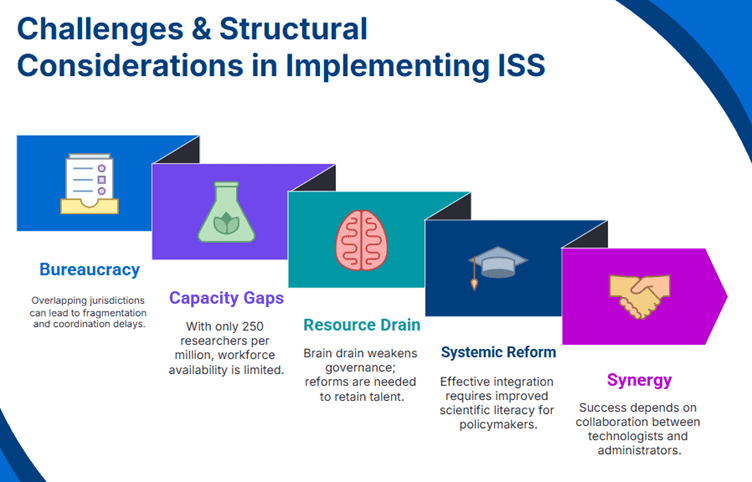
Introducing a new scientific cadre could create overlapping jurisdictions with existing services such as administrative and technical services, potentially complicating coordination unless roles are clearly defined.
Example: Coordination challenges between environmental regulators and administrative authorities sometimes delay project clearances due to differing priorities.
Case Study: Infrastructure projects in ecologically sensitive zones have faced delays due to conflicting assessments between scientific bodies and administrative agencies, highlighting the need for integrated decision-making mechanisms.
B. Capacity constraints and resource limitations in scientific governance
India has only about 250 researchers per million population compared to over 4,000 in developed countries, reflecting structural limitations in scientific workforce availability.
Example: Many Indian scientists work abroad due to better institutional autonomy and funding, resulting in a “brain drain” that weakens domestic scientific governance capacity.
Case Study: Initiatives like the VAIBHAV Fellowship aim to attract Indian scientists working abroad to collaborate with Indian institutions, demonstrating the need for systemic reforms to retain scientific talent.
C. Need for complementary reforms beyond cadre creation
Creating an ISS alone will not ensure effective integration unless accompanied by reforms in administrative training, scientific literacy among policymakers, and institutional accountability mechanisms.
Example: NITI Aayog has established frontier technology initiatives and policy frameworks to integrate technological expertise into governance.
Case Study: The successful implementation of the Aadhaar system involved close collaboration between technologists and administrators, demonstrating that institutional synergy rather than structural isolation is key to effective governance.
Conclusion
The creation of an Indian Scientific Service represents a significant and forward-looking reform that can strengthen evidence-based governance, enhance institutional accountability, and support India’s ambitions in climate action, biotechnology, and technological leadership.
With India targeting an increase in research spending toward 2% of GDP and emerging as one of the world’s largest innovation ecosystems, integrating scientific expertise into governance structures has become both necessary and urgent. However, its success will depend on ensuring clear role definitions, institutional autonomy, coordination mechanisms, and complementary administrative reforms.
A carefully designed Indian Scientific Service can serve as a vital bridge between administrative efficiency and scientific rigor, enabling India to build resilient, future-ready governance systems aligned with its global aspirations and developmental priorities.
Recap: