

Introduction:
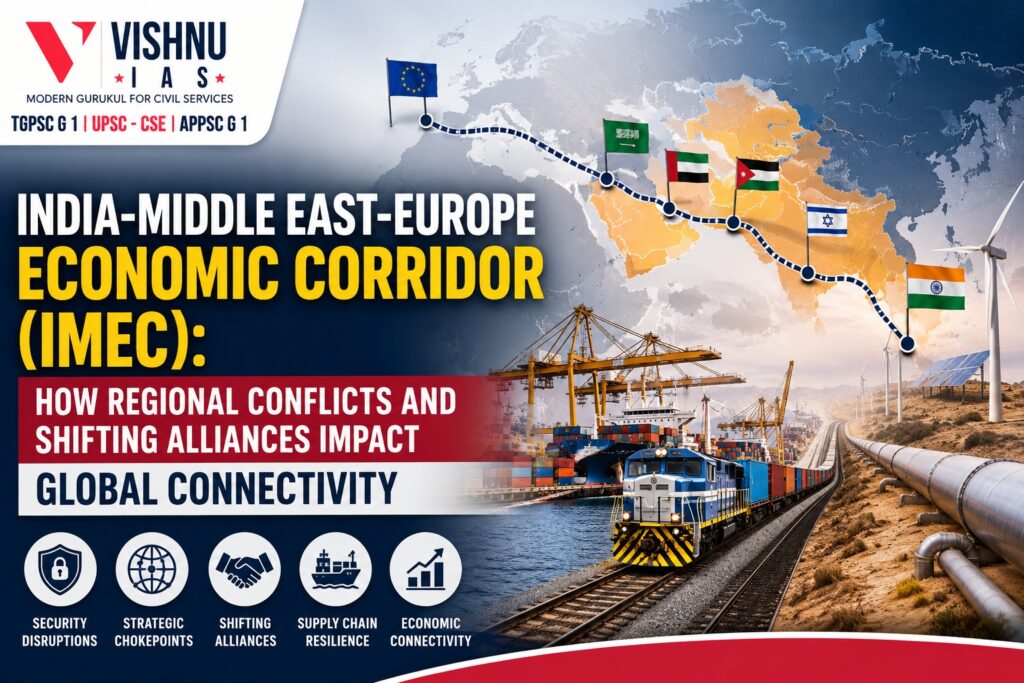
- Transnational connectivity initiatives are cross-border infrastructure and economic integration projects aimed at enhancing trade, energy security, supply-chain resilience, digital connectivity, and strategic cooperation among participating countries. The India-Middle East-Europe Economic Corridor (IMEC), announced in 2023, represents one such ambitious multimodal initiative connecting India with Europe through West Asia via ports, railways, energy pipelines, data corridors, and green hydrogen networks.
- In an era where nearly 80% of global trade by volume moves through maritime routes and critical chokepoints such as the Strait of Hormuz, Bab-el-Mandeb, Malacca Strait, and Suez Canal carry a significant share of global commerce, geopolitical instability increasingly influences economic connectivity.
- Recent security disruptions across West Asia have highlighted both the strategic necessity of corridors like IMEC and their vulnerability to conflicts, regional rivalries, and shifting geopolitical alignments
Body:
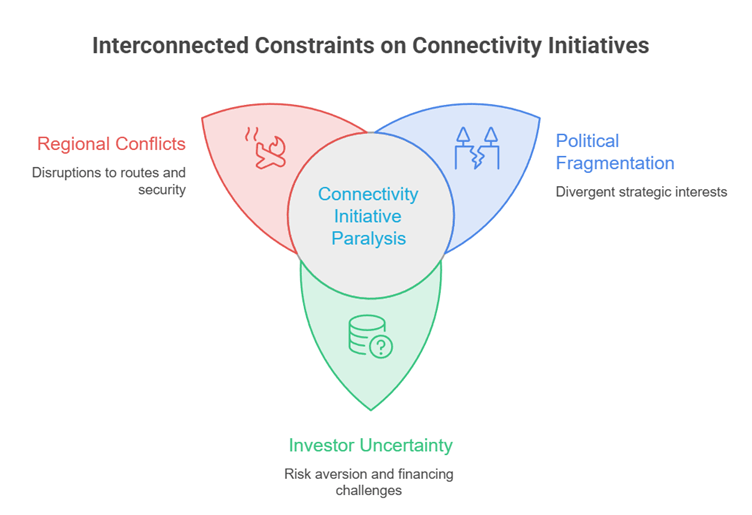
I. Why Regional Conflicts and Shifting Alliances Constrain Connectivity Initiatives
A. Vulnerability to Strategic Chokepoints and Security Disruptions
- Modern connectivity projects depend upon stable maritime and overland routes; conflicts around the Strait of Hormuz, through which a substantial share of global crude oil trade passes, demonstrate how regional wars can disrupt global commerce and energy flows.
- Attacks on shipping lanes, ports, energy terminals, and logistics infrastructure increase insurance costs, transportation delays, and investment uncertainty, reducing the commercial viability of corridors.
- Example – Red Sea Crisis (2023–26): Repeated attacks on commercial shipping in the Red Sea forced many vessels to reroute around the Cape of Good Hope, increasing transit times and freight costs, thereby exposing the fragility of global supply chains.
B. Political Fragmentation and Divergent Strategic Interests
- Connectivity projects require long-term policy coordination among multiple sovereign states; however, regional powers often pursue competing security and geopolitical objectives.
- Differences in strategic outlook between Gulf states, Israel, Iran, Türkiye, and external powers frequently affect infrastructure planning and execution.
- Case Study – Gulf Regional Dynamics: Emerging differences among major Gulf countries regarding security partnerships, energy policies, and external alignments have complicated the creation of a seamless regional economic architecture.
C. Investor Uncertainty and Infrastructure Risk
- Large-scale corridors require billions of dollars in long-term investments, which depend on predictability and stability.
- Wars increase the risk of asset destruction, sanctions, financing constraints, and project delays, discouraging private capital participation.
- Example – Gaza Conflict and Subsequent Regional Escalation: Security concerns around transit nodes and logistics hubs led to delays in operationalizing several proposed connectivity initiatives involving West Asian partners.
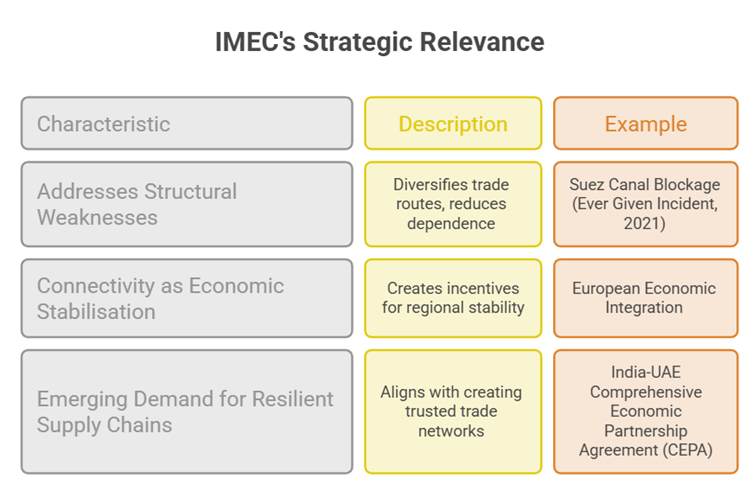
II. Critical Analysis: Why IMEC Remains Strategically Relevant Despite Security Disruptions
A. IMEC Addresses Structural Weaknesses in Existing Trade Networks
- The corridor seeks to diversify global trade routes beyond traditional chokepoints such as the Suez Canal, thereby reducing excessive dependence on a limited number of maritime passages.
- It integrates ports, rail connectivity, energy grids, digital infrastructure, and green hydrogen supply chains, creating a multidimensional connectivity ecosystem.
- Example – Suez Canal Blockage (Ever Given Incident, 2021): The disruption of a single shipping route caused billions of dollars in trade losses globally, demonstrating the need for alternative corridors.
B. Connectivity as a Tool of Economic Stabilisation
- Economic interdependence generated through trade corridors can create incentives for regional stability and cooperation.
- Infrastructure-led integration often transforms geopolitical competition into economic collaboration by increasing mutual stakes in peace and prosperity.
- Case Study – European Economic Integration: Post-war infrastructure and economic cooperation eventually evolved into deeper regional integration, illustrating how connectivity can mitigate historical rivalries.
C. Emerging Demand for Resilient Supply Chains
- Recent disruptions caused by the pandemic, geopolitical tensions, energy shocks, and conflicts have accelerated the search for diversified and secure supply chains.
- IMEC aligns with the broader objective of creating trusted and resilient trade networks linking Asia, West Asia, and Europe.
- Example – India-UAE Comprehensive Economic Partnership Agreement (CEPA): Growing bilateral trade and logistics cooperation demonstrate the economic foundation upon which larger connectivity initiatives can be built.
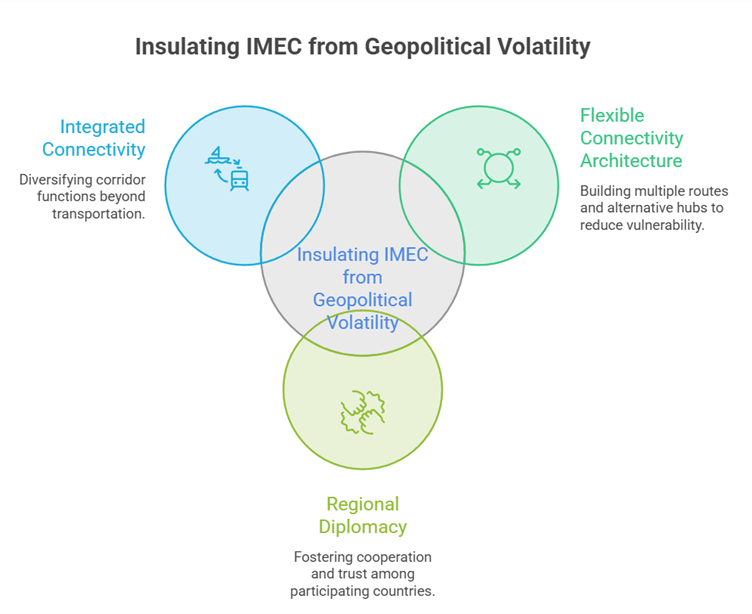
III. Measures Needed to Insulate IMEC from Geopolitical Volatility
A. Building Flexible and Multi-Route Connectivity Architecture
- The corridor should evolve beyond a single fixed alignment and incorporate multiple entry and exit points to reduce vulnerability to conflict zones.
- Alternative port-based networks involving relatively stable maritime hubs can ensure continuity during crises.
- Example – Oman Connectivity Potential: Ports such as Duqm, Salalah, and Muscat provide access outside the immediate conflict-prone environment surrounding the Strait of Hormuz and can function as complementary nodes.
B. Strengthening Regional Diplomacy and Strategic Balancing
- Successful implementation requires sustained diplomatic engagement among all participating countries despite differences in political alignments.
- Countries maintaining strong relations across competing regional blocs can act as bridge-builders and confidence generators.
- Case Study – I2U2 Framework: Cooperation among India, Israel, the UAE, and the United States demonstrates how issue-based partnerships can overcome traditional geopolitical divisions and foster economic collaboration.
C. Integrating Economic, Energy, and Digital Connectivity
- Future corridors must go beyond transportation and include green hydrogen pipelines, electricity interconnections, semiconductor supply chains, data corridors, and logistics parks.
- Such diversification reduces dependence on any single sector and enhances long-term strategic value.
- Government Initiative – National Logistics Policy and PM Gati Shakti: These initiatives strengthen domestic infrastructure integration and improve India’s ability to leverage international corridors through efficient multimodal connectivity.
Conclusion:
- The assertion that transnational connectivity initiatives such as IMEC are increasingly held hostage by regional conflicts and shifting alliances is partly valid, as recent disruptions in West Asia have exposed the vulnerabilities of infrastructure projects to geopolitical instability, security threats, and competing strategic interests. However, these very disruptions also reinforce the necessity of alternative and resilient connectivity frameworks.
- The future success of IMEC will depend not merely on infrastructure construction but on adaptive route design, sustained regional diplomacy, diversified supply chains, and cooperative security arrangements. As global trade continues to expand and energy transitions accelerate, resilient connectivity corridors capable of bypassing conflict zones and strategic chokepoints will become indispensable pillars of economic growth, regional stability, and shared prosperity.