
Role of Domestic Private Sector in Transforming India into a Global Defence Manufacturing Hub
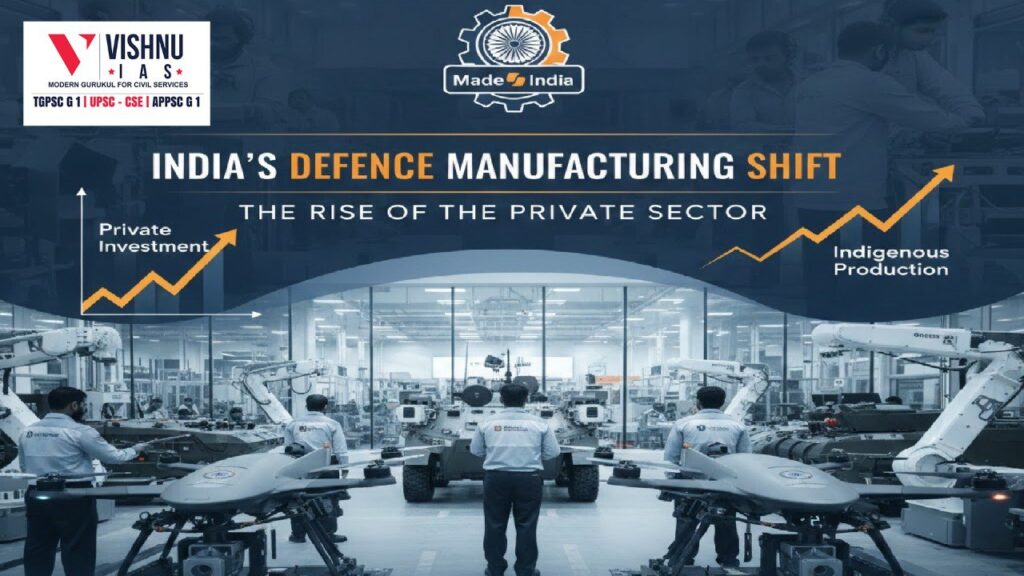
The domestic private sector in India’s defence manufacturing has emerged as a central force in the country’s strategic shift from being one of the world’s largest arms importers to a credible global defence manufacturing hub. This transformation aligns with India’s broader ambition of becoming a developed nation by 2047 and reflects a decisive break from its historically state-dominated defence production model.
Introduction
India’s ambition to transition from being one of the world’s largest arms importers to a global defence manufacturing hub is central to its vision of becoming a developed nation by 2047. Historically, India accounted for a significant share of global arms imports due to a state-dominated production structure, limited private participation, and dependence on foreign original equipment manufacturers (OEMs).
Over the last decade, however, a recalibrated policy framework—anchored in self-reliance (Atmanirbharta), strategic autonomy, and export competitiveness—has progressively repositioned the domestic private sector as a critical driver of this transformation. This shift is unfolding against a volatile global security environment, supply-chain disruptions exposed by recent conflicts, and expanding international demand for cost-effective, reliable defence platforms.
I. Domestic Private Sector as a Catalyst for Defence Manufacturing Transformation
1. Expansion of manufacturing depth and technological capability
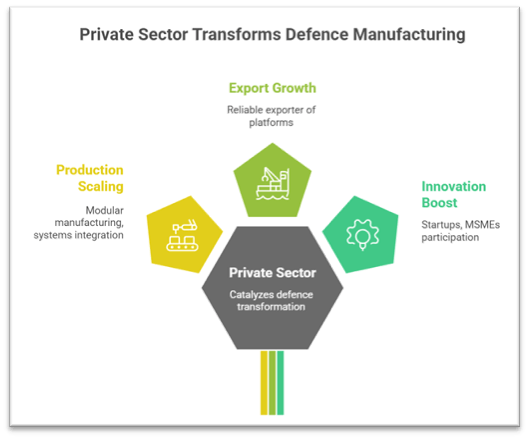
The entry of large Indian conglomerates and specialised private firms has enabled scaling of production, modular manufacturing, and systems integration, areas where legacy public sector units faced capacity and efficiency constraints.
Private firms contributing to artillery systems, armoured platforms, missiles, naval vessels, drones, and electronic warfare suites have significantly increased indigenous content, reducing import dependency across the Army, Navy, and Air Force.
Government initiatives such as ‘Make in India (Defence)’, the ‘Make’ and ‘Make-II’ procurement procedures, and expanded indigenisation lists have created assured demand signals that incentivise long-term private investment.
2. Driving defence exports and global supply-chain integration
The private sector has been instrumental in transforming India from a buyer to a reliable exporter of defence platforms, subsystems, and services across Asia, Africa, Latin America, and Europe.
Indian private manufacturers now supply patrol vessels, radars, artillery components, ammunition, avionics, and unmanned systems to foreign militaries, competing effectively on cost, reliability, and lifecycle support.
Export promotion cells, defence attaché engagement, and government-to-government frameworks have enabled private firms to penetrate markets traditionally dominated by established global suppliers.
3. Strengthening innovation, startups, and MSME participation
Private participation has expanded beyond large firms to include startups and MSMEs, particularly in artificial intelligence, robotics, cyber defence, space-based surveillance, and unmanned platforms.
Defence innovation challenges have enabled rapid prototyping and induction of indigenous solutions for surveillance drones, loitering munitions, and secure communication systems.
Schemes such as iDEX, Defence Industrial Corridors, and relaxed licensing norms have nurtured a bottom-up innovation ecosystem, complementing state-led research efforts.
II. Strategic and Economic Significance of Private Sector-Led Defence Manufacturing
1. Enhancing national security and strategic autonomy
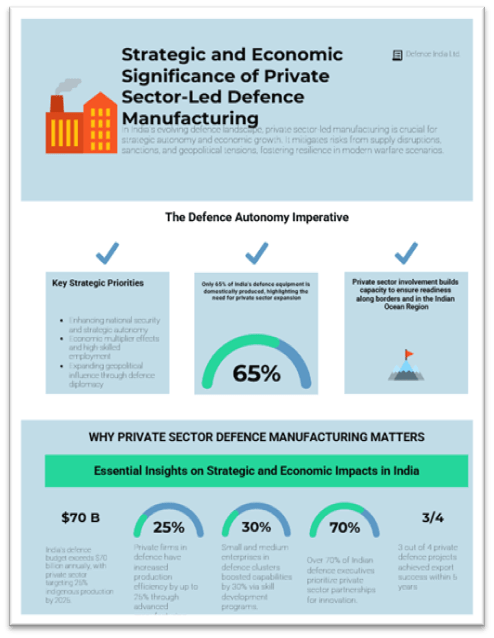
A robust private defence industrial base reduces vulnerability to external supply disruptions, sanctions, and geopolitical uncertainties—an increasingly critical concern in contemporary warfare.
Countries with strong domestic defence industries have demonstrated greater resilience during prolonged conflicts by sustaining production and maintenance without external dependence.
For India, private-sector capacity complements public units in ensuring operational readiness along contested land borders and across the Indian Ocean Region.
2. Economic multiplier effects and high-skilled employment
Defence manufacturing has emerged as a high-value industrial segment, generating skilled employment in engineering, materials science, electronics, and advanced manufacturing.
Defence industrial clusters around aerospace, shipbuilding, and electronics have stimulated local supplier ecosystems, benefiting ancillary industries and regional economies.
The private sector’s export orientation further contributes to foreign exchange earnings and industrial upgrading.
3. Expanding geopolitical influence through defence diplomacy
Defence exports function as instruments of strategic partnership and diplomatic leverage, reinforcing India’s role as a net security provider.
Supply of defence platforms accompanied by training, maintenance, and long-term service support has deepened India’s strategic ties with partner nations.
The private sector’s growing role enhances credibility by offering competitive pricing, timely delivery, and lifecycle reliability.
III. Persistent Regulatory and Structural Hurdles
1. Procedural complexity and regulatory delays
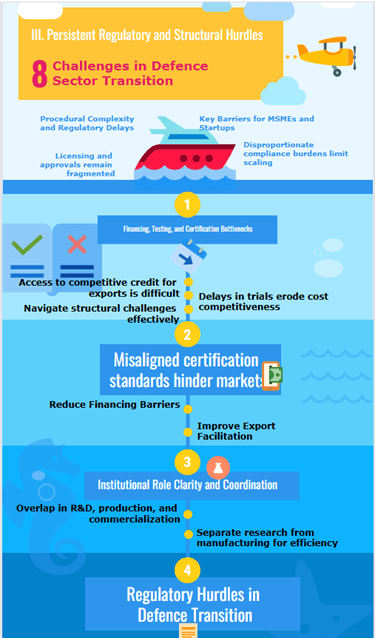
Despite reforms, licensing, export clearances, joint venture approvals, and technology-transfer permissions remain time-consuming and fragmented.
MSMEs and startups often face disproportionate compliance burdens, limiting their ability to scale or participate in global contracts.
The absence of long-term procurement visibility restricts capital-intensive investments.
2. Financing, testing, and certification bottlenecks
Private manufacturers face challenges in accessing competitive credit, particularly for exports involving extended payment cycles.
Delays in field trials and lack of integrated testing infrastructure slow induction timelines.
Domestic certification standards are sometimes misaligned with global norms, affecting export acceptance.
3. Institutional role clarity and coordination
Overlap between research, production, and commercialisation roles continues to affect efficiency.
Global best practices indicate that separating frontier research from industrial-scale manufacturing enhances competitiveness.
The absence of a dedicated defence export facilitation authority dilutes outreach and coordination.
Conclusion:
India’s journey from a major arms importer to a global defence manufacturing hub is inseparable from the expanding role of its domestic private sector. Rising indigenous production, diversified exports, and international acceptance demonstrate tangible progress.
Sustaining this momentum requires deeper regulatory simplification, predictable demand signals, export-oriented financing, and institutional realignment.
A resilient, export-capable defence industrial base will remain a defining pillar of India’s national security, economic transformation, and global strategic standing.
Recap: