
Introduction
Women’s Political Empowerment in India refers to the enhancement of women’s participation, representation, and influence in decision-making institutions, ensuring equality in governance. India’s journey reflects a gradual shift from grassroots inclusion to national-level representation.
Women constitute nearly 48% of India’s population, yet their representation in the Lok Sabha remains around 15% (2024), highlighting persistent gaps.
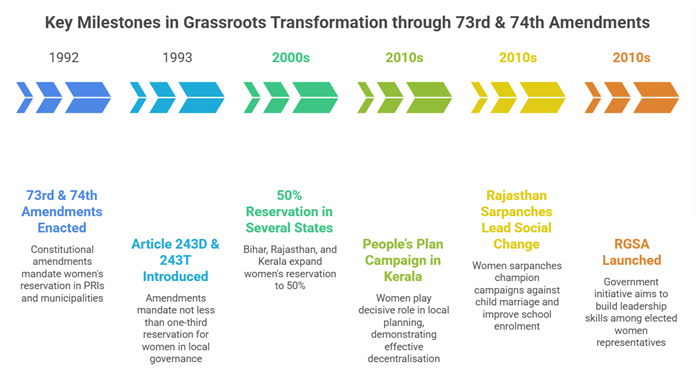
The 73rd and 74th Constitutional Amendments (1992–93) marked a transformative step by introducing one-third reservation for women in Panchayati Raj Institutions (PRIs) and Urban Local Bodies (ULBs). Today, this has resulted in over 15 lakh elected women representatives, with more than 40% participation in many states.
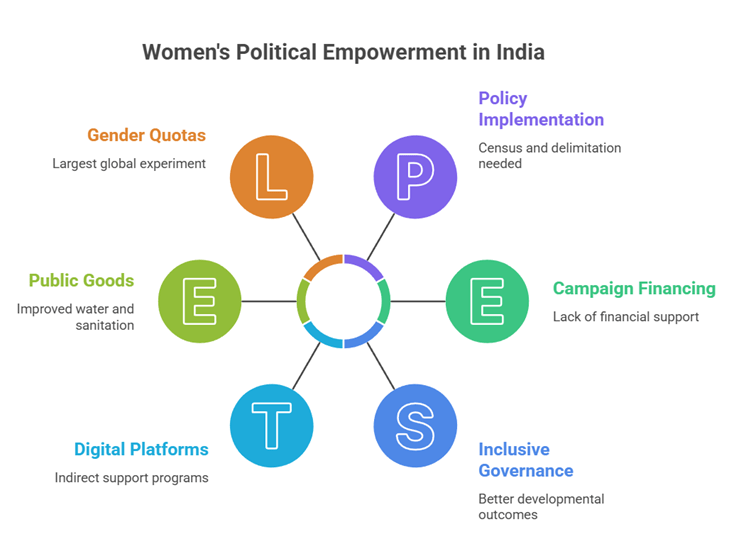
The Nari Shakti Vandan Adhiniyam, 2023 aims to extend similar reservation to Parliament and State Assemblies, though its implementation depends on Census and delimitation.
1. Grassroots Transformation through 73rd & 74th Amendments
a) Institutionalisation of Women’s Representation
The amendments introduced Articles 243D and 243T, mandating at least one-third reservation for women in PRIs and municipalities. Several states like Bihar, Rajasthan, and Kerala increased this to 50%.
This created a strong base of women leaders and helped break traditional gender barriers.
b) Socio-political Empowerment and Leadership Outcomes
Women’s participation improved governance by focusing on key issues like drinking water, sanitation, health, and education.
They also acted as agents of social change by challenging patriarchal norms.
Example: Women sarpanches in Rajasthan led campaigns against child marriage and improved school enrolment.
c) Limitations and Challenges
Despite progress, challenges remain:
- Proxy leadership (“sarpanch pati” issue)
- Lack of administrative skills
- Weak financial and functional autonomy
Government initiatives like Rashtriya Gram Swaraj Abhiyan (RGSA) aim to improve capacity-building.
2. Transition to National-Level Representation: Nari Shakti Vandan Adhiniyam
a) Key Features
The Act introduces Article 334A, providing 33% reservation for women in Lok Sabha and State Assemblies, including SC/ST sub-reservation.
However, implementation depends on Census and delimitation, likely delaying it until after 2029.
b) Political Debates and Concerns
- Delay in implementation due to pending Census
- No reservation for OBC women
- Demand for immediate enforcement
c) Federal Concerns
The Act is linked with delimitation, raising concerns among southern states like Tamil Nadu and Kerala about losing political representation due to population-based seat allocation.
3. Evaluation: Achievements, Gaps, and Way Forward
a) Achievements
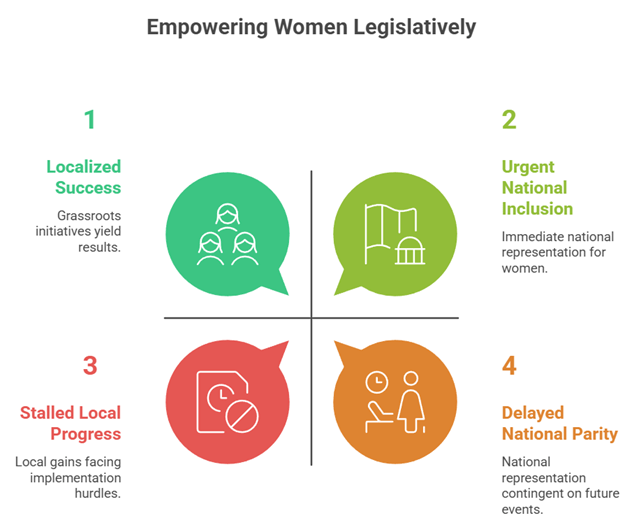
India has one of the largest gender-based political reservation systems globally.
Women leaders have improved governance, especially in welfare and public service delivery.
b) Persistent Gaps
- Low representation at higher political levels
- Lack of party support and funding
- Limited transition from local to national politics
c) Way Forward
- Timely Census and delimitation
- Inclusion of OBC women in reservation
- Strengthening leadership training programs
- Promoting women’s participation through education initiatives
Conclusion
Women’s Political Empowerment in India shows a progressive yet incomplete journey. While grassroots reforms have been successful, extending representation to higher levels is essential.
Ensuring timely implementation, inclusive policies, and strong institutional support can help achieve true gender equality in governance.