Introduction
The VB-G RAM G Act 2025 marks a decisive shift in India’s rural employment architecture, addressing long-standing weaknesses of rural wage employment programmes such as ghost job cards, fragmented asset creation and weak enforceability of worker rights.
Rural wage employment programmes in India have historically served as a statutory safety net against agrarian distress, seasonal unemployment and rural poverty, most notably through the Mahatma Gandhi National Rural Employment Guarantee framework. However, implementation experience over nearly two decades revealed persistent structural weaknesses such as ghost job cards, delayed or denied wages, episodic employment, fragmented asset creation and weak enforceability of worker rights, as repeatedly highlighted by audit findings, parliamentary reviews and field-level evidence.
Against this backdrop, the Viksit Bharat – Guarantee for Rozgar and Ajeevika Mission (Gramin) Act, 2025 introduces a restructured legal and institutional framework that seeks to combine enhanced livelihood security with durable rural development, expanding the statutory employment guarantee to 125 days while redesigning planning, delivery and accountability mechanisms.
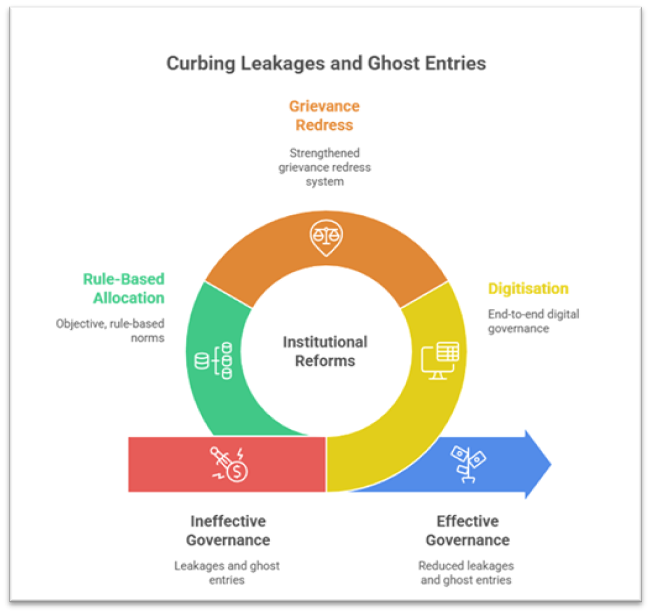
1. Institutional and Governance Reforms to Curb Leakages and Ghost Entries
Digitisation with legal backing and accountability
- The Act institutionalises end-to-end digital governance, including universal worker authentication, real-time muster roll generation and time-bound wage payments, thereby structurally closing spaces for fictitious beneficiaries and inflated work records.
- Example: Aadhaar-based payment systems and near-universal linkage of active workers have already demonstrated how biometric authentication significantly reduced duplicate and fake job cards in several high-migration districts.
Strengthened grievance redress and enforceability
- Procedural dis-entitlements that earlier rendered unemployment allowance ineffective have been removed, and statutory timelines for grievance redress are reinforced, converting the right to work from a nominal entitlement into an enforceable guarantee.
- Case Study: States that operationalised time-bound grievance portals during pandemic disruptions reported higher worker retention and reduced payment-related disputes.
Rule-based allocation and cooperative federalism
- State-wise allocations are determined through objective, rule-based norms rather than discretionary releases, reducing scope for manipulation while treating States as development partners rather than passive implementers.
- Example: Differential funding ratios for Himalayan and northeastern States have enabled better compliance and reduced underutilisation compared to earlier uniform funding norms.
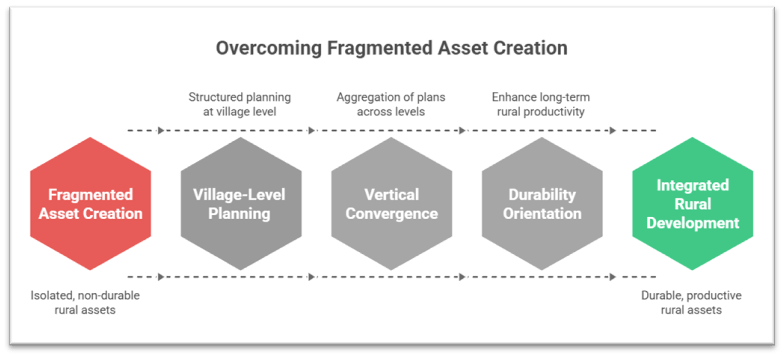
2. Planning and Convergence to Overcome Fragmented Asset Creation
Shift from episodic works to advance participatory planning
- The Act mandates structured village-level planning through Viksit Gram Panchayat Plans, ensuring that employment generation aligns with locally prioritised, technically vetted and sequenced works.
- Example: Districts that adopted advance shelf-of-works planning reported higher continuity of employment and reduced instances of work denial during peak demand periods.
Vertical and horizontal convergence across sectors
- Aggregation of village plans at block, district and State levels enables convergence with agriculture, water conservation, housing and livelihood missions, addressing the earlier problem of isolated and non-durable assets.
- Case Study: Converged watershed and farm-pond projects linked with agriculture extension services have improved irrigation coverage and cropping intensity in semi-arid regions.
Asset durability and productivity orientation
- Works are explicitly designed to enhance long-term rural productivity—soil health, water security, climate resilience—transforming wage employment into a development multiplier.
- Example: Integrated land development works in drought-prone blocks have reduced seasonal migration by stabilising farm incomes.
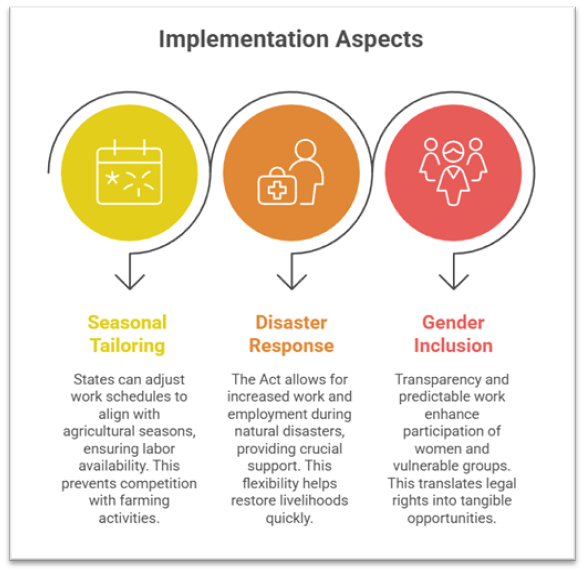
3. Flexibility, Equity and Context-Sensitive Implementation
Seasonal and agro-climatic tailoring of employment
- States are empowered to notify periods during peak sowing and harvesting when works will not be undertaken, ensuring that the employment guarantee complements rather than competes with agriculture.
- Example: Agro-climatic zoning-based notifications in rain-fed regions improved farm labour availability without diluting employment entitlements.
Disaster-responsive and adaptive framework
- The Act allows temporary expansion of permissible works and employment days during natural disasters and extraordinary situations, correcting the rigidity that earlier limited responsiveness during crises.
- Case Study: Flexible relaxation of norms during flood years enabled faster restoration of rural livelihoods and infrastructure.
Gender and inclusion outcomes
- Enhanced transparency and predictable work availability have reinforced participation of women and vulnerable groups, translating legal entitlements into actual access.
- Example: Women-led worksites linked with livelihood missions strengthened both income security and social empowerment.
Conclusion:
The VB-G RAM G Act represents a structural recalibration rather than a dilution of India’s rural employment guarantee architecture. By embedding digital accountability, participatory advance planning, convergence-driven asset creation and enforceable worker rights into statutory design, it directly addresses historical weaknesses such as ghost entries and fragmented development outcomes.
The integration of welfare and development—backed by expanded entitlements and rising public investment—signals a shift towards resilient, productivity-enhancing rural livelihoods.
Going forward, sustained capacity-building of local institutions, continuous social audits and adaptive policy feedback will be critical to ensure that the enhanced guarantee translates into inclusive growth, reduced distress migration and durable rural transformation, reinforcing the constitutional promise of dignity through work.
Recap: