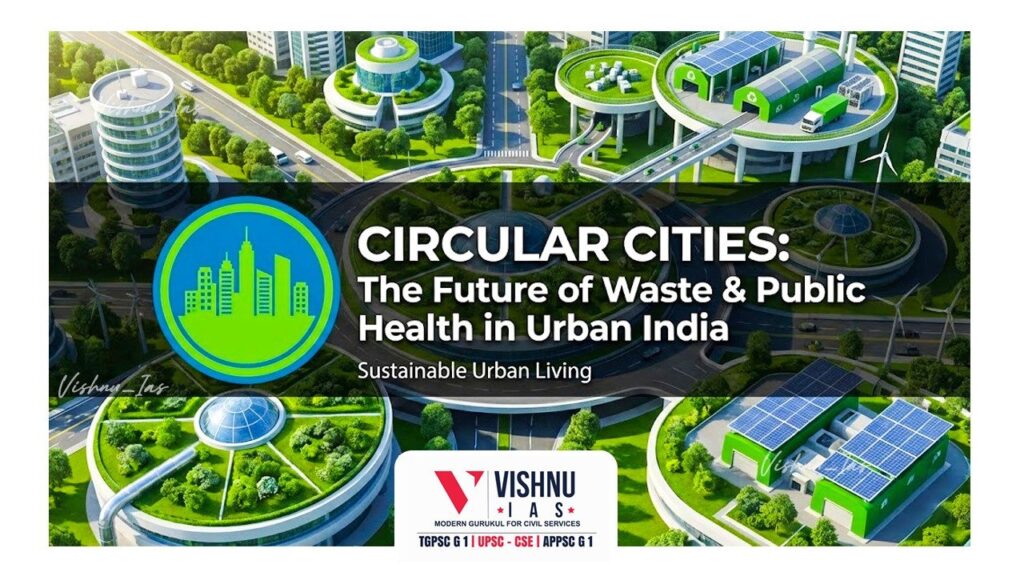
Urban India's Shift to Circular Waste Management: A Necessity for Climate Resilience & Public Health
Circular Waste Management in Urban India is emerging as a defining pillar of sustainable urban development, climate resilience, and public health security. Urban waste management in India is undergoing a conceptual transition from a linear model—characterised by “take–use–dispose”—to a circular economy approach, where waste is treated as a resource capable of being reduced, reused, recycled, and recovered. This shift has gained global momentum with climate negotiations foregrounding waste-linked methane emissions, particularly from organic waste, as a major driver of urban greenhouse gases.
With India’s urban population projected to cross 800 million by mid-century, cities are expected to generate over four times more waste than at the start of this century, making unmanaged waste a direct threat to climate resilience, public health, urban liveability, and economic productivity.
In this context, India’s commitment to Mission LiFE, the Garbage Free Cities framework, and urban missions such as SBM Urban 2.0 and AMRUT signals a recognition that circular waste management is no longer optional but existential.
I. Circular Waste Management as a Pillar of Climate Resilience
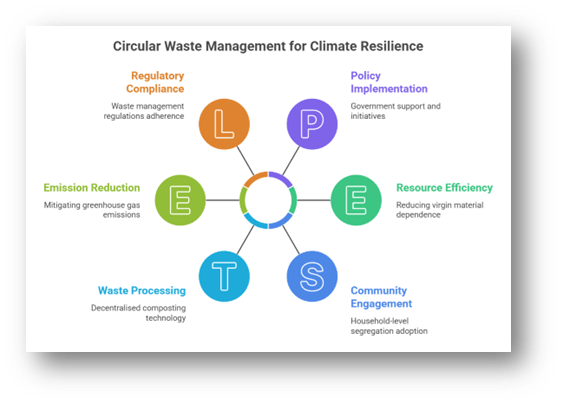
a. Mitigating greenhouse gas emissions through waste circularity
- Organic waste constitutes the largest share of municipal solid waste in Indian cities, and when dumped untreated in landfills, it decomposes anaerobically, releasing methane, a greenhouse gas with far higher short-term warming potential than carbon dioxide.
- Circular practices such as decentralised composting and large-scale bio-methanation directly interrupt this emission pathway while producing soil nutrients and clean energy.
- Example: Indore’s integrated wet waste management, combining household-level segregation with bio-methanation and composting plants, has demonstrated how cities can simultaneously reduce landfill emissions and supply energy for municipal operations.
b. Reducing resource extraction and embodied emissions
- Circular waste management lowers dependence on virgin materials by feeding recycled outputs back into production systems, thereby cutting emissions embedded in mining, manufacturing, and transport.
- Construction and demolition waste, when recycled into aggregates and bricks, reduces pressure on river sand and stone quarries—key contributors to environmental degradation and carbon intensity in the construction sector.
- Case Study: Delhi’s C&D waste recycling plants, which supply materials for road sub-bases and public works, illustrate how urban waste streams can substitute high-emission raw materials.
c. Strengthening urban climate adaptation capacity
- Climate resilience is not limited to emission reduction; it also involves the ability of cities to absorb shocks such as floods, heatwaves, and water stress.
- Poor waste management clogs drains, intensifies urban flooding, and worsens heat islands, while circular systems improve drainage, enhance green cover through compost use, and stabilise urban ecosystems.
- Government Initiative: The Garbage Free Cities (GFC) Star Rating Framework explicitly links waste processing outcomes with broader environmental resilience indicators.
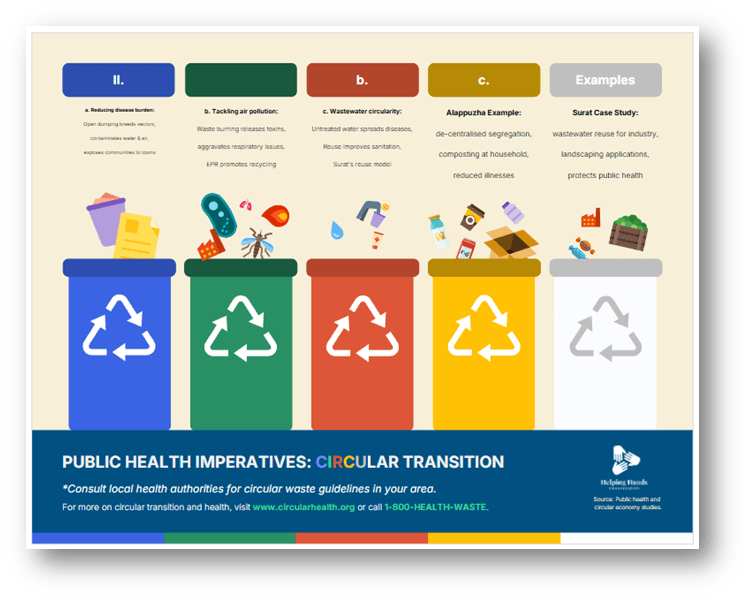
II. Public Health Imperatives Driving the Circular Transition
a. Reducing disease burden from unmanaged waste
- Open dumping and unsegregated waste create breeding grounds for disease vectors, contaminate air and groundwater, and expose waste workers and nearby communities to toxic substances.
- Circular systems that prioritise segregation, safe processing, and scientific disposal directly reduce exposure to pathogens and pollutants.
- Example: Alappuzha’s decentralised waste model, which eliminated landfills by household-level segregation and composting, has been associated with improved sanitation outcomes and reduced public complaints related to waste-linked illnesses.
b. Tackling air pollution from waste burning
- In many Indian cities, dry waste—especially plastics—is either openly burned or ends up in unmanaged dumps, releasing fine particulates and carcinogenic compounds that aggravate respiratory and cardiovascular diseases.
- Circular approaches channel dry waste into recycling streams or controlled refuse-derived fuel systems for industrial use, reducing toxic emissions.
- Government Initiative: Extended Producer Responsibility (EPR) under plastic waste management rules aims to shift the burden of collection and recycling upstream, reducing informal and hazardous disposal practices.
c. Wastewater circularity and urban health security
- Urban public health is inseparable from water security and sanitation. Untreated wastewater contaminates surface and groundwater, heightening risks of waterborne diseases.
- Circular water management—through reuse of treated wastewater for non-potable purposes—reduces freshwater stress while improving sanitation outcomes.
- Case Study: Surat’s wastewater reuse for industrial cooling and landscaping demonstrates how circular water practices can protect public health while sustaining urban economic activity.
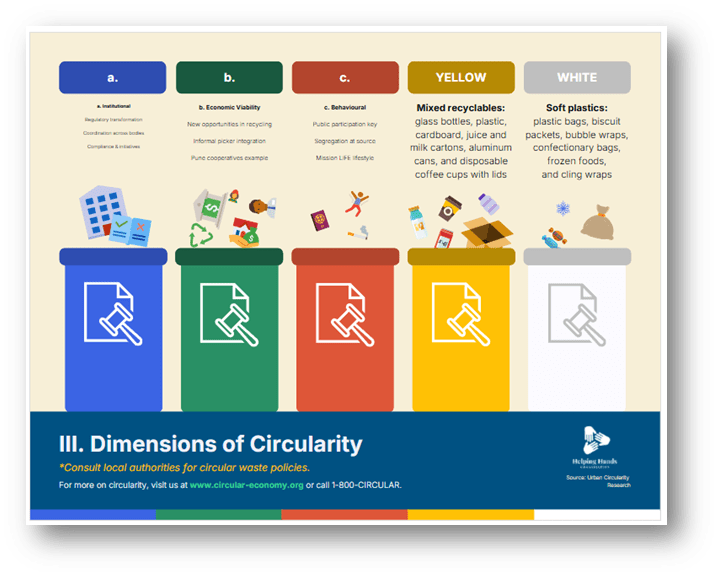
III. Governance, Economic, and Behavioural Dimensions of Circularity
a. Institutional and regulatory transformation
- Transitioning from linear to circular waste management requires coordination across urban local bodies, pollution control authorities, urban development departments, and private operators.
- Compliance with evolving regulations on plastic waste and construction debris is central to ensuring accountability and traceability across the waste value chain.
- Government Initiative: The forthcoming Environment (Construction and Demolition) Waste Management Rules seek to strengthen enforcement by linking waste generation with financial and legal responsibility.
b. Economic viability and urban livelihoods
- Circular waste systems create new economic opportunities in recycling, compost marketing, bioenergy, and material recovery, transforming waste from a fiscal burden into a revenue-generating asset.
- Integrating informal waste pickers into formal systems enhances efficiency while improving livelihoods and social protection.
- Example / Case Study: Pune’s waste picker cooperatives, formally linked to municipal waste collection and segregation, illustrate inclusive circularity that combines environmental and social resilience.
c. Citizen behaviour and cultural transition
- Circularity depends critically on public participation, particularly segregation at source and reduction in waste generation.
- In a rapidly consumerising society, behavioural change is challenging but essential for sustaining waste reforms beyond infrastructure investments.
- Government Initiative: Mission LiFE reframes sustainability as a lifestyle choice, encouraging citizens to internalise reduction and reuse as everyday practices rather than policy mandates.
Conclusion:
Urban India’s shift from linear to circular waste management is fundamentally about survival, not aesthetics. With urban waste volumes set to multiply alongside population growth, failure to adopt circular systems would lock cities into escalating emissions, deteriorating public health, and mounting fiscal stress.
Evidence from high-performing cities shows that scientific waste processing, material recovery, and wastewater reuse can dramatically reduce environmental risks while strengthening urban resilience.
The way forward lies in scaling circular models across all cities, tightening regulatory enforcement, mobilising private capital and innovation, and embedding behavioural change through citizen-centric initiatives.
As global climate discourse increasingly recognises waste as a climate lever, India’s urban transition to circularity represents a decisive opportunity to align climate resilience, public health, and sustainable development in one integrated framework.
Recap: