Updating Consumer Price Index (CPI) Base Year: Significance and Implications for Inflation Measurement in India
Updating Consumer Price Index (CPI) base year is essential for ensuring accurate inflation measurement in India’s rapidly transforming economy. Inflation refers to the sustained increase in the general price level of goods and services over time, leading to erosion in purchasing power. In India, the Consumer Price Index (CPI) serves as the principal measure of retail inflation, reflecting price changes faced by households in both rural and urban areas. Since 2016, the Reserve Bank of India (RBI) has adopted CPI-based inflation as the nominal anchor under the Flexible Inflation Targeting (FIT) framework, with a target of 4% ± 2%, underscoring its macroeconomic centrality.
Over the past decade, structural transformations—rapid urbanisation, expansion of the services sector, digitisation of consumption, and shifts revealed in the Household Consumption Expenditure Survey (2023–24)—have altered spending patterns significantly. Against this backdrop, updating the CPI base year from 2012 to 2024 is not a technical exercise alone but a critical reform to ensure that inflation measurement reflects contemporary economic realities.
I. Rationale and Significance of Updating the CPI Base Year
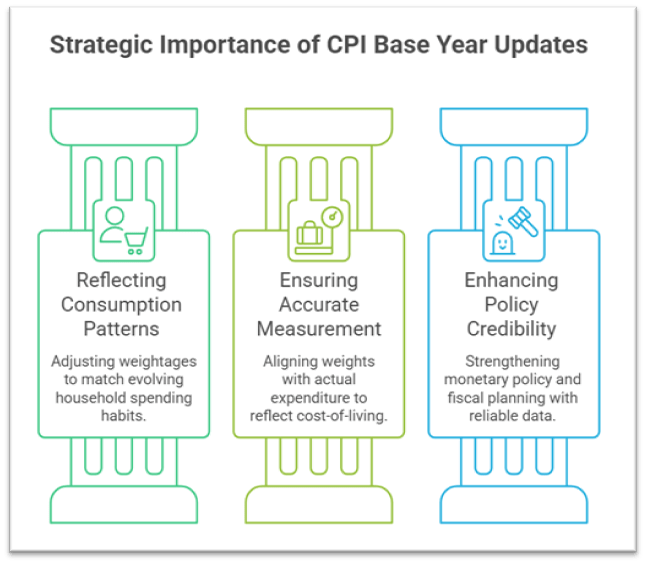
1. Reflecting Changing Consumption Patterns and Economic Structure
- The shift from a goods-dominated to a services-oriented consumption basket necessitates recalibration of weightages; telecom services, air travel, healthcare, and education now occupy a larger share in household budgets.
- Urbanisation and dietary diversification have reduced the relative share of food expenditure compared to earlier decades, requiring adjustment in CPI weight structures.
- Example: The growth of digital payments and e-commerce platforms demands incorporation of online price data to avoid measurement bias.
2. Ensuring Accurate Measurement of Real Purchasing Power
- Inflation affects households asymmetrically; aligning CPI weights with actual expenditure shares ensures it mirrors the true cost-of-living experience.
- Case Study: During vegetable price spikes, correct weight distribution determines whether inflation data captures the impact on lower-income households.
- Government Initiative: Updated HCES data strengthens targeting under schemes such as the Public Distribution System (PDS).
3. Enhancing Policy Credibility and Macro-Economic Governance
- A realistic CPI strengthens monetary transmission under the inflation-targeting regime.
- Credible data supports fiscal planning, including Dearness Allowance (DA) revisions and pension indexation.
- Periodic revisions in line with global statistical norms improve cross-country comparability.
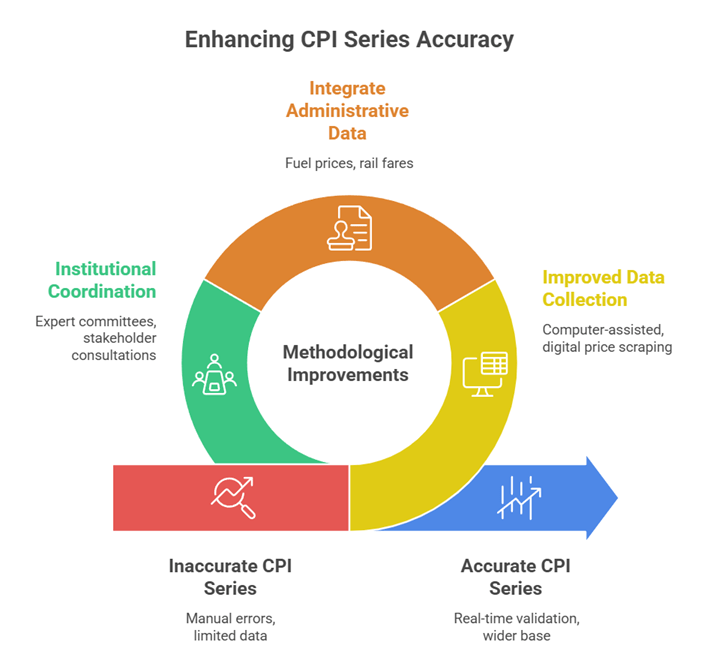
II. Methodological and Institutional Improvements in the New CPI Series
1. Improved Data Collection Mechanisms
- Adoption of computer-assisted price collection reduces manual errors and enhances transparency.
- Digital price scraping for telecom tariffs and airline fares ensures dynamic price representation.
- Example: Online railway and airline ticket pricing is now better captured compared to traditional surveys.
2. Integration of Administrative and Official Data Sources
- Reliance on official records such as fuel prices, rail fares, and PDS rates improves accuracy.
- Combining survey and administrative databases strengthens statistical robustness.
- Case Study: Effective LPG prices under schemes like Pradhan Mantri Ujjwala Yojana are better reflected in inflation measurement.
3. Institutional Coordination and Transparency
- Base revision involves expert committees and statistical field offices under the Ministry of Statistics and Programme Implementation (MoSPI).
- Methodological scrutiny preserves time-series continuity while enhancing representativeness.
- Stakeholder consultations improve trust in official statistics.
III. Implications for Inflation Measurement and Broader Economic Outcomes
1. Implications for Monetary Policy and Financial Markets
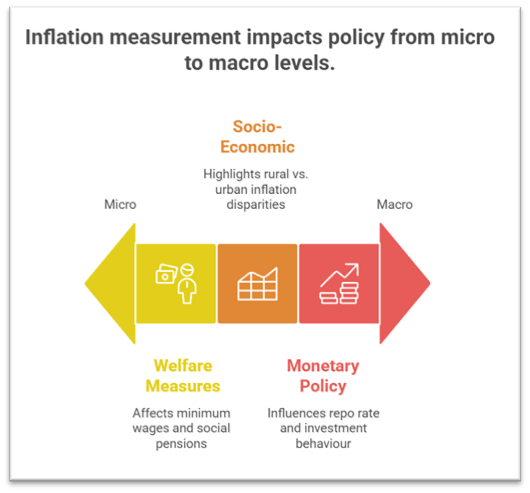
- CPI directly influences RBI’s policy repo rate decisions, affecting borrowing costs and investment sentiment.
- A recalibrated CPI may alter measured inflation trajectories and inflation expectations.
- Example: Higher weight to services inflation may shift policy focus from temporary food shocks to structural pressures.
2. Implications for Fiscal Policy and Welfare Measures
- CPI-linked indexation determines revisions in minimum wages, pensions, and welfare transfers.
- Wage revisions in employment guarantee programmes indirectly depend on inflation trends.
- Inflation data informs subsidy rationalisation and buffer stock interventions during price stress.
3. Socio-Economic and Distributional Implications
- Updated CPI better captures rural-urban inflation differentials and regional disparities.
- It enables analysis of inflation inequality across income groups.
- Rising healthcare expenditure in urban areas reflects demographic shifts that must be incorporated into cost-of-living assessments.
Conclusion:
Updating the CPI base year is fundamental to preserving the credibility and relevance of inflation measurement in a rapidly transforming economy. As India advances toward higher income levels, deeper digitisation, and greater global integration, statistical systems must evolve accordingly.
With retail inflation remaining within the targeted band in recent years while consumption patterns undergo structural shifts, the revised CPI ensures that monetary and fiscal policies are grounded in contemporary realities.
A robust, transparent, and methodologically sound CPI strengthens macroeconomic stability and safeguards household welfare. Continued statistical capacity-building, periodic revisions, and integration of emerging data sources will ensure that the CPI remains a reliable mirror of economic life and a cornerstone of evidence-based governance in India.
Recap: