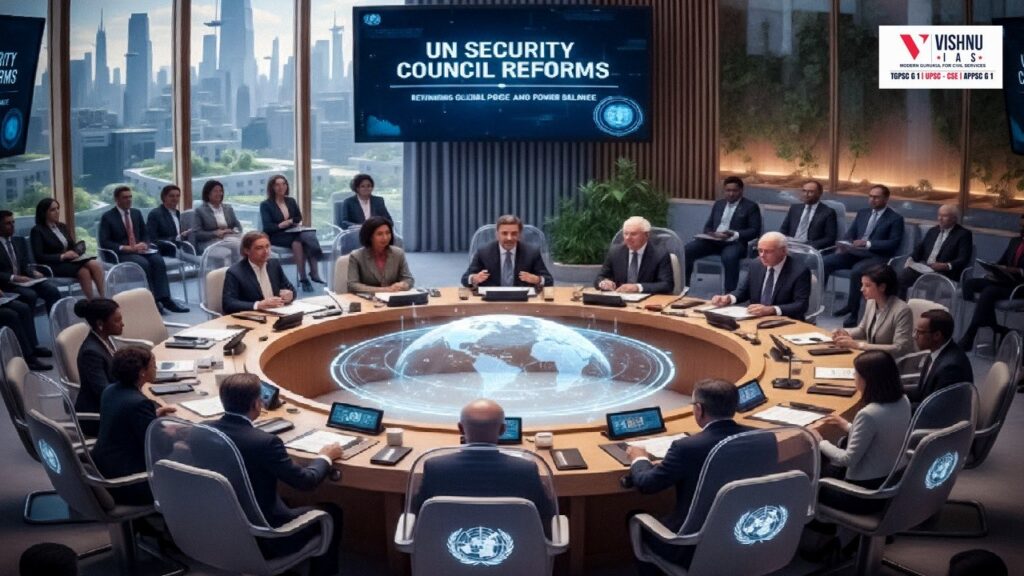
UN Security Council Reforms: Addressing Structural Limits to Sustaining Peace
UN Security Council reforms are increasingly seen as essential for bridging the gap between crisis response and long-term peace. This analysis examines the Council’s structural limitations in sustaining peace and evaluates how functional (non-Charter-changing) reforms could improve its effectiveness in modern conflict and post-conflict settings.
Introduction:
- The United Nations (UN) was founded in 1945 with the primary responsibility for maintaining international peace and security. Central to this objective is the United Nations Security Council (UNSC), established under Article 24 of the UN Charter. The UNSC is empowered to adopt binding decisions, including authorising peace-keeping missions, sanctions, or enforcement actions.
- Yet in the nearly eight decades since its creation, the body has increasingly struggled to sustain peace beyond initial conflict cessation. For example, the post-conflict relapse risk remains high in many countries; modern conflicts involve non-state actors and protracted violence where peace-keeping alone cannot secure long-term stability.
- The structural design of the UNSC, its episodic nature and limited continuity in peace processes, have been identified as key obstacles to sustained peace outcomes. Functional reforms—those that work with existing Charter powers rather than await wholesale structural change—could enhance the UNSC’s effectiveness now.
Body:
• 1. Limitations of the UNSC’s Current Structure in Sustaining Peace
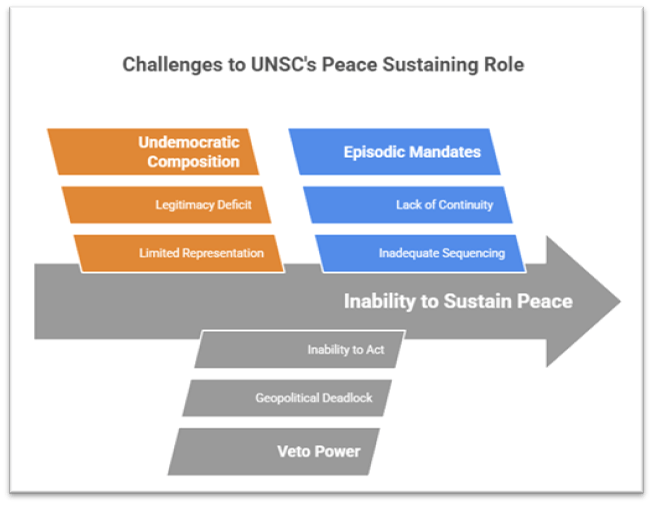
1.1 Undemocratic composition and representation
- The UNSC comprises 15 members including five permanent members (P5) with veto power, while there are 193 UN member-states. This means less than 8 % of states have direct decision-making influence on peace and security matters.
- Regions such as Africa, Latin America & the Caribbean and Asia continue to be under-represented among permanent seats.
- The legitimacy deficit undermines the UNSC’s ability to mobilise long-term political commitment from the global majority, which is vital in sustaining peace processes.
1.2 Veto power and geopolitical deadlock
- The veto held by each P5 member allows any one of them to block a substantive resolution, regardless of the majority view of other states.
- In conflicts such as Rwandan genocide (1994) and Srebrenica massacre (1995), the Council’s inability to act decisively was partly attributed to veto-driven paralysis and lack of mandate clarity.
- This structural veto deadlock means that timely political engagement or follow-through in peace-building phases often fails, weakening sustainable peace efforts.
1.3 Episodic mandates and lack of continuity in political accompaniment
- The UNSC typically mandates peace-keeping or transitional missions for limited durations, often renewing annually or bi-annually, with little built-in mechanism for sustained, phased transitions into peace-building.
- Questions of sequencing—i.e., shifting from military stabilisation to political dialogue to governance and development—are often inadequately addressed. For example, the operation in the South Sudan Civil War shows how peacekeeping stabilised ground but failed to embed political transition mechanisms.
- Institutional memory is weak: when missions wind down, political channels and linkage with the UN system often fade, leaving vacuums in implementation of peace agreements.
• 2. How Functional Reforms Could Enhance UNSC Effectiveness
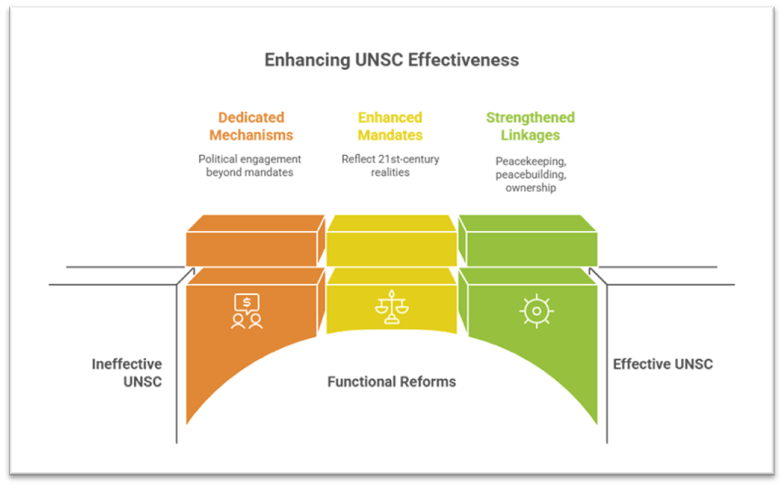
2.1 Establishing dedicated mechanisms for sustained political accompaniment
- A subsidiary body under the United Nations General Assembly (UNGA) could provide political engagement beyond episodic UNSC mandates—ensuring follow-through in peace-process implementation and transitions.
- For instance, the existing United Nations Peacebuilding Commission (PBC) provides advisory support in post-conflict scenarios but lacks authority for active, sustained action during political transitions.
- By leveraging UNGA’s Article 22 authority (to establish subsidiary bodies), a dedicated “Board of Peace and Sustainable Security” could fill this gap without waiting for full structural reform of the UNSC.
2.2 Enhancing mandates, representation, and decision-making to reflect 21st-century realities
- Reform of non-structural dimensions could include expanding the number of elected non-permanent members or introducing categories of longer-term seats with rotating regional representation, thereby increasing legitimacy and buy-in.
- Limit or require abstention rather than veto use in cases of mass atrocities or humanitarian crises; introduce an “emergency override” or “veto restraint” mechanism to enable action when the P5 are divided.
- Strengthen the coherence between UNSC mandates and downstream peace-building efforts: design mandates from their inception to include governance, inclusion and regional cooperation dimensions (the “sustainable security” concept), rather than just short-term stabilisation.
2.3 Strengthening linkages between peace-keeping, peace-building and regional/host-state ownership
- Embed the principle of national ownership and inclusive governance within mandates: for example, ensure peace-keeping missions are tied to measurable political outcomes (e.g., disarmament, elections, constitutional reform) rather than simply holding ground.
- Enhance coordination with regional organisations (e.g., African Union, Association of Southeast Asian Nations) by giving them meaningful roles in the subsidiary body and mission oversight.
- Create predictable financing mechanisms for the transitional and post-conflict phases (rather than relying solely on voluntary contributions), so momentum is maintained when peace-keeping draws down. The PBC has flagged the need for a “quantum leap” in funding for effective peace-building.
• 3. Institutionalising Accountability, Continuity, and Knowledge Systems within the UN Framework
3.1 Creating mechanisms for long-term monitoring and accountability
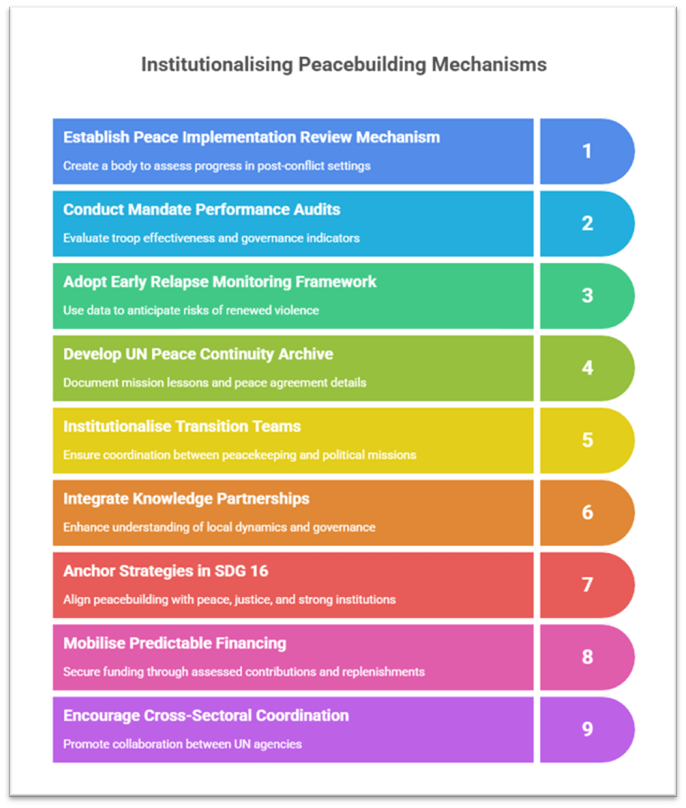
- Establish an integrated “Peace Implementation Review Mechanism” under the proposed subsidiary body or within the Peacebuilding Commission to periodically assess progress in post-conflict settings.
- Ensure mandate performance audits—evaluating not only troop effectiveness but also governance, reconciliation, and institution-building indicators—are made public to enhance transparency.
- Adopt a data-driven early relapse monitoring framework, using UNDP and World Bank post-conflict recovery metrics to anticipate risks of renewed violence, ensuring preventive diplomatic re-engagement.
3.2 Embedding institutional memory and continuity in peace operations
- Develop a centralised UN Peace Continuity Archive that documents all mission lessons, negotiations, and peace agreement implementation details for use by subsequent envoys or missions.
- Institutionalise mandatory transition teams between peacekeeping drawdowns and political missions to prevent gaps in coordination, as seen between UNAMID (Darfur) and UNITAMS (Sudan).
- Integrate knowledge partnerships with think tanks, regional organisations, and academia to enhance context-specific understanding of local dynamics and governance challenges.
3.3 Aligning peacebuilding with the Sustainable Development Goals (SDGs) and financing reform
- Anchor peace-sustaining strategies in SDG 16 (Peace, Justice, and Strong Institutions), ensuring that political settlements evolve into inclusive governance and development frameworks.
- Mobilise predictable financing through assessed contributions and Peacebuilding Fund replenishments rather than ad hoc donor pledges, addressing the chronic funding shortfalls in transition phases.
- Encourage cross-sectoral coordination between UNDP, UNHCR, and the Department of Political and Peacebuilding Affairs (DPPA) so that peace efforts are sustained through governance, livelihoods, and human security programmes beyond mission timelines.
Conclusion:
- In sum, the UNSC’s current structure—rooted in the post-1945 world—faces significant limitations when it comes to sustaining peace: narrow representation, veto-driven paralysis, and episodic mandates without continuous political accompaniment. However, functional reform offers a path forward.
- By leveraging existing Charter provisions, increasing linkages between peace-keeping and peace-building, enhancing representation and mandate coherence, and embedding long-term political engagement and regional participation, the UN system can significantly improve its capacity to manage transitions from war to peace.
- The way forward lies less in awaiting sweeping Charter change and more in implementing innovative institutional design capable of bridging the gap between crisis-response and sustained peace. The future effectiveness of multilateral peace architecture depends on such timely action.
• 1. Limitations of the UNSC’s Current Structure in Sustaining Peace
1.1 Undemocratic composition and representation
- The UNSC comprises 15 members including five permanent members (P5) with veto power, while there are 193 UN member-states. This means less than 8 % of states have direct decision-making influence on peace and security matters.
- Regions such as Africa, Latin America & the Caribbean and Asia continue to be under-represented among permanent seats.
- The legitimacy deficit undermines the UNSC’s ability to mobilise long-term political commitment from the global majority, which is vital in sustaining peace processes.
1.2 Veto power and geopolitical deadlock
- The veto held by each P5 member allows any one of them to block a substantive resolution, regardless of the majority view of other states.
- In conflicts such as Rwandan genocide (1994) and Srebrenica massacre (1995), the Council’s inability to act decisively was partly attributed to veto-driven paralysis and lack of mandate clarity.
- This structural veto deadlock means that timely political engagement or follow-through in peace-building phases often fails, weakening sustainable peace efforts.
1.3 Episodic mandates and lack of continuity in political accompaniment
- The UNSC typically mandates peace-keeping or transitional missions for limited durations, often renewing annually or bi-annually, with little built-in mechanism for sustained, phased transitions into peace-building.
- Questions of sequencing—i.e., shifting from military stabilisation to political dialogue to governance and development—are often inadequately addressed. For example, the operation in the South Sudan Civil War shows how peacekeeping stabilised ground but failed to embed political transition mechanisms.
- Institutional memory is weak: when missions wind down, political channels and linkage with the UN system often fade, leaving vacuums in implementation of peace agreements.
• 2. How Functional Reforms Could Enhance UNSC Effectiveness
2.1 Establishing dedicated mechanisms for sustained political accompaniment
- A subsidiary body under the United Nations General Assembly (UNGA) could provide political engagement beyond episodic UNSC mandates—ensuring follow-through in peace-process implementation and transitions.
- For instance, the existing United Nations Peacebuilding Commission (PBC) provides advisory support in post-conflict scenarios but lacks authority for active, sustained action during political transitions.
- By leveraging UNGA’s Article 22 authority (to establish subsidiary bodies), a dedicated “Board of Peace and Sustainable Security” could fill this gap without waiting for full structural reform of the UNSC.
2.2 Enhancing mandates, representation, and decision-making to reflect 21st-century realities
- Reform of non-structural dimensions could include expanding the number of elected non-permanent members or introducing categories of longer-term seats with rotating regional representation, thereby increasing legitimacy and buy-in.
- Limit or require abstention rather than veto use in cases of mass atrocities or humanitarian crises; introduce an “emergency override” or “veto restraint” mechanism to enable action when the P5 are divided.
- Strengthen the coherence between UNSC mandates and downstream peace-building efforts: design mandates from their inception to include governance, inclusion and regional cooperation dimensions (the “sustainable security” concept), rather than just short-term stabilisation.
2.3 Strengthening linkages between peace-keeping, peace-building and regional/host-state ownership
- Embed the principle of national ownership and inclusive governance within mandates: for example, ensure peace-keeping missions are tied to measurable political outcomes (e.g., disarmament, elections, constitutional reform) rather than simply holding ground.
- Enhance coordination with regional organisations (e.g., African Union, Association of Southeast Asian Nations) by giving them meaningful roles in the subsidiary body and mission oversight.
- Create predictable financing mechanisms for the transitional and post-conflict phases (rather than relying solely on voluntary contributions), so momentum is maintained when peace-keeping draws down. The PBC has flagged the need for a “quantum leap” in funding for effective peace-building.
• 3. Institutionalising Accountability, Continuity, and Knowledge Systems within the UN Framework
3.1 Creating mechanisms for long-term monitoring and accountability
- Establish an integrated “Peace Implementation Review Mechanism” under the proposed subsidiary body or within the Peacebuilding Commission to periodically assess progress in post-conflict settings.
- Ensure mandate performance audits—evaluating not only troop effectiveness but also governance, reconciliation, and institution-building indicators—are made public to enhance transparency.
- Adopt a data-driven early relapse monitoring framework, using UNDP and World Bank post-conflict recovery metrics to anticipate risks of renewed violence, ensuring preventive diplomatic re-engagement.
3.2 Embedding institutional memory and continuity in peace operations
- Develop a centralised UN Peace Continuity Archive that documents all mission lessons, negotiations, and peace agreement implementation details for use by subsequent envoys or missions.
- Institutionalise mandatory transition teams between peacekeeping drawdowns and political missions to prevent gaps in coordination, as seen between UNAMID (Darfur) and UNITAMS (Sudan).
- Integrate knowledge partnerships with think tanks, regional organisations, and academia to enhance context-specific understanding of local dynamics and governance challenges.
3.3 Aligning peacebuilding with the Sustainable Development Goals (SDGs) and financing reform
- Anchor peace-sustaining strategies in SDG 16 (Peace, Justice, and Strong Institutions), ensuring that political settlements evolve into inclusive governance and development frameworks.
- Mobilise predictable financing through assessed contributions and Peacebuilding Fund replenishments rather than ad hoc donor pledges, addressing the chronic funding shortfalls in transition phases.
- Encourage cross-sectoral coordination between UNDP, UNHCR, and the Department of Political and Peacebuilding Affairs (DPPA) so that peace efforts are sustained through governance, livelihoods, and human security programmes beyond mission timelines.
Conclusion:
- In sum, the UNSC’s current structure—rooted in the post-1945 world—faces significant limitations when it comes to sustaining peace: narrow representation, veto-driven paralysis, and episodic mandates without continuous political accompaniment. However, functional reform offers a path forward.
- By leveraging existing Charter provisions, increasing linkages between peace-keeping and peace-building, enhancing representation and mandate coherence, and embedding long-term political engagement and regional participation, the UN system can significantly improve its capacity to manage transitions from war to peace.
- The way forward lies less in awaiting sweeping Charter change and more in implementing innovative institutional design capable of bridging the gap between crisis-response and sustained peace. The future effectiveness of multilateral peace architecture depends on such timely action.