Transnational Cyber Scams in Southeast Asia: India’s Strategic Regional Response
Introduction
Transnational cyber scams involving Southeast Asian “scam compounds” have emerged as a critical security and human-rights concern for India and the broader Asia-Pacific region. Defined broadly, these digital fraud schemes involve victims trafficked or coerced into engaging in online fraud such as romance-investment scams, cryptocurrency fraud, and impersonation “digital-arrest” schemes — with criminal networks spanning multiple jurisdictions.
For example, a recent report by the United Nations Office on Drugs and Crime (UNODC) identifies that cyber-fraud in East and Southeast Asia led to estimated losses of US $18–37 billion in 2023, much of which can be traced to operations based in Myanmar, Cambodia, and Laos. Moreover, India has repatriated nearly 300 of its citizens who were lured into such scam centres in Southeast Asia in early 2025.
The scale, cross-border architecture, human-trafficking component, and institutional enablers distinguish this modern phenomenon from conventional cybercrime.
1. Transnational Architecture of Cyber-Scams
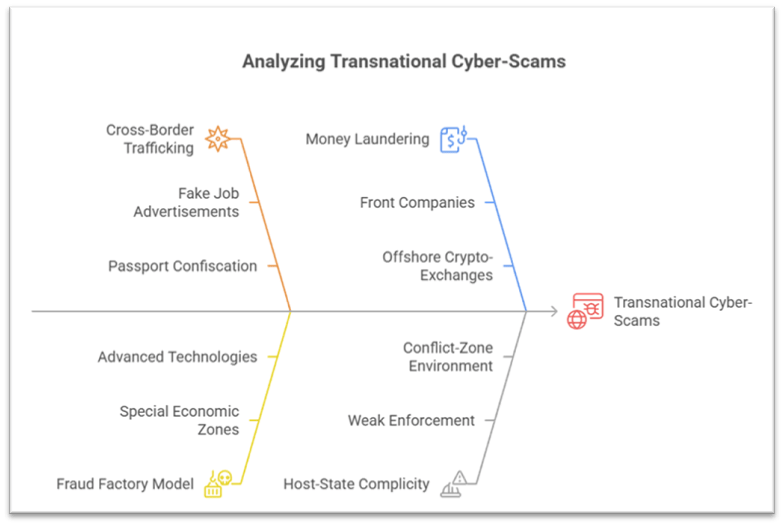
1.1 Cross-Border Trafficking and Forced Criminality
Victims from India and other countries are lured through fake job advertisements (promising high salaries, data-entry or call-centre work) into Southeast Asian countries, particularly Myanmar and Cambodia. Once there, their passports may be confiscated and they are coerced into scam operations.
In Myanmar, regions of weak state control (post-coup 2021) have enabled criminal networks and ethnic armed outfits to host “scam centres.” The OHCHR has noted hundreds of thousands of people trafficked into online scam operations and forced into fraud across Southeast Asia.
1.2 Fraud-Factory/Compound Model & Technology Enablement
These operations function as large “fraud factories” or “scam compounds,” often situated in special economic zones, conflict-affected borderlands, or jurisdictions with lax enforcement.
Criminal groups leverage advanced technologies such as deepfakes, large language models, malware, cryptocurrency laundering, and VoIP gateways with overseas virtual numbers to scale their operations. For instance, between 2022–23 the Asia-Pacific region experienced a 1,530% increase in deepfake fraud.
Case Study: Research on the Huione Group in Cambodia revealed it processed over US $100 billion in Tether/USDT flows in 18 months via scam facilitation and laundering.
1.3 Money-Laundering, Host-State Complicity, and Weak Enforcement
Proceeds from these operations are laundered through front companies, offshore crypto-exchanges, mule networks, and banking systems in multiple jurisdictions. Some states or semi-state actors are either complicit or negligent, allowing scam centres to flourish without adequate oversight.
The transnational nature complicates investigations — victims may be trafficked from India, the compounds may operate from Myanmar/Cambodia, and funds may flow through Chinese-linked criminal networks and crypto rails.
2. Implications for India
2.1 Threat to Indian Citizens and Internal Security
Indian nationals are vulnerable to being trafficked into such scam centres abroad and simultaneously Indian residents are victims of online fraud orchestrated from abroad (e.g., “digital arrest” scams). For example, 85 youths from Visakhapatnam were rescued after being lured to Myanmar and Cambodia.
Financial losses and reputational costs undermine public trust in digital transactions and pose challenges to cyber-law enforcement. The convergence of human trafficking, forced labour, and cybercrime raises internal security, human-rights, and public-order issues for India.
2.2 Foreign Policy and Geopolitical Dimension
India’s neighbourhood includes Southeast Asian states with which it has diplomatic and economic ties through ASEAN, BIMSTEC, and Mekong-Ganga Cooperation. The emergence of scam-centre hubs in Myanmar and Cambodia brings bilateral and multilateral diplomacy to the fore.
The issue reflects the strategic challenge posed by weak-governance zones and cross-border networks, which India must navigate while balancing regional security interests (including China’s influence and Belt & Road projects). China’s repatriation of nationals involved in scams also shows major-power engagement, offering India partnership opportunities.
2.3 Legal, Regulatory and Institutional Challenges
India’s domestic cyber-crime infrastructure faces difficulties in dealing with overseas perpetrators, virtual assets, and victims beyond jurisdiction. The interface between human-trafficking law, cyber-fraud law, extradition, and MLATs becomes critical.
Awareness campaigns and digital literacy programs are vital preventive tools. For instance, game-based interventions like “ShieldUp!” in India show promise for scam-awareness.
3. India’s Strategic Options for a Coordinated Regional Response
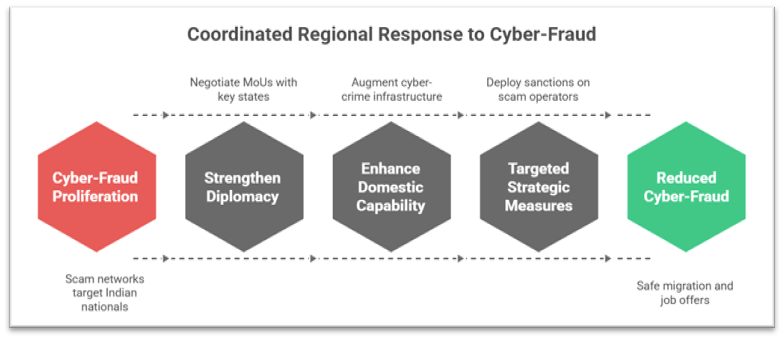
3.1 Strengthening Bilateral and Regional Diplomacy & Cooperation
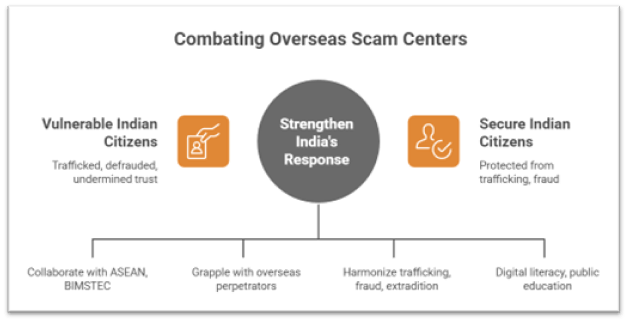
India should engage bilaterally with key Southeast Asian states (Myanmar, Thailand, Cambodia, Vietnam) to negotiate MoUs on cyber-crime, mutual legal assistance, repatriation of victims, and intelligence sharing. For example, India repatriated 283 nationals via an IAF flight from Thailand in March 2025.
India can leverage frameworks like ASEAN-India cooperation, BIMSTEC, and Mekong-Ganga to integrate cyber-fraud and human trafficking into security agendas, applying diplomatic pressure and capacity-building for reforms. Example: U.S. Treasury sanctions on Burmese warlords linked to cyber-scam industries.
3.2 Enhancing Domestic Capability and External Linkages
India must strengthen specialized cyber-crime cells, improve digital-forensics capability for crypto-fraud, and enhance coordination between RBI, FIU-IND, and fintech/crypto regulators to disrupt laundering linkages.
Public education and scam-prevention campaigns should target vulnerable populations, discouraging blind trust in “easy job abroad” offers and educating about “digital arrest” and crypto-fraud traps. International collaboration with INTERPOL, UNODC, FATF, and private-sector platforms is vital for tracking and freezing illicit flows.
3.3 Targeted Strategic Measures and Preventive Diplomacy
India can coordinate sanctions and travel bans on identified scam-centre operators, shell companies, and facilitators. Diplomatic engagement should focus on hotspots like the Myanmar-Thailand border and SEZs in Cambodia and Laos.
Safe-migration and job-offer verification mechanisms can prevent trafficking pipelines — such as a government overseas-employment verification portal with scam-job alert modules.
Conclusion:
The rise of transnational cyber-fraud operations anchored in Southeast Asian “scam-compound” hubs represents one of the most complex intersections of digital crime, human trafficking, and regional instability. For India, this issue impacts internal security, citizen protection, and foreign policy.
Given estimates suggesting hundreds of thousands of victims and annual losses in the tens of billions of dollars, a piecemeal approach will not suffice. India’s way forward lies in building robust partnerships with Southeast Asian states, strengthening domestic cyber capabilities, and leveraging multilateral frameworks to dismantle these layered networks.
Only through sustained regional collaboration and capacity-building can the proliferation of such fraud factories be curtailed and vulnerable citizens protected.
Recap: