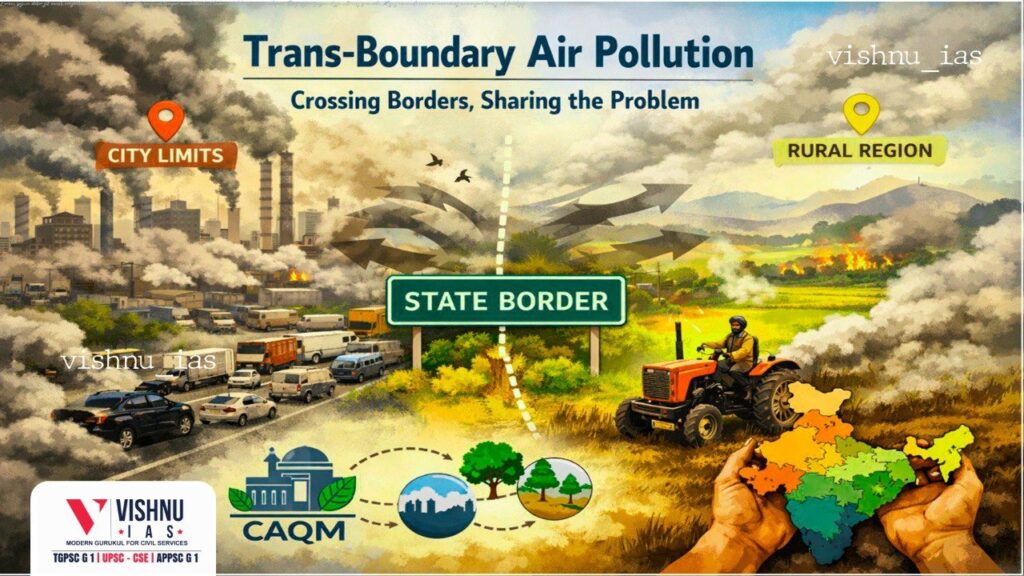
Managing Trans-Boundary Air Pollution in India: How Effectively Does CAQM Address Regional Pollution Beyond City Limits?
Trans-boundary air pollution has become a significant governance challenge in India, compelling policymakers to rethink regional environmental cooperation.
Introduction:
- Air pollution has evolved from a local environmental nuisance into a complex trans-boundary governance challenge, where pollutants generated in one jurisdiction affect air quality, health, and ecosystems far beyond political borders.
- In India’s National Capital Region (NCR), this reality is stark: while vehicular emissions, construction dust, industrial activities, and domestic fuel use dominate urban pollution loads, seasonal agricultural burning, long-range atmospheric transport, and regional meteorological conditions significantly shape pollution outcomes.
- Fine particulate matter (PM2.5), nitrogen oxides, ozone precursors, and toxic gases routinely cross State boundaries, undermining city-centric policy responses. Against this backdrop, the Commission for Air Quality Management (CAQM) was created as a regional institutional response to address air pollution beyond Delhi’s administrative limits.
- However, managing air pollution as a trans-boundary issue raises persistent challenges of attribution, proportionality, coordination, and accountability, testing the effectiveness of existing governance frameworks.
Body:
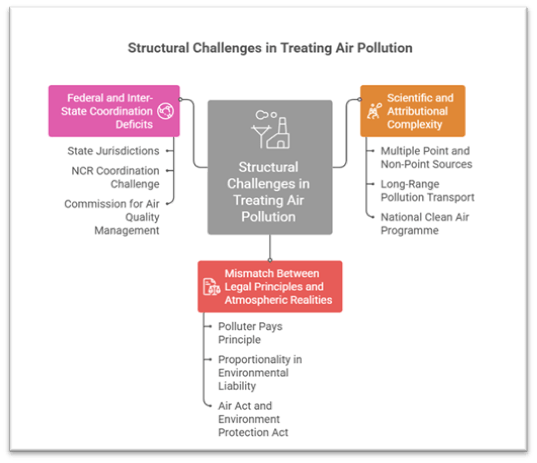
1. Structural Challenges in Treating Air Pollution as a Trans-Boundary Problem
Scientific and attributional complexity
- Air pollution involves multiple point and non-point sources—transport, industry, power generation, biomass burning, and natural dust—whose emissions mix in the atmosphere, making proportional liability difficult to assign.
- Example and Case Study – Long-range pollution transport: Seasonal meteorological patterns in the Indo-Gangetic Plain trap pollutants over northern India, allowing emissions from rural and peri-urban areas to aggravate urban air quality far from their origin.
- Government initiative: India’s expanding air-quality modelling and source-apportionment exercises under the National Clean Air Programme (NCAP) aim to improve scientific attribution but remain uneven across States.
Mismatch between legal principles and atmospheric realities
- Environmental law traditionally relies on the Polluter Pays Principle, yet trans-boundary pollution dilutes direct causality, complicating cost internalisation.
- Example and Case Study – Proportionality in environmental liability: Judicial reasoning in comparative jurisdictions has underscored that seasonal or marginal contributors cannot bear responsibility for pollution generated by structurally dominant sources.
- Government initiative: Regulatory standards under the Air Act and Environment Protection Act focus on compliance and control, not proportional trans-boundary liability sharing.
Federal and inter-State coordination deficits
- Air pollution transcends State boundaries, but India’s federal structure places pollution control primarily within State jurisdictions, often resulting in fragmented enforcement.
- Example and Case Study – NCR coordination challenge: Pollution mitigation measures adopted by Delhi are frequently offset by policy lags or enforcement gaps in surrounding regions.
- Government initiative: CAQM was established precisely to overcome this coordination deficit, though institutional frictions persist.
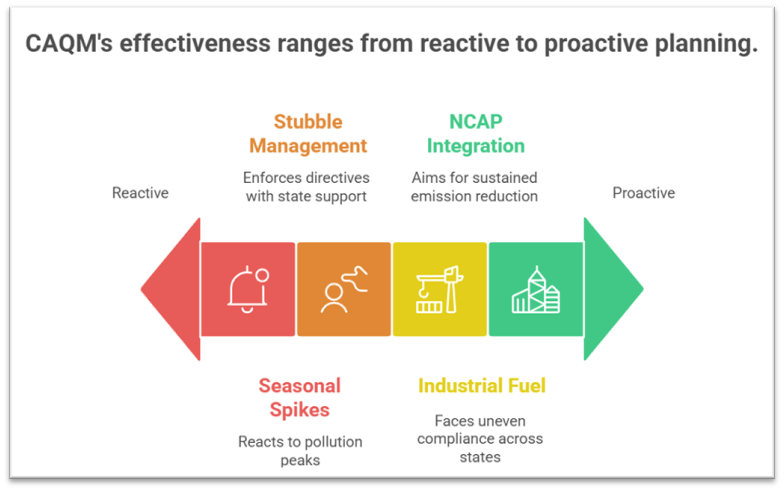
2. Effectiveness of CAQM in Addressing Regional Influences Beyond City Limits
Expanded jurisdiction with limited coercive depth
- CAQM’s mandate extends across the NCR and adjoining areas, allowing uniform directions on stubble management, industrial fuels, vehicular restrictions, and construction activities.
- Example and Case Study – Stubble management directives: Region-wide advisories and graded response measures acknowledge that pollution sources lie beyond Delhi, reflecting a shift from city-centric governance.
- Government initiative: The Graded Response Action Plan (GRAP), enforced by CAQM, operationalises region-specific emergency actions based on pollution severity.
Implementation asymmetry across States
- While CAQM can issue binding directions, enforcement capacity ultimately rests with State governments and local agencies, leading to uneven compliance.
- Example and Case Study – Industrial fuel transition: Cleaner fuel mandates are adopted faster in core urban areas than in peripheral industrial clusters due to administrative and economic constraints.
- Government initiative: Financial and technological support schemes for cleaner fuels and pollution control devices exist but vary in uptake across regions.
Reactive orientation over preventive regional planning
- CAQM’s interventions often intensify during pollution peaks, reflecting a crisis-management approach rather than sustained, long-term regional air-shed planning.
- Example and Case Study – Seasonal pollution spikes: Emergency curbs during winter months highlight the absence of year-round regional emission reduction strategies.
- Government initiative: NCAP provides a long-term framework, but integration with CAQM’s operational mandate remains incomplete.
3. Governance, Justice, and the Limits of Current Institutional Design
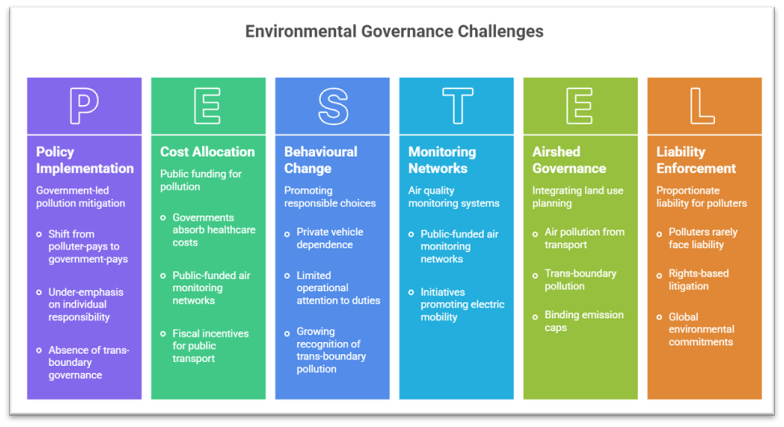
Shift from polluter-pays to government-pays dynamics
- In practice, pollution mitigation costs—monitoring, emergency measures, healthcare impacts—are largely borne by governments, reflecting welfare-oriented judicial and executive approaches.
- Example and Case Study – Public health burden: Governments absorb healthcare costs arising from pollution exposure, while individual polluters rarely face proportionate liability.
- Government initiative: Public-funded air monitoring networks and health advisories exemplify corrective justice but dilute deterrence.
Under-emphasis on individual and collective responsibility
- Environmental duties of citizens, industries, and local bodies receive limited operational attention compared to rights-based litigation.
- Example and Case Study – Urban mobility choices: Private vehicle dependence continues despite policy recognition of transport as a major pollution source.
- Government initiative: Initiatives promoting public transport and electric mobility exist but require stronger behavioural and fiscal incentives.
Absence of a trans-boundary airshed governance model
- CAQM addresses a defined region but does not yet operate as a full-fledged airshed authority integrating land use, agriculture, energy, and transport planning across States.
- Example and Case Study – International comparison: Regional air pollution regimes elsewhere demonstrate the effectiveness of binding emission caps and shared responsibility mechanisms.
- Government initiative: India’s participation in global environmental commitments indicates growing recognition of trans-boundary pollution, but domestic institutionalisation remains partial.
Conclusion:
- Managing air pollution as a trans-boundary issue requires moving beyond city-focused interventions to region-wide, science-driven, and cooperative governance. While the CAQM represents a significant institutional advance by acknowledging that pollution does not respect administrative boundaries, its effectiveness is constrained by enforcement asymmetries, reactive policy design, and limited integration with long-term regional planning.
- A credible way forward lies in evolving CAQM into an airshed-based authority with stronger fiscal coordination, harmonised State action plans, and preventive emission reduction strategies across sectors. Strengthening source attribution science, aligning incentives for cleaner agriculture and transport, and embedding individual environmental duties alongside State responsibility can progressively internalise pollution costs.
- As air pollution continues to impose substantial public health and economic burdens, a cooperative federal approach grounded in proportionality, prevention, and regional solidarity is essential to translating institutional intent into sustained air quality improvement.
1. Structural Challenges in Treating Air Pollution as a Trans-Boundary Problem
Scientific and attributional complexity
- Air pollution involves multiple point and non-point sources—transport, industry, power generation, biomass burning, and natural dust—whose emissions mix in the atmosphere, making proportional liability difficult to assign.
- Example and Case Study – Long-range pollution transport: Seasonal meteorological patterns in the Indo-Gangetic Plain trap pollutants over northern India, allowing emissions from rural and peri-urban areas to aggravate urban air quality far from their origin.
- Government initiative: India’s expanding air-quality modelling and source-apportionment exercises under the National Clean Air Programme (NCAP) aim to improve scientific attribution but remain uneven across States.
Mismatch between legal principles and atmospheric realities
- Environmental law traditionally relies on the Polluter Pays Principle, yet trans-boundary pollution dilutes direct causality, complicating cost internalisation.
- Example and Case Study – Proportionality in environmental liability: Judicial reasoning in comparative jurisdictions has underscored that seasonal or marginal contributors cannot bear responsibility for pollution generated by structurally dominant sources.
- Government initiative: Regulatory standards under the Air Act and Environment Protection Act focus on compliance and control, not proportional trans-boundary liability sharing.
Federal and inter-State coordination deficits
- Air pollution transcends State boundaries, but India’s federal structure places pollution control primarily within State jurisdictions, often resulting in fragmented enforcement.
- Example and Case Study – NCR coordination challenge: Pollution mitigation measures adopted by Delhi are frequently offset by policy lags or enforcement gaps in surrounding regions.
- Government initiative: CAQM was established precisely to overcome this coordination deficit, though institutional frictions persist.
2. Effectiveness of CAQM in Addressing Regional Influences Beyond City Limits
Expanded jurisdiction with limited coercive depth
- CAQM’s mandate extends across the NCR and adjoining areas, allowing uniform directions on stubble management, industrial fuels, vehicular restrictions, and construction activities.
- Example and Case Study – Stubble management directives: Region-wide advisories and graded response measures acknowledge that pollution sources lie beyond Delhi, reflecting a shift from city-centric governance.
- Government initiative: The Graded Response Action Plan (GRAP), enforced by CAQM, operationalises region-specific emergency actions based on pollution severity.
Implementation asymmetry across States
- While CAQM can issue binding directions, enforcement capacity ultimately rests with State governments and local agencies, leading to uneven compliance.
- Example and Case Study – Industrial fuel transition: Cleaner fuel mandates are adopted faster in core urban areas than in peripheral industrial clusters due to administrative and economic constraints.
- Government initiative: Financial and technological support schemes for cleaner fuels and pollution control devices exist but vary in uptake across regions.
Reactive orientation over preventive regional planning
- CAQM’s interventions often intensify during pollution peaks, reflecting a crisis-management approach rather than sustained, long-term regional air-shed planning.
- Example and Case Study – Seasonal pollution spikes: Emergency curbs during winter months highlight the absence of year-round regional emission reduction strategies.
- Government initiative: NCAP provides a long-term framework, but integration with CAQM’s operational mandate remains incomplete.
3. Governance, Justice, and the Limits of Current Institutional Design
Shift from polluter-pays to government-pays dynamics
- In practice, pollution mitigation costs—monitoring, emergency measures, healthcare impacts—are largely borne by governments, reflecting welfare-oriented judicial and executive approaches.
- Example and Case Study – Public health burden: Governments absorb healthcare costs arising from pollution exposure, while individual polluters rarely face proportionate liability.
- Government initiative: Public-funded air monitoring networks and health advisories exemplify corrective justice but dilute deterrence.
Under-emphasis on individual and collective responsibility
- Environmental duties of citizens, industries, and local bodies receive limited operational attention compared to rights-based litigation.
- Example and Case Study – Urban mobility choices: Private vehicle dependence continues despite policy recognition of transport as a major pollution source.
- Government initiative: Initiatives promoting public transport and electric mobility exist but require stronger behavioural and fiscal incentives.
Absence of a trans-boundary airshed governance model
- CAQM addresses a defined region but does not yet operate as a full-fledged airshed authority integrating land use, agriculture, energy, and transport planning across States.
- Example and Case Study – International comparison: Regional air pollution regimes elsewhere demonstrate the effectiveness of binding emission caps and shared responsibility mechanisms.
- Government initiative: India’s participation in global environmental commitments indicates growing recognition of trans-boundary pollution, but domestic institutionalisation remains partial.
Conclusion:
- Managing air pollution as a trans-boundary issue requires moving beyond city-focused interventions to region-wide, science-driven, and cooperative governance. While the CAQM represents a significant institutional advance by acknowledging that pollution does not respect administrative boundaries, its effectiveness is constrained by enforcement asymmetries, reactive policy design, and limited integration with long-term regional planning.
- A credible way forward lies in evolving CAQM into an airshed-based authority with stronger fiscal coordination, harmonised State action plans, and preventive emission reduction strategies across sectors. Strengthening source attribution science, aligning incentives for cleaner agriculture and transport, and embedding individual environmental duties alongside State responsibility can progressively internalise pollution costs.
- As air pollution continues to impose substantial public health and economic burdens, a cooperative federal approach grounded in proportionality, prevention, and regional solidarity is essential to translating institutional intent into sustained air quality improvement.
Recap: