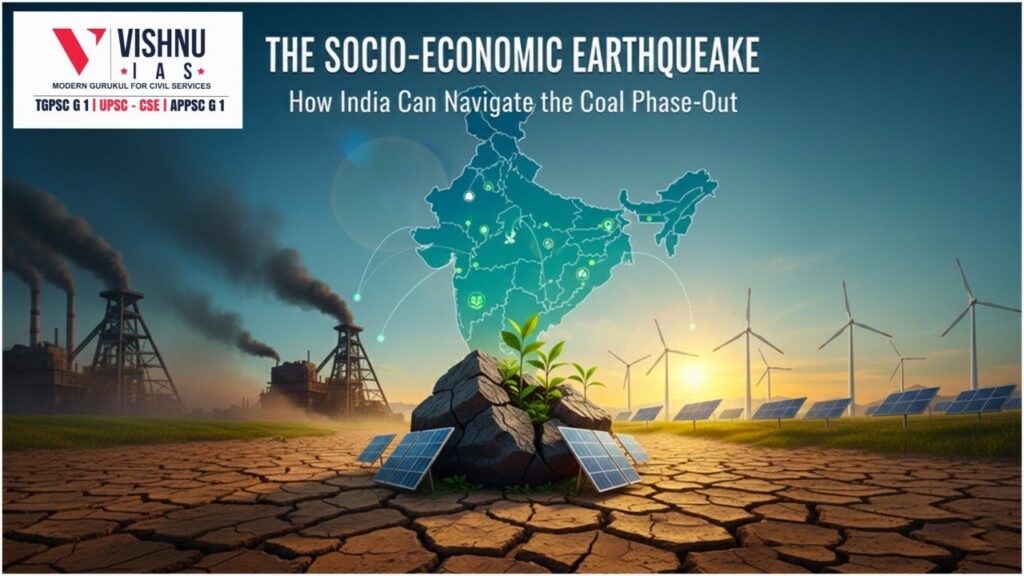
Socio-Economic Challenges in India’s Coal Phase-Out: A Critical Analysis & Measures for a Just Transition
The socio-economic challenges in India's coal phase-out are deeply intertwined with regional employment, energy security, state finances, and the pace of renewable energy adoption. A coal phase-out, in policy discourse, refers to a planned reduction and eventual elimination of coal-based power in favour of cleaner energy sources, undertaken while safeguarding social and economic stability. India’s challenge is acute because coal currently accounts for over 70 percent of electricity generation and remains integral to energy security, industrial growth, and employment in several regions.
Yet, continued coal dependence risks worsening air pollution, health burdens, and long-term climate-induced GDP losses estimated at 3–10 percent by 2100. This creates a complex socio-economic dilemma where both accelerated transition and delayed transition carry significant costs. A critical analysis must therefore balance national development needs with the imperatives of sustainability and justice.
1. Structural and Regional Socio-Economic Dependencies on Coal
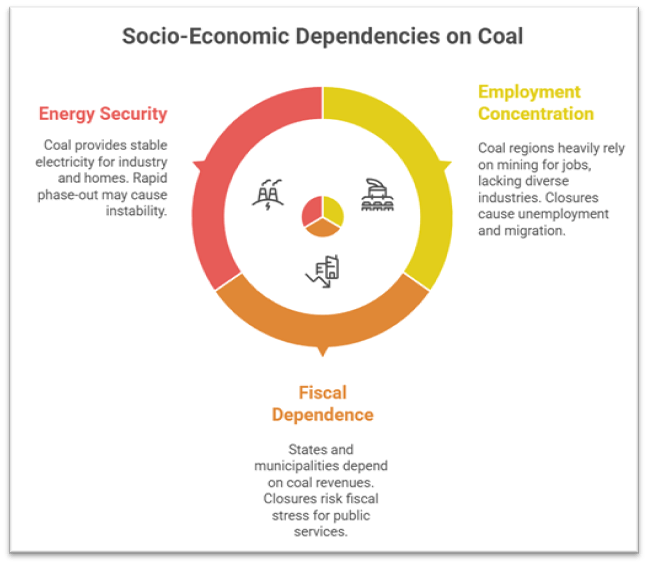
a. Employment and Livelihood Concentration in Coal Regions
- Coal-bearing districts in Jharkhand, Chhattisgarh, Odisha, and West Bengal exhibit high dependence on mining for direct and indirect employment, with limited alternative industries. Sudden closures can trigger unemployment spikes, distress migration, and disruption of local economies.
- The presence of single-industry economies, similar to the challenges observed in Jharia coalfields or Korba industrial belt, heightens social risk as households lack diversified income sources.
- Government schemes such as the District Mineral Foundation (DMF) aim to channel mining revenues toward welfare, but coverage gaps and under-utilisation persist, limiting their ability to cushion job losses during a phase-down.
b. Fiscal Dependence of States and Local Bodies
- States like Jharkhand and Chhattisgarh derive a significant share of revenues from royalties, cess, and taxes on coal; municipalities depend on ancillary revenues from coal-linked commerce.
- Experience from Singareni Collieries belt shows how public utilities, transport services, and local contractors rely on the mining ecosystem, risking fiscal stress if closures are unplanned.
- While mechanisms such as the GST compensation regime and Viability Gap Funding (VGF) exist to offset shocks, no dedicated fiscal transition framework currently supports coal-dependent states.
c. Energy Security and Low-Cost Power Imperatives
- Coal continues to provide stable baseload electricity, critical for manufacturing, urbanization, and rural electrification. Rapid phase-out without firm renewable alternatives may induce supply instability.
- Thermal plants in States like Madhya Pradesh and Uttar Pradesh supply affordable power to DISCOMs already burdened with debt, making renewable integration financially complex.
- Initiatives such as UDAY and the Revamped Distribution Sector Scheme (RDSS) attempt to strengthen distribution and renewable procurement, but slow structural reforms impede large-scale coal displacement.
2. Constraints in Renewable Energy Adoption and Transition Readiness
a. Variability, Grid Constraints, and Storage Gaps
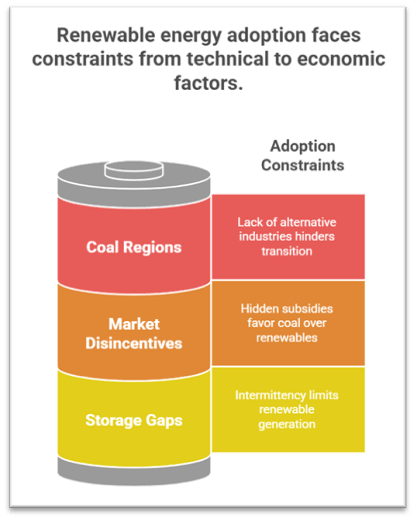
- Renewable generation shares in installed capacity have grown to nearly half, but actual generation lags due to intermittency and inadequate battery storage, pumped hydro capacity, and transmission corridors.
- The challenge mirrors global experiences, such as South Africa’s grid instability during rapid transition, demonstrating that coal cannot be withdrawn without firm alternatives.
- Government initiatives like Green Energy Corridors, National Pumped Hydro Policy, and large-scale storage tenders aim to address this gap, but the roll-out remains slower than transition demands.
b. Financial and Market Disincentives
- Coal often appears economical due to hidden subsidies, long-term PPAs, and low external cost accounting. Renewables face hurdles such as curtailment, payment delays, and land acquisition.
- Case studies from Rajasthan and Tamil Nadu show high curtailment rates for wind and solar when grids lack flexibility, discouraging private investment.
- Reforms including Time-of-Day tariffs, carbon pricing proposals, Renewable Purchase Obligations (RPOs), and market-based economic dispatch are steps forward but not yet comprehensive.
c. Limited Economic Diversification in Coal Regions
- Unlike countries that began transition after building alternative industries, Indian coal belts have low penetration of manufacturing, services, or modern agriculture.
- Regions such as Dhanbad or Talcher face skill deficits and infrastructure gaps, preventing seamless absorption of displaced workers.
- Government efforts such as Aspirational Districts Programme, PM-Kaushal Vikas Yojana, and PM-Gati Shakti can aid diversification, but require targeted alignment with coal-transition objectives.
3. Social and Environmental Externalities Shaping a Just Transition
a. Health Burdens and Environmental Inequities
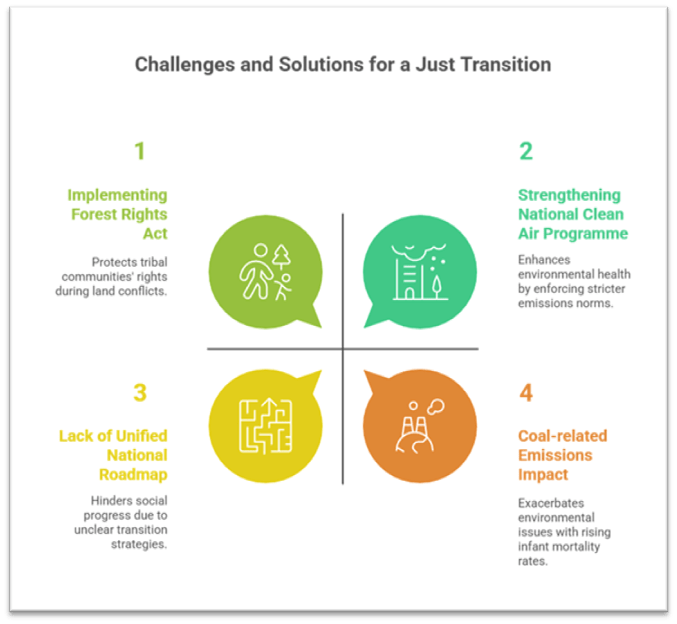
- Coal-related emissions contribute to elevated respiratory diseases, premature mortality, and degraded local ecosystems; one study correlates an additional 1 GW of coal capacity with a significant rise in infant mortality around plant areas.
- Areas such as Singrauli or Chandrapur exemplify cumulative impacts on tribal communities, farmers, and informal workers who bear disproportionate costs.
- Strengthening National Clean Air Programme targets and enforcing emissions norms for old plants can prevent further externalisation of health costs during transition.
b. Displacement, Land Conflicts, and Social Vulnerability
- Mine expansions and closures both trigger resettlement challenges, often affecting tribal populations under protective laws.
- Experiences in Hasdeo Arand underline how land, forest rights, and cultural identities complicate coal transition choices.
- Programmes like Forest Rights Act implementation, better compensation frameworks, and community-led rehabilitation models are vital to maintain social legitimacy.
c. Gaps in Institutional Structures for a Just Transition
- India lacks a unified national roadmap with clear timelines for phased retirements, social protection architecture, and retraining systems.
- International examples such as Chile’s coal phase-out or Germany’s Coal Commission show how robust transition funds, social dialogue, and regional development pacts enable smoother change.
- India’s proposals for a Green Energy Transition India Fund and use of DMF funds for diversification are positive but require statutory backing and transparent governance.
Conclusion:
India’s coal phase-out is not merely an energy transition but a multi-sector socio-economic transformation whose risks, if unmitigated, can deepen regional inequalities, destabilise livelihoods, and weaken public finances. Yet, failure to transition carries far higher long-term costs through health impacts, rising temperatures, and projected GDP losses approaching double-digit proportions by the century’s end.
A just and orderly transition therefore requires a time-bound coal exit roadmap, integrating renewable energy expansion, firm storage capacity, market reforms, reskilling programmes, diversified regional development, and dedicated financial support for coal-dependent States. With coordinated planning and equitable burden-sharing, India can simultaneously strengthen its climate commitments and secure a resilient economic future.
Recap: