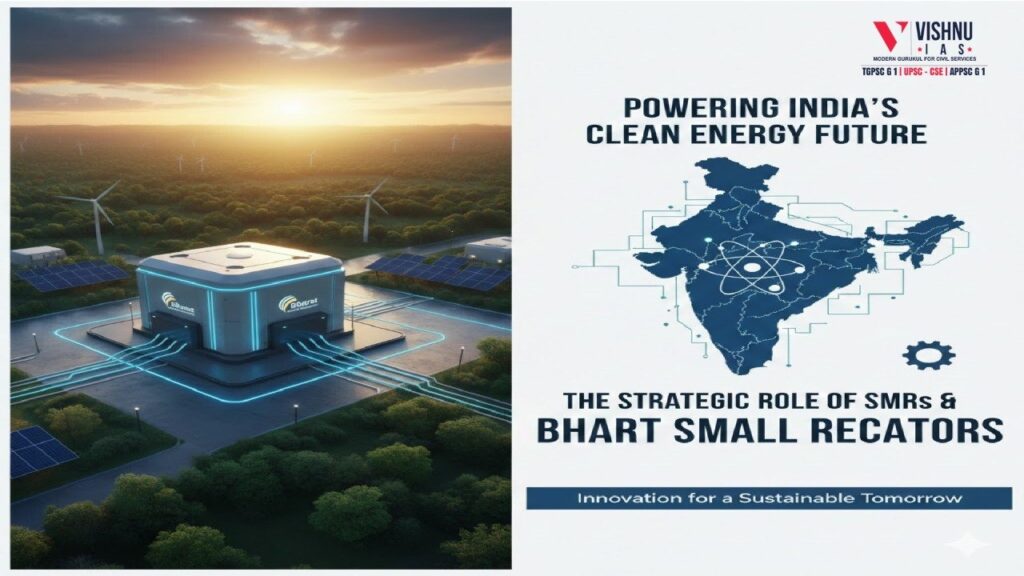
Small Modular Reactors (SMRs) and Bharat Small Reactors (BSRs): Strategic Role in India’s Clean Energy Transition
Small Modular Reactors in India are emerging as a critical pillar of the country’s clean energy transition, offering reliable, low-carbon baseload power while enabling decentralised and regionally balanced development.
Introduction
Human development has historically moved in lockstep with rising per capita energy consumption, a relationship first systematised by Earl Cook and now empirically captured through the Human Development Index (HDI), which integrates income, education and health outcomes. For countries aspiring to cross the high human development threshold of 0.9, energy availability must be not only abundant but also reliable, affordable and clean.
In India’s case, projections indicate that achieving such development levels in a digitalised economy would require a many-fold expansion of energy generation, alongside deep decarbonisation and large-scale electrification of end uses. Against this backdrop, Small Modular Reactors (SMRs) and the indigenously conceptualised Bharat Small Reactors (BSRs) assume strategic importance as scalable, low-carbon, baseload energy solutions that can complement renewables while supporting decentralised growth.
Their relevance is further amplified by recent legislative reforms that seek to modernise India’s nuclear governance framework.
I. Strategic Significance of SMRs and BSRs in India’s Clean Energy Transition
1. Enabling low-carbon baseload power in a renewable-heavy grid
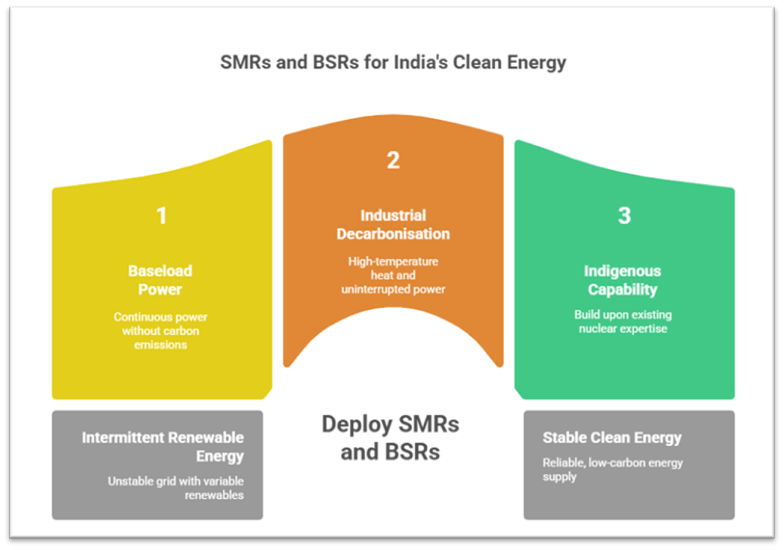
As India’s energy mix shifts away from fossil fuels, the intermittency of solar and wind creates a structural need for non-seasonal baseload generation; SMRs and BSRs provide continuous power without carbon emissions, stabilising grids increasingly dominated by variable renewables.
Example – Renewable–Nuclear Complementarity: Regions with high solar penetration, such as western India, face evening peak deficits; small reactors located near load centres can smooth supply without large-scale storage costs.
Government initiatives promoting green hydrogen, electrified transport and industrial decarbonisation further increase round-the-clock electricity demand, which SMRs can reliably support.
2. Supporting industrial decarbonisation and energy-intensive sectors
Hard-to-abate sectors such as steel, fertilisers, cement and petrochemicals require high-temperature heat and uninterrupted power, which SMRs can deliver either directly or via electricity and hydrogen.
Case Study – Fertiliser and Steel Clusters: Locating BSRs near fertiliser plants or steel hubs can reduce dependence on coal and natural gas, cutting lifecycle emissions while ensuring energy security.
This aligns with national missions aimed at reducing industrial emissions while preserving competitiveness and employment.
3. Advancing indigenous capability and strategic autonomy
BSRs build upon India’s long-standing expertise in Pressurised Heavy Water Reactor (PHWR) technology, fuel fabrication, heavy water production and reactor design, ensuring minimal external dependence.
Example – Indigenous PHWR Programme: The successful deployment of multiple 700 MW PHWR units demonstrates India’s ability to design, construct and operate nuclear systems safely at scale.
Smaller reactor formats allow faster learning curves, modular manufacturing and wider participation of Indian industry, reinforcing technological sovereignty.
II. Decentralisation Potential of SMRs and BSRs
1. Distributed energy for regional and local development
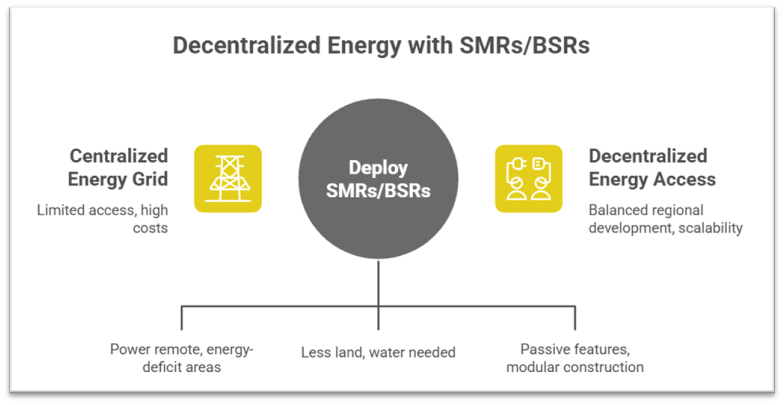
Unlike large nuclear plants that require extensive exclusion zones and coastal or riverine siting, SMRs and BSRs can be deployed closer to tier-2 cities, industrial corridors and remote regions.
Example – Remote and Energy-Deficit Areas: Small reactors can power regions with weak grid connectivity, reducing reliance on diesel generation and long transmission lines.
This supports balanced regional development, a long-standing objective of Indian planning.
2. Reduced land, water and infrastructure footprint
SMRs and BSRs require significantly less land and cooling water compared to conventional large reactors, making them suitable for densely populated or water-stressed regions.
Case Study – Inland Nuclear Deployment: Smaller reactors enable inland siting without the ecological and social costs associated with mega-projects.
This feature complements India’s constraints on land acquisition and environmental clearances.
3. Enhanced safety, scalability and phased capacity addition
Passive safety features, lower core inventories and modular construction reduce accident risks and financial exposure.
Example – Modular Rollout Strategy: Capacity can be added incrementally in response to demand growth, avoiding overcapacity and stranded assets.
Such scalability aligns with India’s gradual but sustained increase in electricity demand driven by digitalisation and electrification.
III. Legislative Framework Enabling Decentralised Nuclear Deployment
1. Consolidation and modernisation of nuclear governance
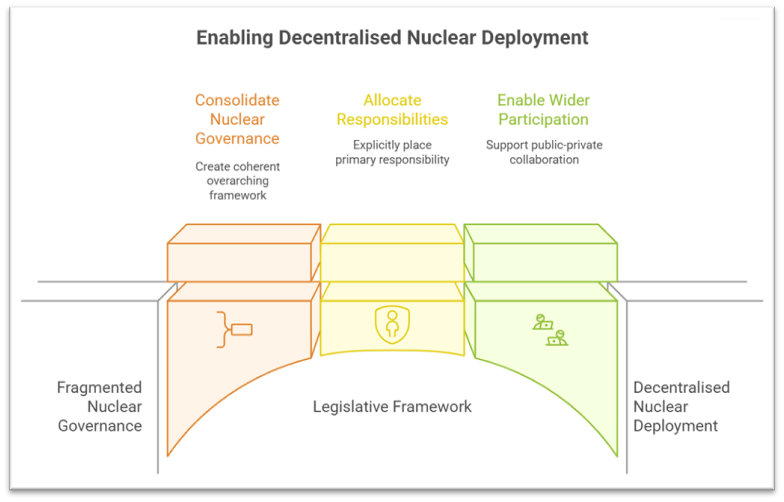
Recent legislative reforms integrate previously fragmented provisions governing atomic energy development, regulation and liability into a coherent overarching framework.
By formally recognising the existing nuclear regulator within the new legal architecture, the framework strengthens regulatory certainty and institutional continuity.
This clarity is essential for deploying multiple small reactors across diverse locations.
2. Clear allocation of safety, security and liability responsibilities
The framework explicitly places primary responsibility for safety, security and safeguards on the licensee, aligning with global best practices.
Example – Liability Rationalisation: Streamlined liability norms reduce ambiguity for operators and suppliers, encouraging private sector participation without diluting safety.
This is particularly relevant for SMRs and BSRs, where decentralised deployment involves multiple operators and sites.
3. Opening pathways for wider participation and innovation
By enabling collaboration between public sector entities and Indian industry, the legislation supports manufacturing, construction and operation of small reactors at scale.
Case Study – Public–Private Synergy: Indian heavy engineering firms and technology suppliers can participate in reactor components and balance-of-plant systems.
This aligns with broader national initiatives on manufacturing self-reliance and clean energy innovation.
Conclusion
India’s aspiration to become a high human development, low-carbon economy demands energy solutions that are clean, reliable, scalable and socially acceptable. Small Modular Reactors and Bharat Small Reactors emerge as strategically significant instruments in this transition by addressing the twin challenges of deep decarbonisation and rising electricity demand in a densely populated, resource-constrained context.
Supported by a modernised legislative framework that clarifies regulation, safety and liability while enabling decentralised deployment, these technologies can complement renewables, underpin industrial transformation and strengthen energy security. Going forward, sustained investment in indigenous technology, regulatory capacity-building and public engagement—alongside continued improvements in energy efficiency—will be critical to realising the full potential of small reactors as pillars of India’s clean energy future.
Recap: