Shift from Fortress Conservation to Community-Centered Approach in India’s Tiger Conservation
Introduction
Tiger conservation in India has gradually evolved from a “fortress conservation model”—which prioritised creating inviolate spaces by excluding human presence—to a community-centered approach that recognises the rights and participation of forest-dwelling communities in protecting biodiversity. With India hosting over 70% of the world’s tigers (3,682 as per the 2022 All India Tiger Estimation Report) and nearly 200 million people dependent on forests, reconciling ecological preservation with social justice has become a central challenge. The shift represents an attempt to balance the objectives of the Wildlife (Protection) Act, 1972, Forest Rights Act (FRA), 2006, and global commitments under SDG 15 (Life on Land) through a model of participatory and inclusive conservation.
I. Evolution of Conservation Paradigm in India
From Fortress Conservation to Coexistence
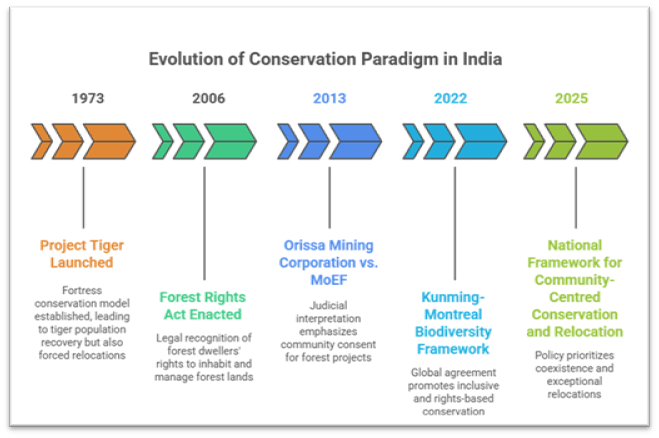
- The Project Tiger (1973) adopted a fortress model—establishing core zones free of human interference. While it helped tiger populations recover from below 1,800 in the 1970s, it often led to forced relocations of tribal communities, causing socio-economic dislocation.
- The Forest Rights Act (2006) marked a paradigm shift, legally recognising the rights of forest dwellers to inhabit and manage forest lands, aligning conservation with social justice.
- Recent frameworks such as the National Framework for Community-Centred Conservation and Relocation (2025) reaffirm that relocations should be exceptional, not routine, emphasizing coexistence instead of exclusion.
Legal and Institutional Realignments
- The Union Ministry of Tribal Affairs now plays a larger role alongside the Ministry of Environment, Forest and Climate Change (MoEFCC), ensuring that conservation policies align with rights-based governance.
- Judicial interpretations of the FRA, such as in Orissa Mining Corporation vs. Ministry of Environment (2013), underscored that community consent is vital for forest projects, embedding participatory governance into conservation law.
- Integration of provisions from the SC/ST (Prevention of Atrocities) Act against unlawful evictions strengthens the accountability mechanism in conservation enforcement.
Changing Global and Domestic Imperatives
- India’s updated policy aligns with global conservation trends promoted by the Convention on Biological Diversity (CBD) and the Kunming-Montreal Global Biodiversity Framework (2022), which emphasise “inclusive and rights-based conservation.”
- The growing importance of climate forests under carbon sequestration frameworks has redefined forest value beyond biodiversity, necessitating a broader, multi-stakeholder approach.
- Recognition that traditional communities act as effective stewards of biodiversity supports the transition toward sustainable, participatory conservation.
II. Impacts on Forest-Dwelling Communities
Securing Tenure and Livelihoods
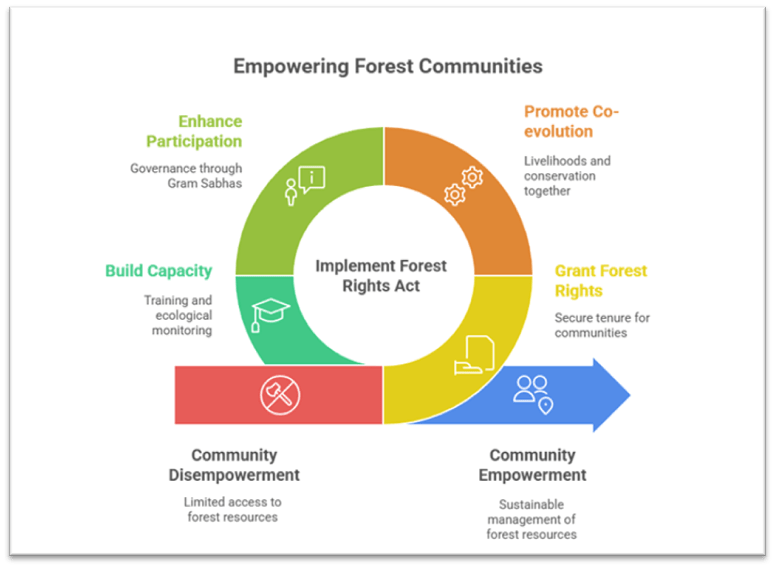
- The FRA has granted individual and community forest rights to over 4.5 million people, allowing them to sustainably manage and access forest resources.
- Models like Joint Forest Management (JFM) in Madhya Pradesh and Van Dhan Yojana under TRIFED have shown how livelihoods and conservation can co-evolve.
- Sustainable cohabitation frameworks now promote eco-tourism, non-timber forest produce (NTFP) value chains, and biodiversity stewardship programs, ensuring both ecological and economic resilience.
Social Empowerment and Institutional Inclusion
- Community participation in governance through Gram Sabhas has enhanced transparency and local ownership of conservation outcomes.
- Examples like Mendha-Lekha village (Gadchiroli, Maharashtra) demonstrate how self-governed forest communities can protect biodiversity while earning revenue from forest produce.
- The policy’s emphasis on redress mechanisms and local-level grievance systems enhances social justice and mitigates past instances of displacement and marginalisation.
Challenges of Integration and Capacity
- Despite the progressive shift, implementation gaps persist—States differ in applying FRA provisions, and relocation pressures remain in tiger reserves such as Kanha and Nagarhole.
- Many tribal regions lack access to education, healthcare, and basic infrastructure, making coexistence models complex.
- Building institutional capacity for scientifically managed coexistence, backed by training and local ecological monitoring, remains a major challenge.
III. Implications for Tiger Habitats and Conservation Outcomes
Balancing Ecological Integrity with Human Presence
- Core zones remain vital for breeding and survival of tigers; studies by the Wildlife Institute of India show that human-free habitats increase prey density and tiger occupancy.
- Yet, coexistence zones with controlled resource use—such as Buffer Zone Management in Satpura Tiger Reserve—illustrate that humans and tigers can sustainably share landscapes.
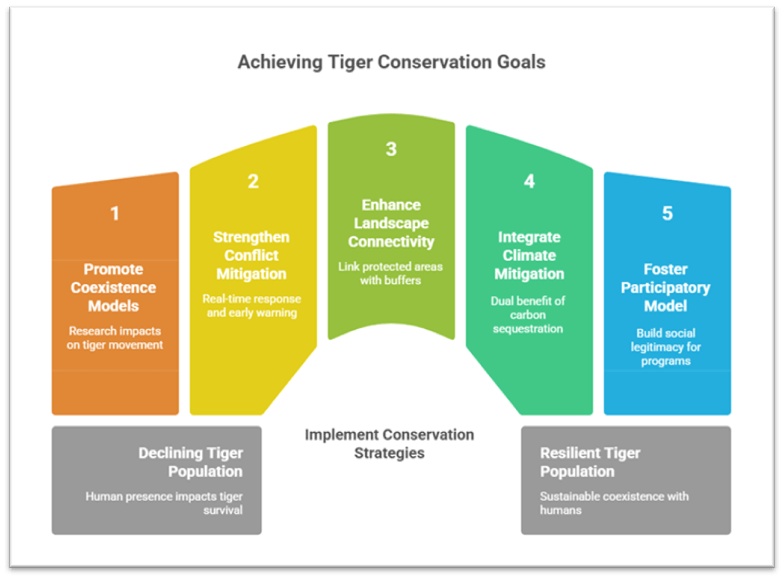
- The policy now promotes pilot research projects on coexistence models, using scientific monitoring to assess impacts on tiger movement, prey base, and human conflict.
Addressing Human–Wildlife Conflict
- Conflict mitigation measures, such as the Compensatory Afforestation Fund Management and Planning Authority (CAMPA) and Project Tiger’s Conflict Management Protocol (2018), are being strengthened with real-time response systems.
- Use of early warning technologies, solar fencing, and insurance schemes for crop and livestock losses in reserves like Sundarbans and Corbett have reduced human fatalities and retaliation killings.
- A national mission for Community-Based Human–Tiger Interface Management could standardise best practices and provide scientific oversight.
Towards Resilient and Inclusive Conservation
- Landscape-level conservation initiatives, such as the Tiger Corridors Connectivity Plan (NTCA, 2023), seek to link protected areas through community-managed buffers, enhancing genetic diversity and habitat resilience.
- Integrating climate mitigation goals with biodiversity management ensures a dual benefit of carbon sequestration and species protection.
- The participatory model not only fosters long-term sustainability but also builds social legitimacy—a critical factor for the durability of conservation programs.
Conclusion:
The transition from fortress conservation to a community-centered model marks a defining moment in India’s environmental governance—one that merges ecological integrity with human dignity. While the protection of tiger populations demands scientific rigor and inviolate core zones, equitable participation of forest dwellers ensures legitimacy and continuity. Going forward, India must strengthen local ecological institutions, expand community-based monitoring, and promote evidence-driven coexistence frameworks. With the latest estimation showing a 6% rise in tiger numbers (2018–2022) and enhanced forest cover under ISFR 2023, a balanced, rights-based, and science-backed conservation pathway can secure both India’s biodiversity heritage and the livelihoods of millions who live within it.
Recap: