
Security Through Sustainability: How the SAGAR Doctrine Anchors India’s Maritime Strategy in the Indian Ocean
Security through sustainability marks a significant evolution in India’s maritime thinking, moving beyond traditional notions of naval dominance and sea-lane control to a holistic framework that views the ocean as an ecological, economic, and social system. This shift is particularly relevant in the Indian Ocean Region (IOR), which supports nearly one-third of the global population, carries over 80% of global seaborne trade by volume, and includes some of the world’s most climate-vulnerable coastal and island states.
Introduction
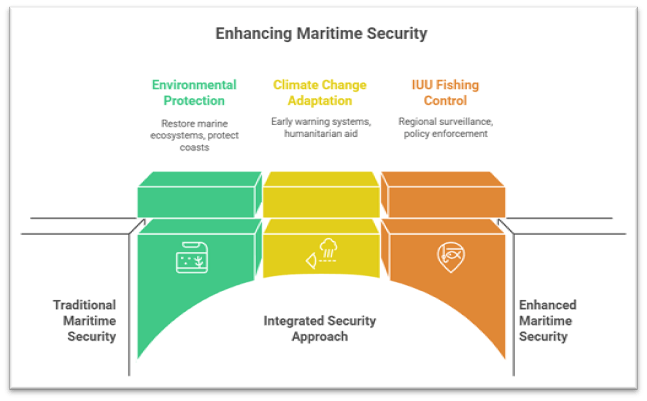
India’s maritime approach is undergoing a calibrated transition from a narrow focus on naval power, sea-lane control and balance of forces towards “security through sustainability”, a framework that recognises the ocean as an ecological, economic and social system rather than merely a strategic space.
With the Indian Ocean Region (IOR) supporting nearly one-third of the global population, accounting for over 80% of global seaborne trade by volume, and hosting some of the world’s most climate-vulnerable coastal and island states, traditional security paradigms alone are proving insufficient. Rising sea surface temperatures, ocean acidification, Illegal, Unreported and Unregulated (IUU) fishing, and intensifying extreme weather events are now direct drivers of instability, livelihood loss and humanitarian crises.
In this context, India’s SAGAR (Security and Growth for All in the Region) doctrine provides a normative and operational anchor for integrating environmental stewardship, economic resilience and cooperative security into a holistic maritime strategy aligned with contemporary global ocean governance imperatives.
I. Rationale for the Shift: Limits of Traditional Maritime Security
1. Environmental degradation as a non-traditional security threat
Marine ecosystem collapse now directly undermines human security, as coral reef bleaching, mangrove loss and declining fish stocks weaken coastal livelihoods, particularly in the IOR where a significant share of the population depends on artisanal fisheries.
Example / Case Study: Repeated coral bleaching episodes in the Lakshadweep and Maldives have reduced reef-based fisheries, increasing economic vulnerability and dependence on external assistance.
Government Initiative: India’s National Coastal Mission integrates coastal protection, mangrove restoration and climate adaptation, recognising ecological stability as foundational to long-term security.
2. Climate change amplifying instability and disaster risk
Rising sea levels and intensifying cyclones transform the ocean into a source of chronic insecurity, overwhelming small island and low-lying coastal states and stretching humanitarian response capacities.
Example / Case Study: India’s rapid humanitarian assistance to Mozambique and Madagascar after cyclones under Mission SAGAR illustrated how climate shocks can quickly become regional security challenges.
Institutional Mechanism: INCOIS and IMD-led early warning systems, extended to IOR partners, demonstrate how climate science is now integral to maritime security cooperation.
3. IUU fishing and resource competition as conflict multipliers
Depletion of shared fish stocks increases inter-state tensions and fuels maritime crime, especially in poorly governed waters of the western Indian Ocean.
Example / Case Study: Somali Basin piracy initially emerged from grievances linked to illegal fishing and environmental exploitation.
Policy Response: India’s participation in regional maritime domain awareness initiatives, including white shipping agreements and IFC-IOR, reframes surveillance as both ecological and security governance.
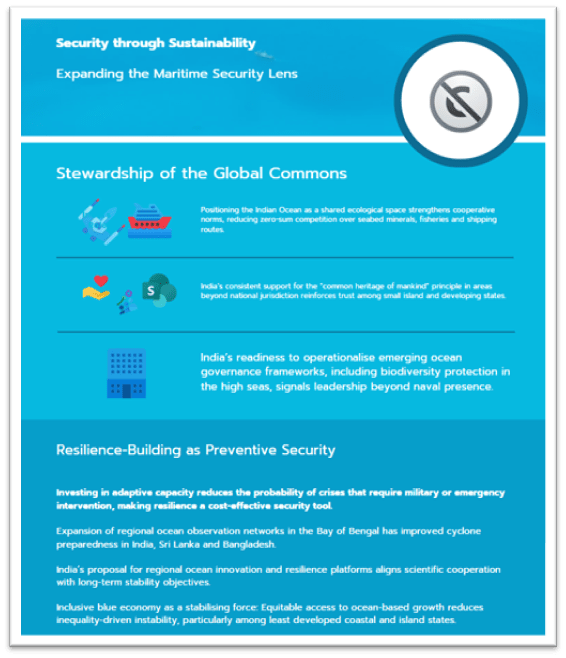
II. Security through Sustainability: Expanding the Maritime Security Lens
1. Stewardship of the global commons
Positioning the Indian Ocean as a shared ecological space strengthens cooperative norms, reducing zero-sum competition over seabed minerals, fisheries and shipping routes.
Example / Case Study: India’s consistent support for the “common heritage of mankind” principle in areas beyond national jurisdiction reinforces trust among small island and developing states.
Global Engagement: India’s readiness to operationalise emerging ocean governance frameworks, including biodiversity protection in the high seas, signals leadership beyond naval presence.
2. Resilience-building as a preventive security strategy
Investing in adaptive capacity reduces the probability of crises that require military or emergency intervention, making resilience a cost-effective security tool.
Example / Case Study: Expansion of regional ocean observation networks in the Bay of Bengal has improved cyclone preparedness in India, Sri Lanka and Bangladesh.
Institutional Support: India’s proposal for regional ocean innovation and resilience platforms aligns scientific cooperation with long-term stability objectives.
3. Inclusive blue economy as a stabilising force
Equitable access to ocean-based growth reduces inequality-driven instability, particularly among least developed coastal and island states.
Example / Case Study: Sustainable aquaculture and marine biotechnology initiatives under India’s Blue Economy framework illustrate growth pathways compatible with ecological limits.
Domestic Anchor: Pradhan Mantri Matsya Sampada Yojana (PMMSY) links fisheries modernisation with sustainability, reinforcing the livelihood–security nexus.
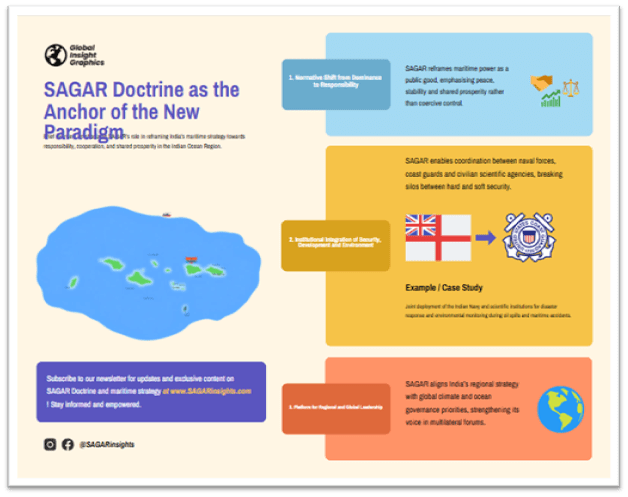
III. SAGAR Doctrine as the Anchor of the New Paradigm
1. Normative shift from dominance to responsibility
SAGAR reframes maritime power as a public good, emphasising peace, stability and shared prosperity rather than coercive control.
Example / Case Study: India’s non-reciprocal capacity-building assistance to Indian Ocean island states in hydrography and coastal surveillance under SAGAR principles.
Strategic Value: This approach enhances India’s credibility as a benign and trusted partner, countering perceptions of hegemonic intent.
2. Institutional integration of security, development and environment
SAGAR enables coordination between naval forces, coast guards and civilian scientific agencies, breaking silos between hard and soft security.
Example / Case Study: Joint deployment of the Indian Navy and scientific institutions for disaster response and environmental monitoring during oil spills and maritime accidents.
Operational Framework: The Indo-Pacific Oceans Initiative (IPOI) complements SAGAR by structurally embedding sustainability and capacity-building into maritime cooperation.
3. Platform for regional and global leadership
SAGAR aligns India’s regional strategy with global climate and ocean governance priorities, strengthening its voice in multilateral forums.
Example / Case Study: India’s leadership role in shaping inclusive narratives around ocean finance and technology transfer for developing states.
Forward Linkage: SAGAR provides strategic coherence to India’s engagement with emerging ocean-related agreements and its chairmanship roles in regional organisations.
Conclusion:
The shift from traditional maritime security to security through sustainability reflects a pragmatic recognition that environmental degradation, climate change and livelihood insecurity are now among the most potent drivers of instability in the Indian Ocean Region.
By embedding ecological stewardship, resilience-building and inclusive growth into its maritime strategy, India aligns its national interests with regional well-being. The SAGAR doctrine offers a durable anchor for this transition, translating ethical responsibility into operational cooperation and strategic trust.
As global ocean finance gains momentum and new governance frameworks mature, India’s challenge lies in converting vision into implementation—mobilising finance, deepening regional partnerships and institutionalising sustainability-led security. If pursued with consistency and inclusivity, this paradigm can ensure that the Indian Ocean evolves not into a zone of rivalry, but into a shared space of stability, resilience and equitable prosperity.
Recap: