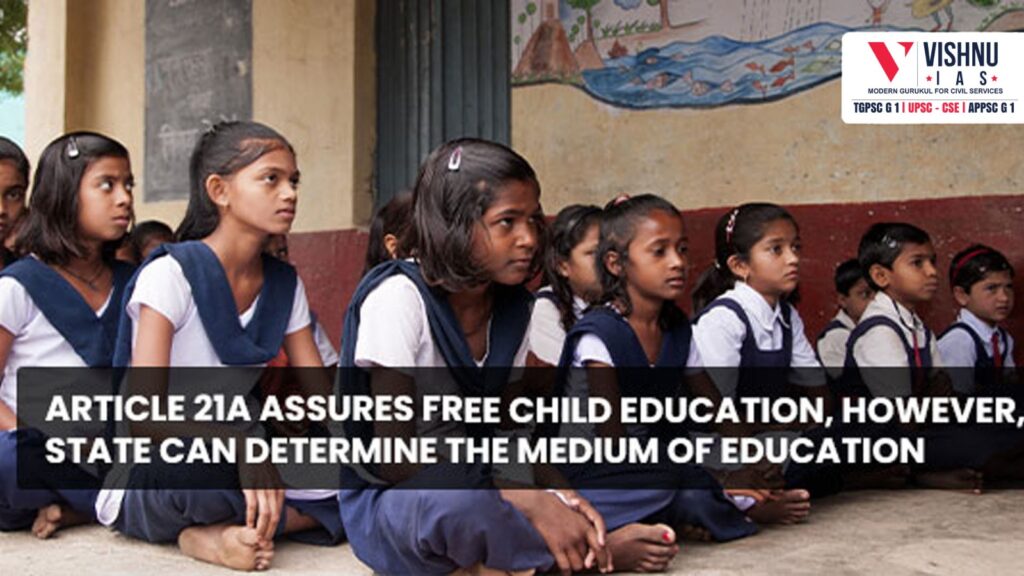
• However, despite the constitutional mandate, the real cost of schooling borne by households continues to rise, driven by increasing dependence on private schools and the growing culture of private tuition. Recent national surveys reveal that nearly half of urban school-going children and one-fourth of rural children are enrolled in private institutions, where annual fees and coaching expenses often match the monthly consumption expenditure of low-income households.
• This widening gap between constitutional promises and economic realities poses a significant threat to the principle of basic and universal education.
I. Rising Educational Expenditure and Its Implications on Universal Access
1. High Private School Fees Restrict Access to Basic Schooling
- Private schooling costs have increased steadily across levels, with annual expenditures in many urban centres crossing amounts equivalent to lower decile household incomes, making even basic schooling inaccessible for poorer families.
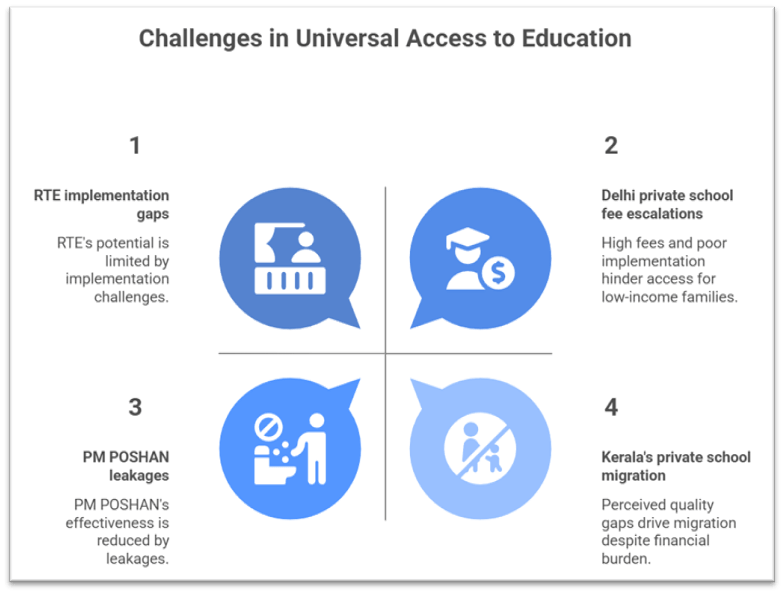
- EXAMPLE: Delhi private school fee escalations prompted regulatory interventions because many low-income families were forced to withdraw children, reflecting affordability barriers.
- SCHEME/INITIATIVE: Right of Children to Free and Compulsory Education Act (RTE), Section 12(1)(c) mandates 25 percent reservation in private schools for disadvantaged groups, but implementation gaps limit its equalising potential.
2. Rising Share of Private School Enrolment Reduces Reliance on Public Schooling
- Declining confidence in government schools, especially in urban areas where private enrolment exceeds 50 percent, leads to an increasing financial burden on households for what is constitutionally guaranteed to be free.
- CASE STUDY: Kerala, despite strong public schooling, has seen gradual migration to certain private schools in urban pockets due to perceived quality gaps, illustrating national trends.
- SCHEME/INITIATIVE: Samagra Shiksha Abhiyan attempts to integrate school improvement initiatives from pre-primary to senior secondary levels, yet uneven outcomes persist.
3. Government School Fees Persist Despite “Free Education”
- Survey findings indicate that 25–35 percent of students in government schools still report paying course fees, contradicting the promised free education norm.
- EXAMPLE: Instances of informal charges for examinations, maintenance, or uniforms in government schools in states like Uttar Pradesh and Bihar disproportionately burden economically weaker families.
- SCHEME/INITIATIVE: PM POSHAN, free textbook schemes, and uniform assistance programmes aim to minimise household expenditure, but leakages and inconsistencies remain challenges.
II. Burgeoning Private Coaching Culture and Its Impact on Equality in Education
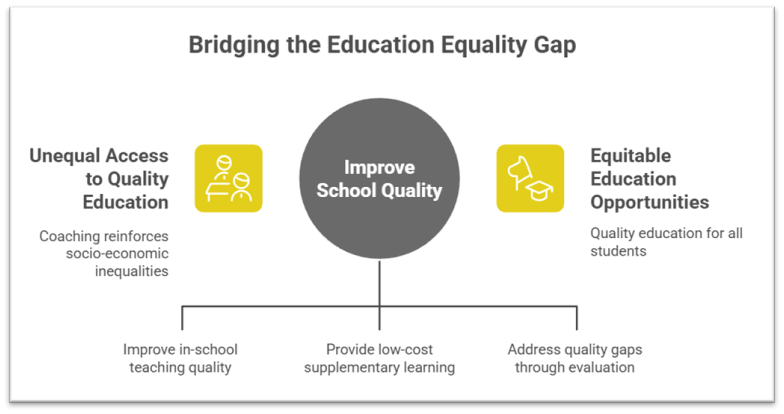
1. Growing Dependence on Coaching Reinforces Socio-Economic Inequalities
- More than one-fourth of schoolchildren now rely on private tuition; the proportion rises to above 40 percent at secondary levels in urban areas, creating a parallel schooling industry.
- EXAMPLE: Kota and Hyderabad’s coaching ecosystems show how academic competition pushes families into high expenditure cycles that poorer students cannot afford.
- SCHEME/INITIATIVE: National Initiative for School Heads and Teachers for Holistic Advancement (NISHTHA) aims to improve in-school teaching quality, attempting to reduce reliance on tuition.
2. Coaching Costs Exceed School Fees in Many Cases
- Tuition fees in higher secondary classes in urban centres often exceed annual school fees, making quality education a function of purchasing power rather than constitutional entitlement.
- CASE STUDY: West Bengal household expenditure surveys show that private tuition accounts for the highest share of educational spending, even among middle-income families.
- SCHEME/INITIATIVE: Digital learning initiatives such as DIKSHA and PM e-Vidya seek to expand low-cost supplementary learning but lack universal device and connectivity access.
3. Private Tuition Becomes a Substitute for Poor School Quality
- Underpaid or untrained private school teachers often compel students to rely on coaching to fill learning gaps, creating a vicious cycle of expenditure.
- EXAMPLE: Studies in Rajasthan’s private schools found lower teacher qualifications and higher dependence on paid tutoring despite high school fees.
- SCHEME/INITIATIVE: Performance Grading Index (PGI) and School Quality Assessment and Accreditation Framework (SQAAF) aim to address quality gaps through systemic evaluation.
III. Systemic Consequences: Threats to the Idea of Basic and Universal Education
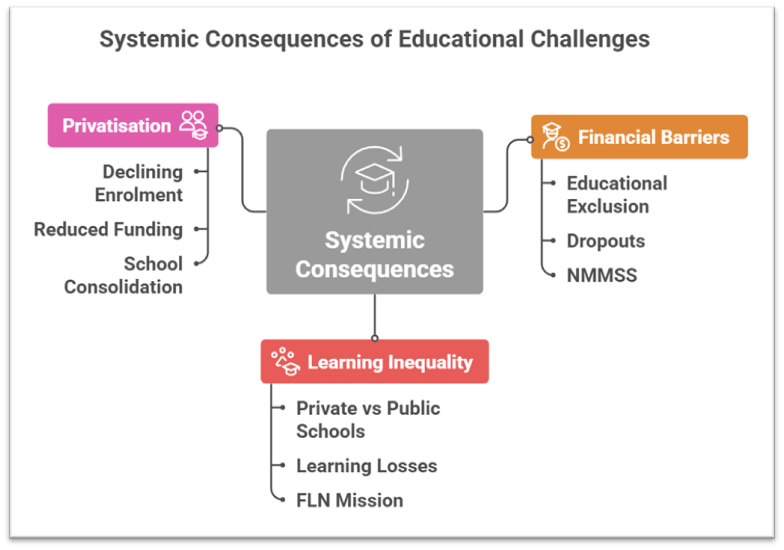
1. Financial Barriers Lead to Educational Exclusion and Dropouts
- Rising costs disproportionately affect the poorest households, often pushing students into intermittent schooling or complete dropouts, undermining the universalisation target under NEP 2020.
- EXAMPLE: Migration-affected households in cities like Mumbai and Gurugram often withdraw children temporarily due to unaffordable fees.
- SCHEME/INITIATIVE: National Means-cum-Merit Scholarship Scheme (NMMSS) offers financial support to prevent dropouts at Class 8–9 transition.
2. Widening Learning Inequality Contradicts the Spirit of Article 21A
- The wealthier strata secure better outcomes due to access to private schools and coaching, while poorer children depend on under-resourced public schools, widening learning disparities.
- CASE STUDY: Post-pandemic assessments across states showed learning losses were sharper among government school children due to lesser access to remote learning, reflecting institutional inequality.
- SCHEME/INITIATIVE: Foundational Literacy and Numeracy (FLN) Mission under NIPUN Bharat aims to ensure universal basic learning by Class 3 to narrow early learning gaps.
3. Growing Privatisation Undermines Public School System
- Declining enrolment weakens public schools through reduced funding and community engagement, making them less capable of fulfilling the constitutional mandate.
- EXAMPLE: In several states, multigrade-teaching government schools with low enrolment risk closure or merging, further reducing access in remote areas.
- SCHEME/INITIATIVE: School consolidation policies, infrastructure grants under Samagra Shiksha, and teacher rationalisation aim to revitalise government schools.
Conclusion:
• Rising household expenditure on education threatens the constitutional promise of free and universal education by creating financial, social, and institutional barriers that disproportionately affect disadvantaged groups. As private schooling and coaching become central to academic success, education risks shifting from a right guaranteed by the State to a commodity determined by household income.
• Achieving the NEP 2020 goal of universal schooling by 2030 requires urgent revitalisation of government schools through better funding, teacher training, performance monitoring mechanisms, and stronger equity-focused initiatives.
• Survey evidence consistently shows that as the quality of public schooling improves, reliance on private tuition and private schools declines. Strengthening public education, therefore, remains the single most important pathway to restoring the constitutional vision of equitable, inclusive, and accessible education for every child in India.
Recap: