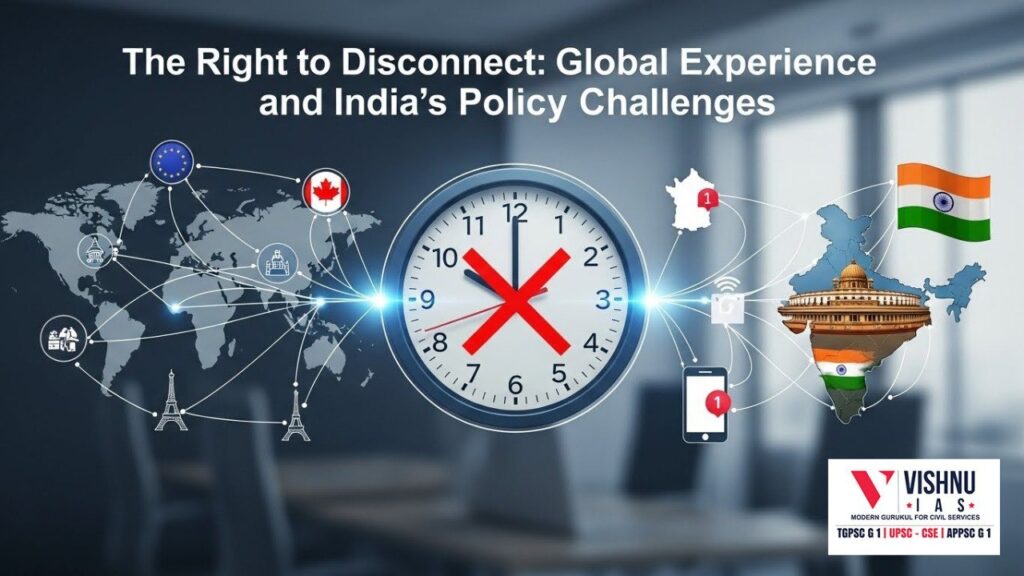
Right to Disconnect in India: Global Trends and Socio-Economic Challenges
The Right to Disconnect in India is gaining global attention as countries redefine work-life balance in the digital age. This article explores global trends and the socio-economic challenges India may face in implementing a Right to Disconnect law across its diverse and informal workforce.
The Right to Disconnect in India refers to a legally protected entitlement that allows employees to disengage from work-related digital communication beyond prescribed working hours without fear of adverse consequences. In the digital economy, where smartphones, instant messaging platforms and remote work have dissolved temporal boundaries, this right has emerged as a response to rising overwork, burnout and mental health distress.
Globally, extended working hours have been linked to declining productivity and rising non-communicable diseases, while in India, the situation is particularly acute due to a young workforce, weak collective bargaining and an expanding service-led economy.
Against this backdrop, the debate around legislating the right to disconnect is not merely about labour welfare but about public health, economic sustainability and the future of work.
1. Global Trends and Evolving Norms on the Right to Disconnect
Legislative recognition in advanced economies
- Several countries have formally embedded the right to disconnect within their labour frameworks, recognising that unregulated digital availability undermines worker well-being.
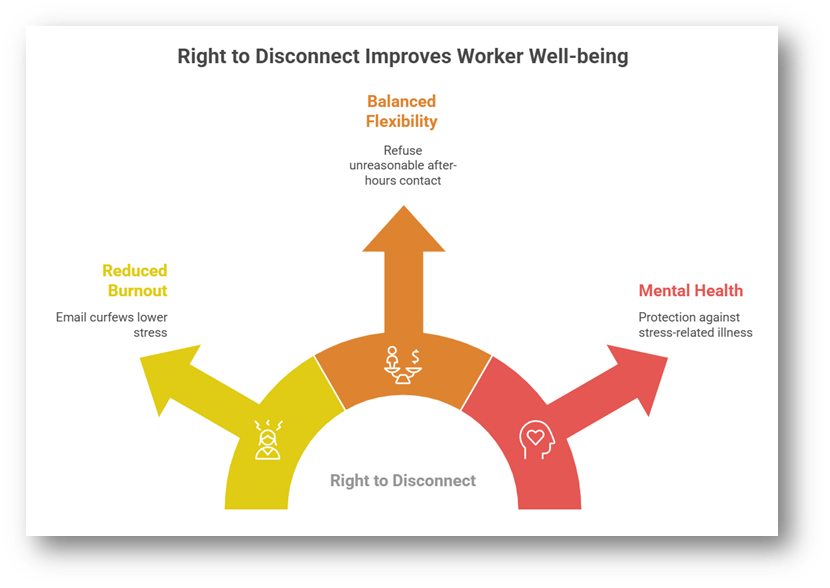
- Example – France: Mandated employer–employee negotiations on after-hours communication protocols, shifting focus from hours logged to output delivered.
- Example – Australia: Introduced enforceable protections allowing workers to refuse unreasonable after-hours contact, signalling a balance between flexibility and safeguards.
Shift from productivity measured by time to productivity measured by outcomes
- Global labour reforms increasingly challenge the culture of presenteeism, acknowledging that longer hours do not equate to higher efficiency.
- Case Study – European IT and consulting firms: Adoption of “email curfews” and delayed delivery systems reduced burnout while maintaining client responsiveness.
- These practices align with international labour standards promoting decent work and sustainable productivity.
Integration of mental health into occupational safety
- The right to disconnect is increasingly framed as part of workplace health and safety, not merely a communication rule.
- Example – Ireland and Portugal: Laws explicitly link digital disconnection with protection against stress-related illness, reinforcing employer responsibility.
- This reflects a global consensus that worker well-being is a prerequisite for long-term economic resilience.
2. Socio-Economic and Structural Hurdles in the Indian Context
Dominance of informality and contractual employment
- India’s workforce is overwhelmingly informal, with contractual, gig and freelance workers lacking stable hours or enforceable protections.
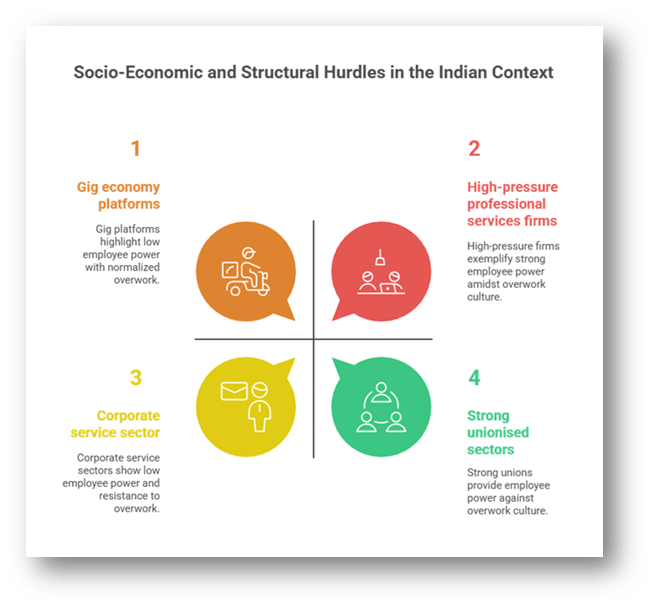
- Case Study – Gig economy platforms: Algorithm-driven incentives compel workers to remain perpetually available, blurring any notion of “after-hours.”
- A uniform right to disconnect risks exclusion unless definitions of “employee” are broadened beyond traditional factory or office workers.
Power asymmetry between employers and employees
- Weak unionisation and high unemployment create a fear-driven compliance culture, where refusal to respond after hours is perceived as career risk.
- Example – Corporate service sector: Late-night emails and weekend calls function as informal performance signals rather than operational necessities.
- This undermines the enforceability of rights unless backed by strong grievance redressal mechanisms.
Cultural valorisation of overwork and economic insecurity
- Long hours are often normalised as ambition or dedication, especially among young professionals seeking upward mobility.
- Case Study – High-pressure professional services firms: Instances of extreme stress and health collapse have exposed the human cost of unchecked workloads.
- In a developing economy context, workers may prioritise income security over well-being, complicating behavioural change.
3. Policy, Administrative and Economic Challenges in Implementation
Fragmented labour governance and federal complexity
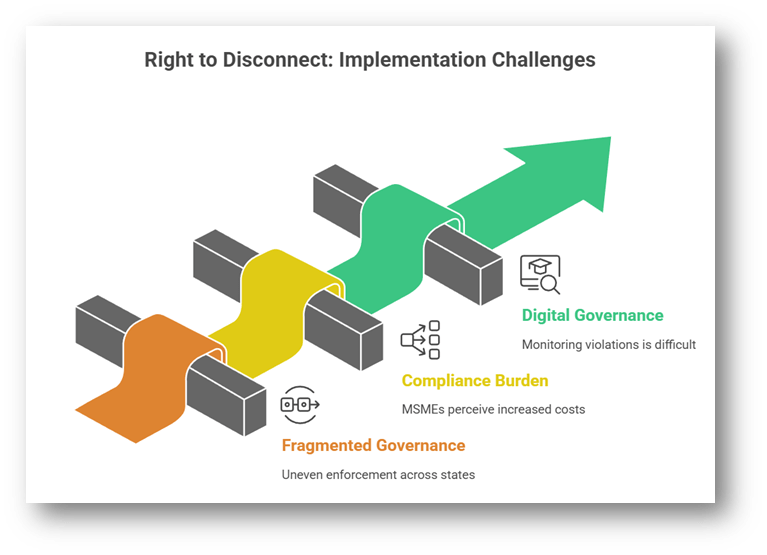
- Labour is a concurrent subject, and uneven State capacity can lead to inconsistent enforcement.
- Example – State-level initiatives: Progressive steps by some States highlight intent but also underline the need for a coherent national framework.
- Without central harmonisation, workers in less-regulated regions may remain unprotected.
Compliance burden on micro, small and medium enterprises (MSMEs)
- MSMEs, operating on thin margins, may perceive the right to disconnect as increasing costs or reducing flexibility.
- Government Initiative – Labour Codes consolidation: Aims to simplify compliance, but operational clarity on digital work norms remains limited.
- Balancing worker protection with enterprise viability is essential to avoid informalisation through evasion.
Digital governance and enforcement challenges
- Monitoring violations in a remote, platform-based work environment is inherently difficult.
- Example – App-based work systems: Automated task allocation can bypass human accountability, diluting legal responsibility.
- Effective enforcement will require technological audits, awareness campaigns and institutional capacity-building.
Conclusion:
The global movement towards the Right to Disconnect reflects a growing recognition that economic growth cannot be sustained on the back of exhausted workers. For India, adopting a uniform legislative framework offers an opportunity to recalibrate its development trajectory by prioritising human capital sustainability alongside productivity.
However, success will depend on contextual adaptation—expanding legal definitions to include informal and gig workers, strengthening grievance mechanisms, and fostering cultural change within organisations. Complementary measures such as awareness drives, mental health integration into occupational safety, and phased implementation for smaller enterprises can ease the transition.
By aligning labour reform with public health and productivity goals, India can transform the right to disconnect from a symbolic promise into a practical instrument for a healthier, more resilient workforce, ensuring that its demographic dividend does not become a demographic liability.
Recap: