How Retrospective Environmental Clearances in India Weaken Accountability and Deterrence
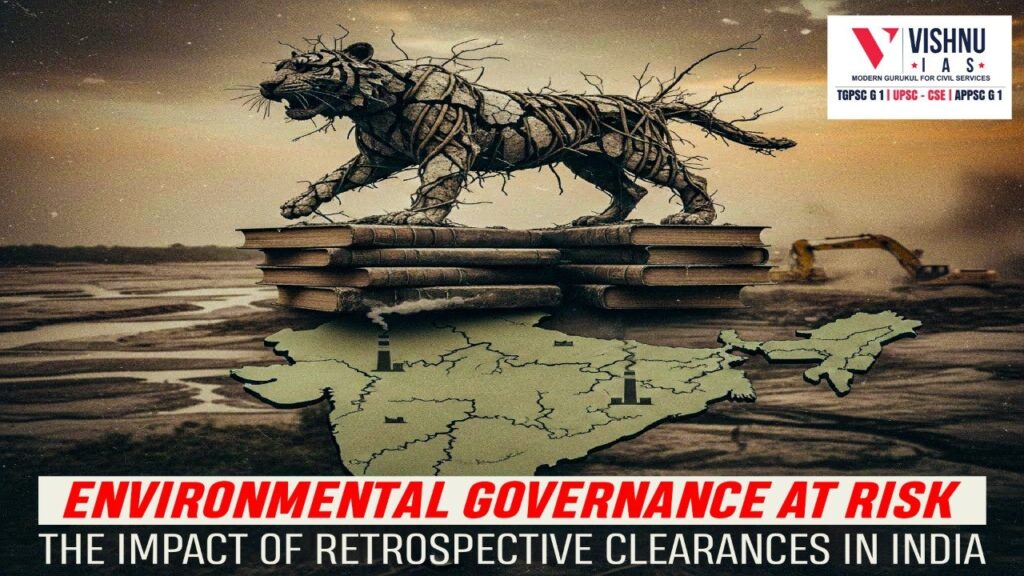
Retrospective environmental clearances in India have emerged as a contentious feature of environmental governance, raising serious concerns about accountability, deterrence, and the integrity of regulatory institutions.
Introduction
• Retrospective or ex post facto environmental clearances refer to the practice of granting Environmental Clearances (ECs) to projects after they have already commenced construction or operations without statutory approval. In India, the Environmental Impact Assessment (EIA) framework under the Environment (Protection) Act, 1986 mandates prior EC for activities with significant ecological impacts.
• However, periodic notifications and office memoranda have permitted retrospective ECs, raising concerns about compliance, deterrence, and environmental rule of law. In a context where India ranked among the countries with the highest ecological risks as per recent global environmental vulnerability assessments, weakening preventive mechanisms directly affects not just ecosystems but also communities dependent on them.
• Retrospective regularisation therefore becomes a key governance issue, especially as India pushes rapid industrialisation and infrastructure expansion.
Body
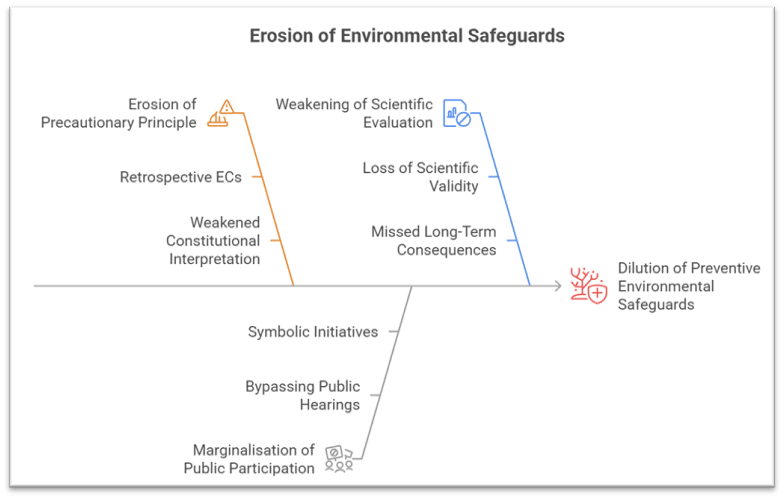
1. Dilution of Preventive Environmental Safeguards
Erosion of the Precautionary Principle
• Granting retrospective ECs undermines the core preventive purpose of EIAs, which are designed to evaluate impacts before project initiation. Without prior scrutiny, irreversible damage may occur, as seen in cases like the Sterlite Copper Plant (Example: Sterlite Copper Case, Tamil Nadu), where post-facto compliance failed to prevent severe air and groundwater contamination.
• It also weakens the constitutional interpretation of the right to a healthy environment under Article 21, limiting the ability of regulators to enforce proactive safeguards.
• Government efforts such as the National Clean Air Programme or the Coastal Regulation Zone regimes rely on anticipatory planning; retrospective ECs discourage project proponents from aligning with these requirements.
Marginalisation of Public Participation
• Prior EC includes processes like public hearings that allow affected communities to raise objections. Post-facto clearances bypass such essential democratic checks.
• This has been evident in industrial clusters in states such as Gujarat and Odisha (Example: POSCO Odisha public hearing concerns) where local populations faced environmental burdens without meaningful consultation.
• Initiatives like the Forest Rights Act and Gram Sabha–based approvals for diversion of forest land become symbolic if final approvals can be granted retrospectively.
o Weakening of Scientific Evaluation
• EIAs require expert appraisal, cumulative impact assessments, and mitigation planning. When assessments are prepared ex post, they lose scientific validity as ecosystems may already have been damaged.
• In riverine projects (Example: Ken-Betwa Interlinking case debates), retrospective impact assessments miss long-term hydrological and biodiversity consequences.
• Schemes like National Mission for Clean Ganga emphasise ex ante study of catchment vulnerability, a standard contradicted by retrospective permissions.
2. Incentivising Non-compliance and Reducing Deterrence
o Creation of a Moral Hazard and Perverse Incentive
• When violators can legalise breaches through retrospective ECs by paying fines, compliance becomes optional rather than mandatory. Developers may proceed with construction assuming later regularisation.
• Several mining operations in central India (Example: Illegal mining in Bellary, Karnataka) expanded operations without prior ECs, later seeking regularisation under liberalised frameworks.
• This discourages adherence to schemes like Environmental Management Plans, effluent control rules, or the Hazardous Waste Rules.
Undermining the Deterrent Effect of Environmental Penalties
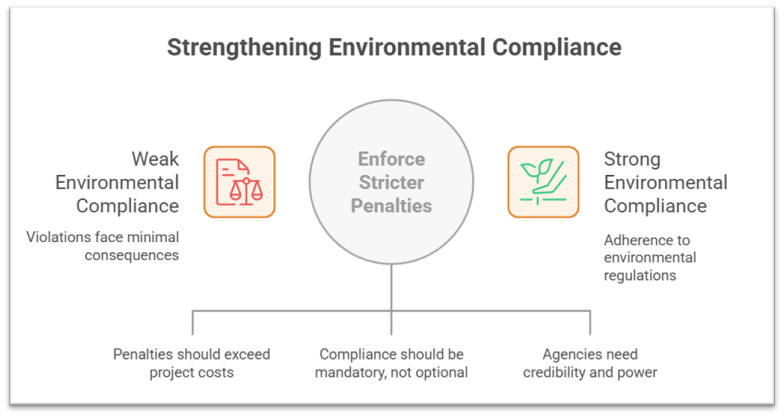
• Penalties under current rules often amount to a fraction of project costs; retrospective ECs further dilute deterrence by avoiding stringent consequences such as closure or restoration mandates.
• Cases of illegal sand mining along the Yamuna and Chambal rivers demonstrate that minimal penalties combined with retrospective regularisation cannot counter the economic incentives for violations.
• Government mechanisms like the Pollution Index or star-rating of industries rely on compliance indicators; retrospective approvals distort these frameworks.
Weakening Regulatory Authority
• When violations are condoned ex post, agencies like State Pollution Control Boards and expert committees lose both credibility and enforcement power.
• Instances where state authorities recorded violations (Example: Madhya Pradesh SPCB reports on thermal plants) but were compelled to process retrospective clearances reveal this weakening.
• Initiatives such as Digital India–enabled environmental monitoring systems or Continuous Emission Monitoring Systems (CEMS) become less effective if rule violations face minimal consequences.
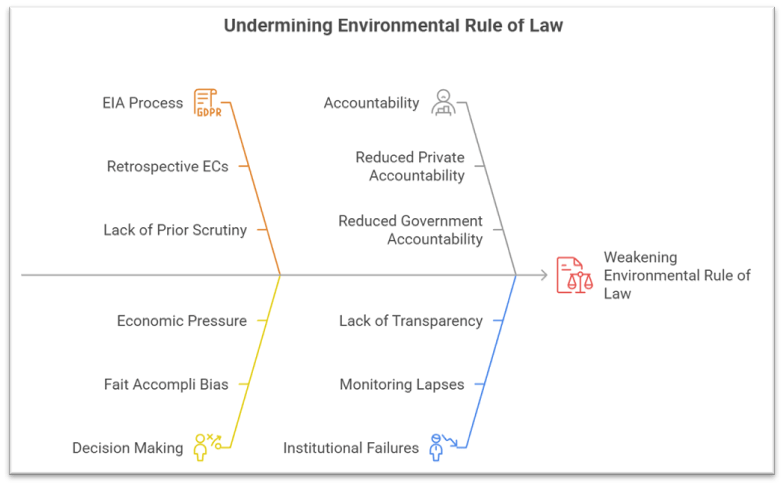
3. Undermining the Environmental Rule of Law
EIA Process Reduced to a Formality
• Retrospective ECs convert the EIA process from a substantive safeguard into a procedural ritual. Once a project is built, the scope for altering location, design, or technology is minimal.
• Urban infrastructure projects in eco-sensitive zones (Example: Dahanu Taluka Eco-sensitive Zone case) show how prior scrutiny was crucial in balancing development and protection; retrospective approvals foreclose such balancing.
• This weakens statutory instruments under the Wildlife Protection Act or Wetlands Rules which depend on prior appraisal.
Fait Accompli Bias in Decision Making
• Decision-makers face pressure to regularise ongoing projects to avoid economic losses or displacement, even if violations are clear.
• Hydro-electric projects in Himalayan states (Example: Srinagar Hydroelectric Project impact debates) often advance rapidly before securing approvals, later claiming sunk costs as justification.
• National Green Tribunal orders directing site inspections or restoration become harder to enforce once retrospective ECs are granted.
Reduced Accountability Across Institutions
• Retrospective permissions dilute accountability not only of private actors but also of government agencies that failed to monitor violations.
• Institutional lapses in monitoring coastal projects (Example: Kerala coastal highway violations) revealed systemic failures, yet retrospective approvals shielded both developers and regulators.
• Government initiatives such as Compensatory Afforestation Fund Management or the Green Rating for Integrated Habitat Assessment depend on transparent and accountable governance, which retrospective clearances undermine.
Conclusion
• Retrospective environmental clearances fundamentally weaken India’s environmental governance by eroding preventive safeguards, incentivising non-compliance, and undermining the rule of law. In an era where environmental degradation and climate stress pose increasing risks to public health, biodiversity, and economic resilience, the need for strong, anticipatory environmental regulation is greater than ever.
• A way forward lies in strengthening prior EC norms, enhancing digital transparency in project monitoring, empowering local communities in decision-making, and ensuring that penalties for violations exceed the economic gains from non-compliance. Reinforcing institutional capacities, updating EIA methodologies, and adopting real-time ecological monitoring tools can help restore credibility.
• Ensuring that environmental regulation is anchored in prevention rather than post-facto regularisation is essential for sustainable development and for protecting the rights of present and future generations.
Recap: