How the Relaxation of Green Cover Requirements Aligns with Nature-Based Solutions (NbS) in Sustainable Development
Introduction
- The principle of Nature-Based Solutions (NbS), as endorsed in various international climate and biodiversity frameworks, refers to actions that protect, sustainably manage, and restore natural or modified ecosystems to address societal challenges while ensuring human well-being and ecosystem resilience.
- With industries increasingly central to economic growth, countries have been re-examining regulatory frameworks to simplify norms under the broader objective of ease of doing business. One such trend is the relaxation of mandatory green-cover requirements within industrial estates and individual units.
- While this move is often justified by citing global industrial norms, its alignment with NbS requires a deeper analysis of ecological capacity, population pressures, and landscape-level sustainability. Empirical research illustrates that green belts can reduce total suspended particulate matter by up to 65% and lower ambient noise by 10–17 decibels, yet these remain localised mitigative effects rather than ecosystem restoration.
1. Ecological and Environmental Implications of Relaxed Green Cover Norms
a) Limited ecological restoration capacity of on-site green belts
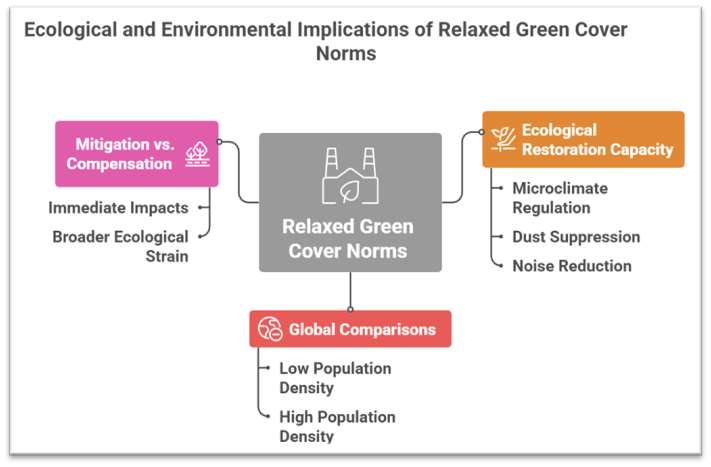
- Green belts within industrial premises primarily offer microclimate regulation, dust suppression, and noise reduction, but they cannot substitute the biodiversity, carbon sequestration or hydrological functions of natural ecosystems.
- Industrial plantations typically remain narrow and mono-specific, making them more vulnerable to degradation and less capable of supporting ecological connectivity.
- Examples such as industrial plantations in Gujarat’s PCPIR region show that internal vegetative buffers helped reduce localized particulate levels, yet did not address broader ecological fragmentation created by large-scale land conversion.
b) Misaligned global comparisons on green-area ratios
- Nations with low population density and vast open landscapes can afford lower on-site green ratios, as surrounding natural ecosystems continue to provide ecological buffering.
- In contrast, densely populated and industrially saturated regions in India require stronger on-site safeguards due to limited ecological resilience and higher environmental stress.
- The experience of South Korea’s Incheon Free Economic Zone demonstrates that reduced plot-level greenery only worked because it was paired with large surrounding coastal and forest buffers, a condition not replicable in many Indian industrial clusters.
c) On-site green cover as mitigation, not compensation
- On-site greenery mitigates immediate impacts such as thermal stress and pollution dispersal but cannot reverse losses from deforestation, wetland reclamation or habitat loss due to industrial expansion.
- The Cochin industrial belt, for instance, shows visible improvements in microclimate through internal plantations, yet simultaneously reports decline in backwater ecology, indicating a mismatch between on-site mitigation and broader ecological strain.
- Government initiatives such as Compensatory Afforestation under the Forest Conservation Act underscore the need for ecological compensation beyond industrial boundaries.
2. Assessing Alignment with Principles of Nature-Based Solutions (NbS)
a) NbS stresses ecosystem restoration beyond site boundaries
- NbS principles emphasise landscape-scale ecological resilience, which requires interventions in natural or semi-natural ecosystems, not merely ornamental or localised vegetation.
- Internal green belts cannot ensure carbon neutrality, watershed protection or wildlife corridors, which are central to NbS frameworks.
- Projects such as Aravalli Biodiversity Restoration in Haryana, linked with industrial clusters, demonstrate that off-site restoration has stronger ecological outcomes than plot-level greenery.
b) NbS requires co-benefits and long-term ecosystem health
- Relaxing green norms without alternative commitments weakens co-benefits like flood mitigation, drought buffering and soil stability, which NbS aims to achieve.
- Successful NbS applications, such as wetland conservation in East Kolkata Wetlands, show that long-term resilience requires protection of natural systems rather than isolated plantations.
- Government programs like National Mission for a Green India embed NbS thinking by linking afforestation with ecosystem services, pointing to the need for similar integration in industrial policy.
c) NbS emphasises community and stakeholder involvement
- NbS highlights community participation, yet reduced green-cover norms may limit local community access to ecological buffers, especially in peri-urban industrial zones.
- Case studies from Odisha’s community-led mangrove restoration near industrial sites reveal how shared stewardship produces stronger ecological benefits than industry-only vegetation efforts.
- Initiatives such as Joint Forest Management show that aligning industries with local governance could generate more inclusive NbS-aligned approaches.
3. Toward a Balanced NbS-Based Industrial Greening Strategy
a) Combining partial on-site green norms with mandatory off-site greening
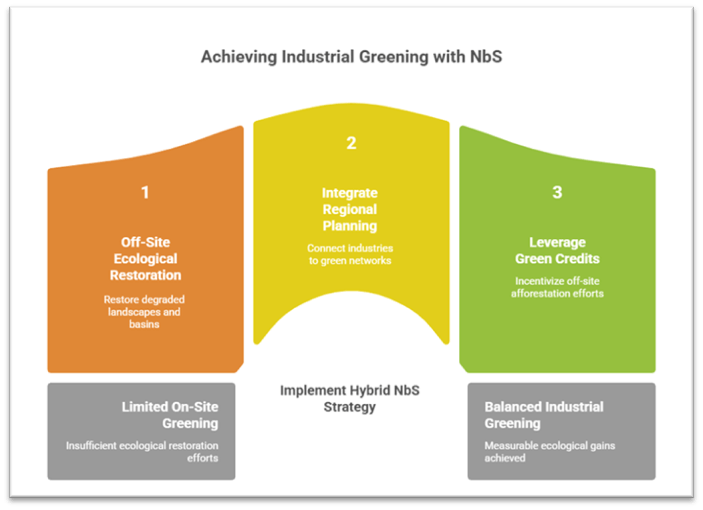
- A hybrid model linking reduced internal green cover with compulsory off-site ecological restoration can align industrial development with NbS principles.
- Off-site commitments may include restoring degraded landscapes, river basins, or buffer zones around protected areas.
- Examples include the Western Ghats restoration projects funded by industrial CSR, which improved watershed services far beyond what internal green belts could achieve.
b) Integrating industrial greening with regional ecological planning
- Landscape-level planning ensures that industries become part of larger ecological corridors and green networks, improving resilience.
- Initiatives like Delhi NCR’s Regional Green Plan demonstrate the value of integrating green buffers into industrial and urban planning.
- State-level programmes such as Madhya Pradesh’s river rejuvenation–industrial convergence model show the benefits of integrating industrial afforestation with catchment restoration.
c) Leveraging green credits, carbon markets and incentive mechanisms
- Linking relaxed green cover norms to green credit programmes, carbon offset markets and ecosystem service payments ensures measurable ecological gains.
- The Green Credit Programme supports industries investing in afforestation outside their premises, bridging the gap created by lowered on-site norms.
- International examples like Costa Rica’s Payment for Ecosystem Services model reflect how incentivised restoration aligns development with NbS-led sustainability.
Conclusion:
- Relaxing green-cover requirements within industrial units can only partially align with the principles of Nature-Based Solutions when complemented by a rigorous, scientifically designed landscape-level restoration strategy.
- NbS does not view greenery as ornamental, but as an integrated ecological process that enhances biodiversity, ecosystem resilience and human well-being. As global studies show, the resilience of future economies is inseparable from the resilience of the ecosystems that support them. India, with high population density and rapidly expanding industrial zones, must therefore embed compensatory afforestation, regional ecological planning and community-inclusive restoration into industrial policy.
- A balanced approach, supported by expanding green-credit mechanisms and updated environmental regulations, can ensure that industrialisation progresses without undermining natural systems.
- Relaxing green-cover requirements within industrial units can only partially align with the principles of Nature-Based Solutions when complemented by a rigorous, scientifically designed landscape-level restoration strategy.
- NbS does not view greenery as ornamental, but as an integrated ecological process that enhances biodiversity, ecosystem resilience and human well-being. As global studies show, the resilience of future economies is inseparable from the resilience of the ecosystems that support them. India, with high population density and rapidly expanding industrial zones, must therefore embed compensatory afforestation, regional ecological planning and community-inclusive restoration into industrial policy.
- A balanced approach, supported by expanding green-credit mechanisms and updated environmental regulations, can ensure that industrialisation progresses without undermining natural systems.
Recap: