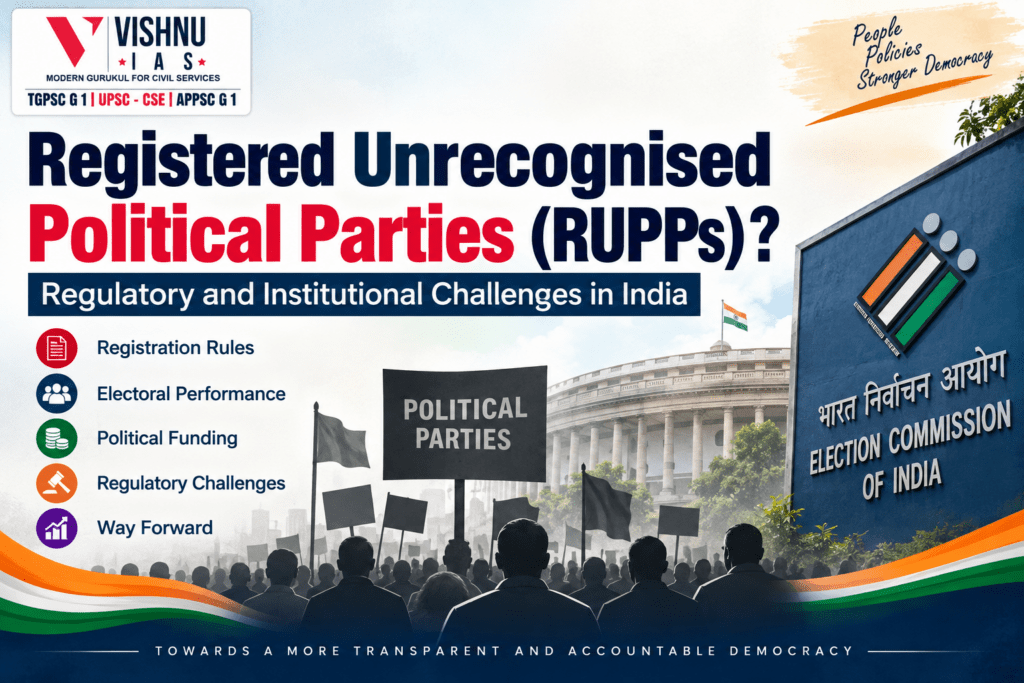
Registered Unrecognised Political Parties (RUPPs): Regulatory & Institutional Challenges in India
Registered Unrecognised Political Parties (RUPPs) occupy an important space in India's electoral system. Political parties are essential instruments of representative democracy and derive constitutional protection from the freedom to form associations under Article 19(1)(c). Under Section 29A of the Representation of the People Act, 1951 (RPA), an association or body of individual citizens of India can apply to the Election Commission of India (ECI) for registration as a political party.
A Registered Unrecognised Political Party (RUPP) is a political party registered with the ECI under Section 29A but which has not fulfilled the electoral performance criteria for recognition as a State or National Party under the Election Symbols (Reservation and Allotment) Order, 1968. The finding that six Gujarat-based RUPPs received around ₹1,700 crore in donations in 2023–24, while collectively fielding only 15 candidates in the 2024 Lok Sabha election, has brought the regulatory challenges surrounding RUPPs into sharp focus.
1. Registered Unrecognised Political Parties
Legal basis for registration
- Section 29A of the RPA, 1951 provides the statutory mechanism for registration of political parties with the ECI.
- The party's constitution must contain an undertaking to bear true faith and allegiance to the Constitution of India and to the principles of socialism, secularism and democracy, and to uphold the sovereignty, unity and integrity of India.
- The ECI examines the application and provides an opportunity of hearing before deciding whether to register the association.
Registration versus recognition
- The Election Symbols (Reservation and Allotment) Order, 1968 classifies political parties into:
- Recognised political parties, consisting of National and State parties; and
- Unrecognised political parties.
- Recognition is linked to electoral performance satisfying specified vote-share and seat criteria at the state level, while National Party status requires fulfilment of prescribed electoral conditions across India.
- Thus, RUPP is a legally registered political party which has not acquired the electoral support necessary for recognition.
Benefits and regulatory obligations
- RUPPs can participate in elections and their candidates are generally allotted free symbols, while a common symbol may be allotted to eligible unrecognised parties under the ECI's prescribed framework.
- The ECI currently maintains a separate mechanism for allotment of common symbols under Para 10B of the Symbols Order.
- Registered political parties also receive tax-related benefits subject to statutory conditions.
- Under the Income-tax Act, 2025, the tax treatment of political parties is provided through Section 12 read with Schedule VIII. It provides exclusion from total income for specified income and voluntary contributions of political parties registered under Section 29A, subject to conditions such as maintenance of accounts, auditing, disclosure of specified donations and prescribed modes of receiving donations.
- Political parties are also required under Section 29C of the RPA to submit details of contributions above ₹20,000 received in a financial year. Failure to submit the prescribed contribution report can result in loss of the applicable tax benefit.
2. Regulatory and Institutional Challenges
Rapid proliferation of RUPPs
- The ECI's 2025 lists contained more than 2,700 RUPPs, while its subsequent notifications have involved registration, delisting and verification of RUPPs. The Commission has specifically identified parties that neither participate in elections nor exist at their registered addresses as a concern.
- The problem is therefore not the existence of small political parties per se, but the possibility that registration may be retained by non-serious or inactive entities that continue to access statutory benefits.
Letter-pad parties and lack of electoral activity
- A significant number of RUPPs do not regularly contest elections. This has led to the expression “letter-pad parties” for entities that possess formal registration without meaningful electoral activity.
- The ECI has taken action against inactive or untraceable RUPPs. In 2025, it initiated verification proceedings against 345 RUPPs concerning whether they had contested elections continuously since 2019 and whether they existed at their registered addresses.
Limited power of the Election Commission to de-register
- The most important institutional constraint arises from the Supreme Court's judgment in Indian National Congress v. Institute of Social Welfare & Ors. (2002).
- The Court held that Section 29A does not expressly confer power on the ECI to de-register a political party for violation of constitutional provisions or the undertaking given at the time of registration. Registration under Section 29A is a quasi-judicial act, and the ECI cannot exercise a general power of review in the absence of statutory authority.
- However, the Court recognised limited exceptional circumstances in which registration could be cancelled, including:
- Registration obtained through fraud or forgery.
- A party altering its constitution so as to cease compliance with the requirements of Section 29A (5).
- A situation such as the party being declared unlawful by the Central Government under applicable law.
- Thus, the judgment protects political pluralism and prevents arbitrary executive or electoral interference, but it also creates a regulatory gap where Parliament has not expressly provided a broader de-registration mechanism.
Weak compliance and transparency in political funding
- RUPPs are required to maintain financial records and comply with disclosure requirements. However, compliance remains a major concern.
- According to an Association for Democratic Reforms (ADR) analysis, 73.26% of 2,764 RUPPs did not submit audit and contribution reports to the ECI, highlighting serious gaps in financial transparency. ADR also found that the top ten RUPPs had combined income of about ₹3,014 crore during 2019–20 to 2023–24.
- This creates the possibility that registration could be used as a gateway to tax benefits and financial transactions without adequate public scrutiny.
Fragmentation of regulatory responsibility
- Political party regulation involves multiple institutions. ECI deals with registration, election participation, symbols and electoral disclosures.
- Income-tax authorities examine compliance with conditions attached to tax benefits and the financial records of political parties.
- Financial Intelligence Unit-India and enforcement agencies can examine suspicious financial transactions where their statutory jurisdiction is attracted.
- This multi-institutional framework can create coordination and accountability gaps, particularly when information relating to political donations, tax compliance and electoral participation is distributed across different regulatory systems.
De-registration versus political pluralism
- On one hand, continued registration of parties that neither contest elections nor comply with reporting requirements can facilitate misuse of electoral and tax-related benefits.
- On the other hand, an excessively high electoral-performance threshold for continued registration could disadvantage new, regional, ideological or emerging political movements.
Long-pending reforms
- Law Commission's 255th Report recommended providing for de-registration where a political party fails to contest Parliamentary or State elections for ten consecutive years. The recommendation has been under consideration for legislative action.
- The ECI has also advocated reforms to give it appropriate statutory authority to act against non-serious parties.
- However, merely requiring parties to contest an election may not completely solve the problem. A party could theoretically contest elections only to retain registration and associated benefits. Hence, electoral participation, financial transparency and meaningful compliance should be considered together.
Way Forward
- Parliament shall amend the RPA to establish clearly defined grounds and procedures for de-registration, while incorporating notice, hearing and judicial review safeguards.
- Access to tax benefits and other statutory privileges should be conditional upon timely filing of audited financial statements; contribution reports; income-tax returns; organisational details; and prescribed election-related disclosures.
- The ECI, Income-tax Department, FIU-IND and other competent agencies should develop inter-operable digital databases for political donations, returns and election participation, subject to privacy and legal safeguards.
- Annual financial reports, contribution reports and compliance status shall be made easily searchable in a standardised public database.
Conclusion
RUPPs occupy an important space between constitutional freedom of political association and the institutional requirements of electoral accountability. Their proliferation is not inherently undesirable in a diverse democracy; the challenge arises when registration is retained without meaningful political activity or financial transparency. Strengthening accountability without suppressing political pluralism is therefore essential to preserve the integrity of India's electoral democracy.