

Reforming UGC for Academic, Administrative & Financial Autonomy in Higher Education
Academic freedom is the cornerstone of higher education, enabling universities to foster critical thinking, innovation, and societal progress by allowing unfettered exploration of ideas. The University Grants Commission (UGC), established under the UGC Act of 1956, serves as India’s apex regulatory body for higher education, tasked with coordinating, determining, and maintaining standards while disbursing grants.
However, the evolving demands of the 21st-century knowledge economy, coupled with India’s ambition to become a global education hub, have sparked debates about the need for reforming UGC to enhance academic, administrative, and financial autonomy in higher education institutions (HEIs). The National Education Policy (NEP) 2020 envisions a shift toward greater institutional autonomy, proposing the replacement of the UGC with the Higher Education Commission of India (HECI) to address these challenges.
Academic Autonomy and Its Role in Fostering Excellence
- Curriculum Design and Flexibility: Academic autonomy allows universities to design curricula aligned with global standards and industry needs. NEP 2020 emphasizes multidisciplinary education, but the UGC’s centralized regulations, like prescribed syllabi, limit innovation. For example, IIT Madras under the Institutes of Eminence scheme introduced a flexible BS in Data Science, unlike state universities constrained by UGC norms.
- Freedom in Research Priorities: Faculty-driven research agendas are critical for advancement, but UGC’s funding control often prioritizes government-aligned projects. The National Research Foundation (NRF) under NEP 2020 aims to address this with INR 50,000 crore funding over five years.
- Encouraging Unorthodox Thinking: Diverse, even dissenting ideas drive progress, but the regulatory environment sometimes discourages this—particularly in humanities and social sciences.
Administrative Autonomy and Institutional Governance
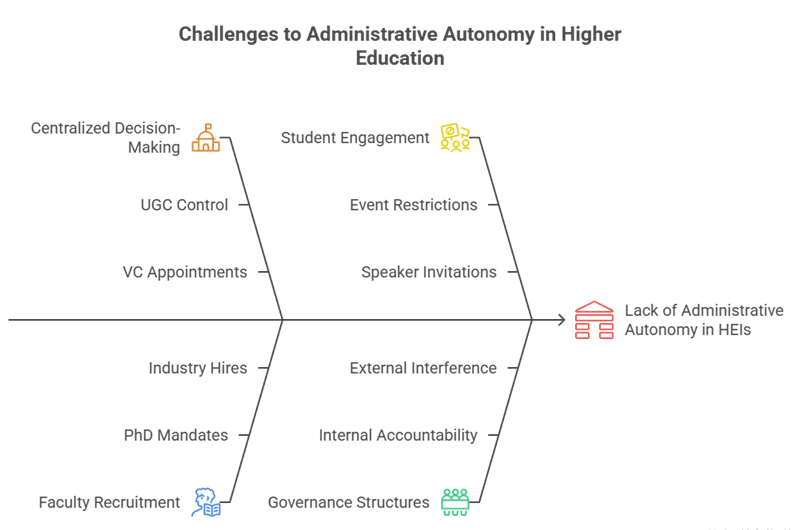
- Decentralized Decision-Making: Administrative autonomy empowers institutions to manage staffing, infrastructure, and governance. IIM Ahmedabad, under the IIM Act 2017, exemplifies the benefits of such autonomy.
- Faculty Recruitment and Development: Rigid qualification norms limit hiring flexibility. Private autonomous institutions like BITS Pilani recruit industry experts to enrich learning experiences.
- Student Engagement and Campus Activities: Autonomy enables universities to freely organize academic and cultural initiatives.
- Governance Structures for Accountability: Decentralized governance models, as seen in Germany, boost innovation and efficiency.
Financial Autonomy and Resource Management
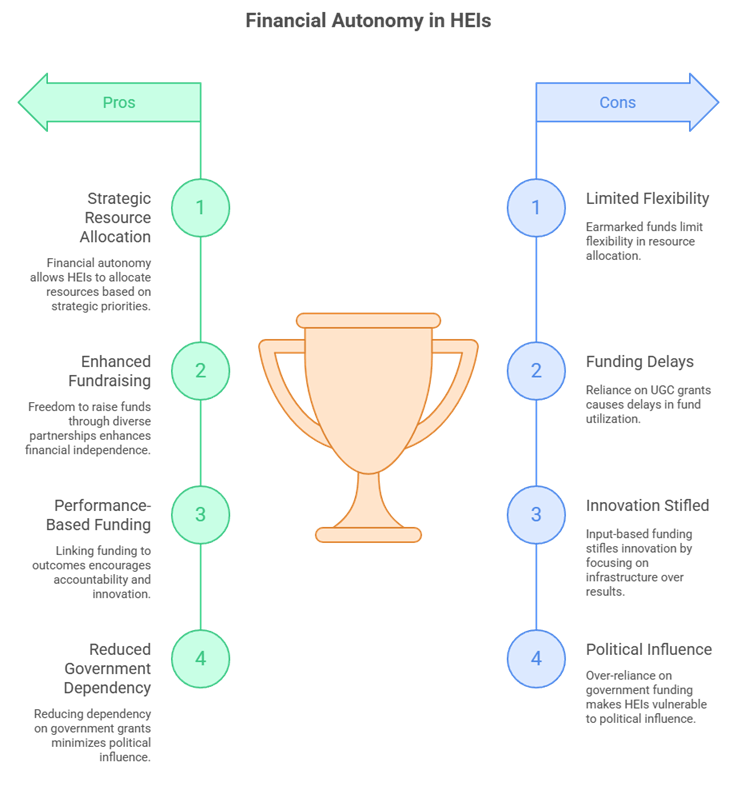
- Independent Fund Allocation: Financial autonomy allows strategic resource use. IIT Delhi’s alumni-driven fundraising contrasts with the delays faced by grant-dependent state universities.
- Fundraising and Endowments: International best practices show that alumni and industry partnerships can significantly boost funding.
- Performance-Based Funding: Linking funds to measurable outcomes fosters innovation and accountability.
Counterarguments: Challenges of Granting Full Autonomy
- Risk of Commercialization: Without oversight, institutions may focus on profit over quality.
- Disparities in Quality: Autonomy could widen the gap between elite and underfunded HEIs.
- Potential for Misgovernance: Lack of regulation might lead to inefficiencies or corruption.
- Political Sensitivities: Governments may resist reforms that enable criticism.
Conclusion:
Reforming regulatory structures like the UGC is essential to grant academic, administrative, and financial autonomy to HEIs, fostering innovation, critical thinking, and global competitiveness. The NEP 2020’s vision of replacing the UGC with the HECI aligns with global best practices, but its success depends on phased reforms, transparent governance, and equitable support for all institutions.
Recap: