Paradox of Democracy in India: Election Commission’s SIR and the Battle Over ‘The People’
Introduction
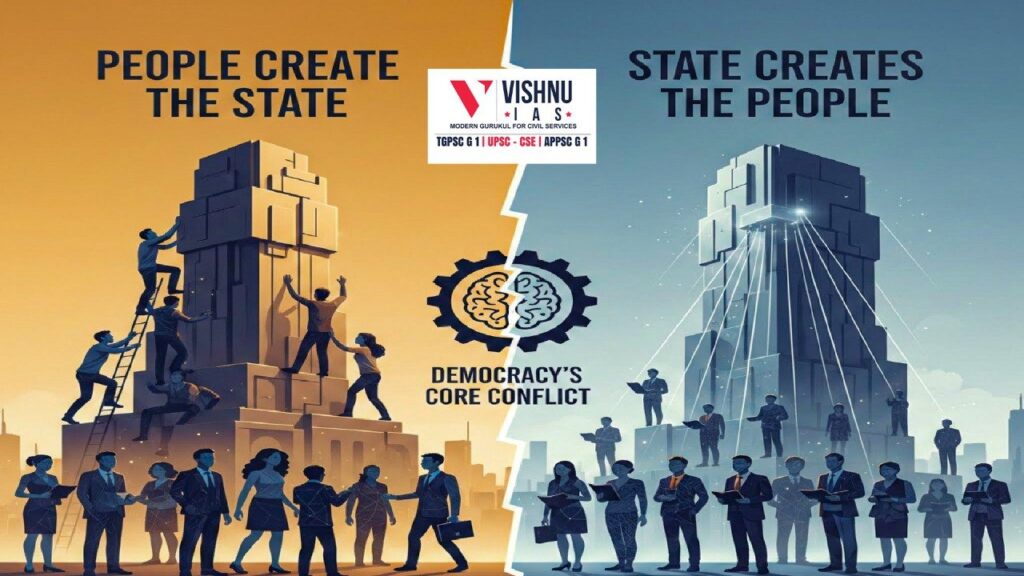
The paradox of democracy in India becomes evident when the state, which is a creation of the people, acquires the power to decide who truly belongs to ‘the people’.
The legitimacy of a modern democratic state rests on the principle that sovereignty belongs to the people, and the state exists as their institutional creation. Yet, across democracies, a structural paradox persists: the very state that derives authority from the people is also empowered to decide who qualifies as ‘the people’. This tension becomes sharper in contexts where citizenship is complex, documentation is inconsistent, and administrative discretion is wide. India’s citizenship framework, shaped by the Citizenship Act, 1955 and subsequent amendments, illustrates how citizenship is not evidenced by a single fool-proof document, but by a mosaic of records whose authenticity is often contested.
Against this backdrop, the Election Commission of India’s (ECI) Special Intensive Revision (SIR) of electoral rolls has triggered legal, political and philosophical debates on the boundaries of state authority, the rights of residents, and the processes through which citizenship and franchise are operationalised.
The issue is not merely administrative. It touches upon the constitutional right to vote, the principle of universal adult franchise, and the tension between jus soli and jus sanguinis traditions of citizenship. When electoral rolls are scrutinised en masse, the risk of exclusion, bureaucratic overreach, and unequal access to documentation becomes a core democratic concern.
The Structural Paradox of Citizenship Determination in a Democracy
a. State authority versus popular sovereignty
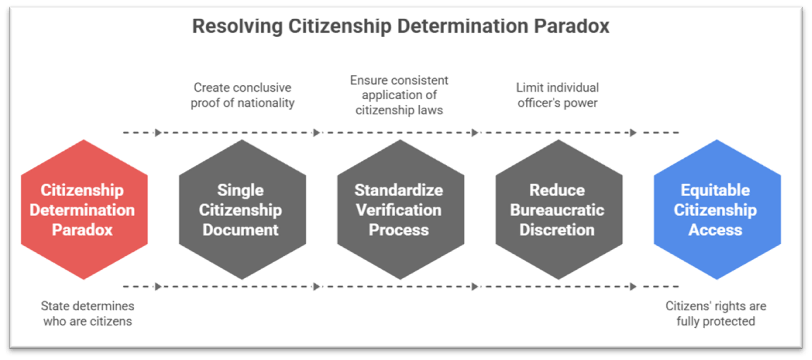
- Modern constitutional democracies operate on the principle that the people create the state, yet the state retains legal and administrative mechanisms to determine citizenship, through statutes such as the Citizenship Act and rules governing registration.
- This creates an inherent asymmetry: basic political rights, including voting, depend on recognition by the same state whose legitimacy originates from those recognised citizens.
- Example: Citizenship by birth rules post-2004 tie eligibility to parents’ status, making the determination of a child’s citizenship contingent on administrative certification of parental legality.
b. Documentary citizenship and the risk of exclusion
- India lacks a single conclusive citizenship document; passports, voter IDs and Aadhaar function as identity proofs but not proofs of nationality. This makes citizenship dependent on a chain of documents that may be fragile, lost, or difficult to verify, especially for migrants, rural populations or disaster-affected communities.
- The paradox manifests in situations where administrative absence or documentation gaps are interpreted as individual failure, shifting the burden of proof entirely onto citizens.
- Case study: Assam’s NRC process, where nearly 19 lakh residents were excluded in the draft NRC because legacy documents failed to meet stringent administrative standards.
c. Discretionary power at the lowest levels
- Although citizenship debates appear constitutional, determination often occurs through street-level bureaucracy: local revenue officials, police constables, border personnel, and electoral officers.
- Such decentralised discretion creates uneven application of law, increasing vulnerability to bias, errors or corruption.
- Example: In routine electoral roll revisions, booth-level officers verify applicants’ status, effectively shaping the demos in their locality.
Citizenship, Electoral Rights, and the Legal-Administrative Interface
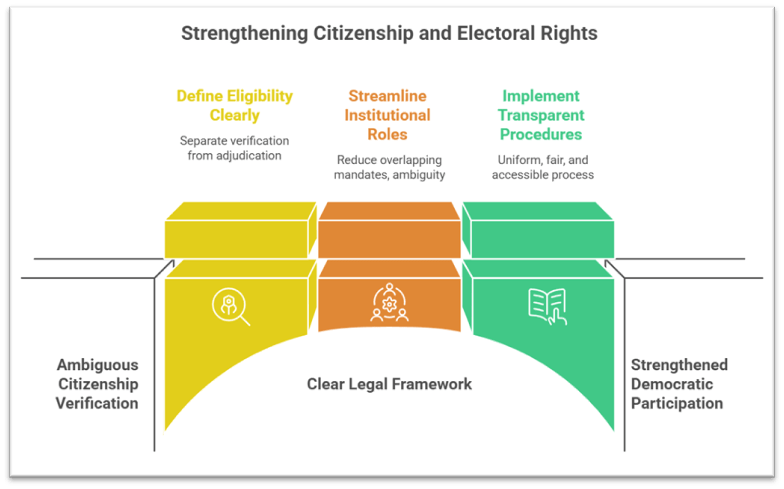
a. Distinction between eligibility verification and formal citizenship adjudication
- The ECI argues that verifying eligibility for enrolment is not equivalent to deciding citizenship; however, the practical effect is similar, because being struck off rolls affects an individual’s political existence.
- This blurring of roles intensifies the paradox: bodies designed to protect democratic participation may end up curating who participates.
- Example: ECI’s powers under the Representation of the People Act allow roll maintenance but not citizenship adjudication, yet the eligibility verification process inevitably touches citizenship questions.
b. Overlapping frameworks and institutional ambiguity
- India’s citizenship governance involves the MHA, Foreigners Tribunals, state police, and district administrations, each with partially overlapping mandates.
- The NPR–NRC architecture legally places the onus of proof on individuals, reinforcing the state’s role in constructing the citizenry.
- Government initiatives such as the National Population Register exercises highlight this complexity: while aimed at enumeration, they often shape perceptions of citizenship legitimacy.
c. Lack of procedural safeguards and uneven transparency
- While mechanisms exist for objections and claims, the absence of uniform, transparent procedures increases the possibility of wrongful exclusions.
- In cross-border regions or urban informal settlements, residents often face disproportionate scrutiny because of migration, displacement, or linguistic identity, reinforcing structural inequities.
- Case example: In border districts of West Bengal and Tripura, frequent re-verification drives have led to large-scale demands for additional documents, disproportionately affecting economically weaker groups.
SIR as a Contemporary Illustration of the Democracy Paradox
a. The trigger and scope of the SIR
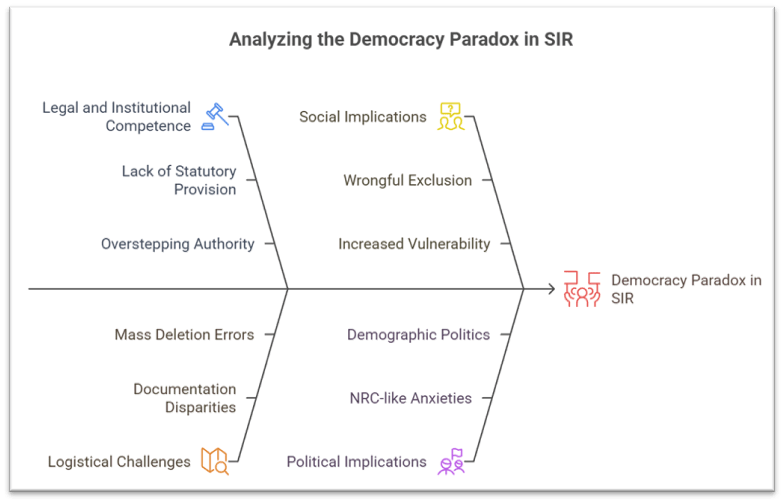
- The SIR aims to detect non-citizens on electoral rolls nationwide, but there is no explicit statutory provision for an en masse exercise of this nature.
- Critics argue that the ECI’s move implicitly assumes a presumption of non-citizenship, reversing the democratic norm that residents are citizens unless proven otherwise.
- The nationwide scale also raises logistical concerns, given documentation disparities across states.
b. Legality and questions of institutional competence
- Petitions contend that only the Union Home Ministry has the authority to decide citizenship, and that the ECI risks overstepping into quasi-judicial determination.
- This reflects the core paradox: institutions meant to facilitate political rights may inadvertently police political membership.
- Case example: In the past, mass deletion errors in states such as Telangana and Karnataka during roll purification exercises led to controversies over disenfranchisement, showing the fragility of large-scale verification processes.
c. Social and political implications of misclassification
- Wrongful exclusion from electoral rolls not only bars individuals from voting but can also trigger scrutiny under other citizenship processes, increasing vulnerability.
- The risk is especially heightened for groups with limited documentation—migrants, minorities, women, and the elderly—making administrative errors democratically consequential.
- The SIR thus becomes a proxy terrain where broader anxieties about NRC-like exercises, demographic politics, and administrative overreach converge.
Conclusion:
The paradox of democracy lies in its need to rely on the state to determine the very citizenry from whom it draws its legitimacy. As seen in the debates surrounding the SIR, the state’s role in defining who belongs can both safeguard and threaten democratic participation. A robust system must therefore prioritise procedural fairness, transparency, and minimal exclusion, while ensuring that citizenship determination remains firmly within constitutional limits.
Moving forward, India requires a clear, citizen-friendly documentation framework, stronger grievance redressal mechanisms, and technology-assisted but human-centric verification, ensuring that democratic rights are not undermined by administrative complexities. The commitment to universal adult franchise must guide reforms, ensuring that governance does not dilute the principle that the people constitute the state, and not the other way around.
Recap: