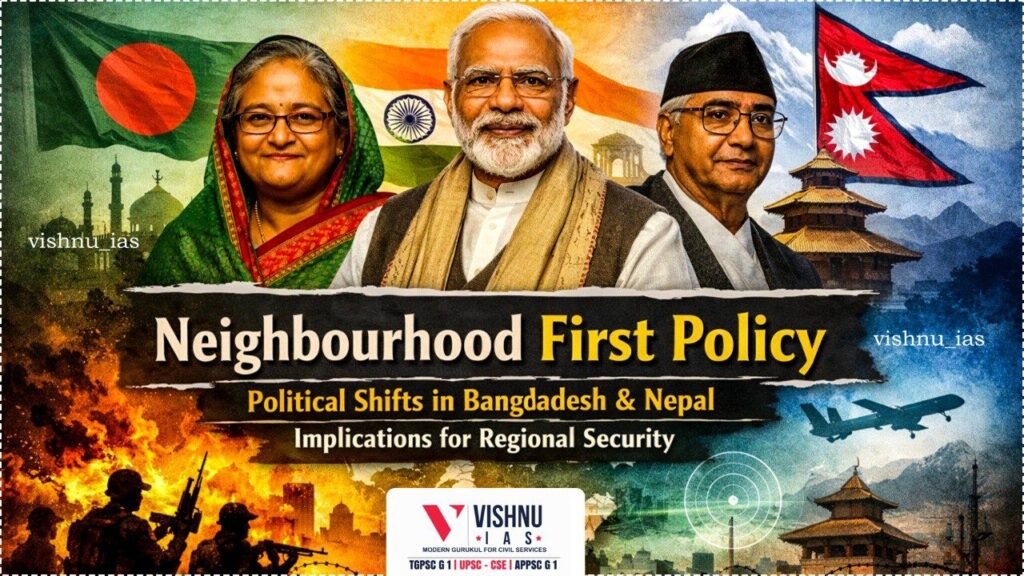
Critically Examining India’s Neighbourhood First Policy Amid Political Transitions in Bangladesh and Nepal
India’s Neighbourhood First Policy seeks to prioritise political trust, economic integration, development partnership and security cooperation with South Asian neighbours as a foundation for India’s rise as a regional and global power. The approach aligns with India’s constitutional vision of peaceful coexistence and its strategic need for a stable periphery, given that South Asia accounts for nearly 40% of India’s external trade routes, hosts critical energy and connectivity corridors, and remains vulnerable to political volatility, terrorism and great-power competition. However, the political transitions in Bangladesh (2024 regime-change protests) and Nepal (2025 Gen-Z-led demonstrations) have tested the resilience, adaptability and credibility of this policy, raising questions about its effectiveness and its implications for regional security.
Introduction
- India’s ‘Neighbourhood First’ policy seeks to prioritise political trust, economic integration, development partnership and security cooperation with South Asian neighbours as a foundation for India’s rise as a regional and global power.
- The approach aligns with India’s constitutional vision of peaceful coexistence and its strategic need for a stable periphery, given that South Asia accounts for nearly 40% of India’s external trade routes, hosts critical energy and connectivity corridors, and remains vulnerable to political volatility, terrorism and great-power competition.
- However, the political transitions in Bangladesh (2024 regime-change protests) and Nepal (2025 Gen-Z-led demonstrations) have tested the resilience, adaptability and credibility of this policy, raising questions about its effectiveness and its implications for regional security.
I. Neighbourhood First and Political Transitions: Assessing Diplomatic Effectiveness
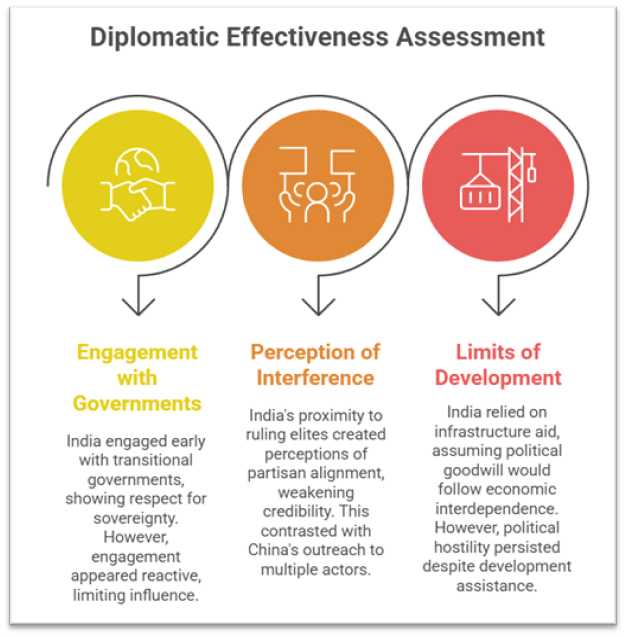
1. Engagement with Transitional Governments
- India adopted early diplomatic outreach, including high-level visits and bureaucratic engagement, signalling respect for sovereignty and continuity of ties during transitions.
- EXAMPLE: Outreach to the interim administration in Bangladesh through senior diplomatic channels aimed to prevent strategic drift, yet failed to arrest the rapid deterioration in bilateral trust by late 2025.
- Despite structured mechanisms like Joint Consultative Commissions, India’s engagement appeared reactive rather than anticipatory, limiting influence over evolving political narratives.
2. Perception of Political Interference vs Strategic Silence
- India’s historical proximity to ruling elites in Dhaka and Kathmandu created perceptions of partisan alignment, which weakened its credibility amid popular movements demanding political change.
- EXAMPLE: In Nepal, Gen-Z protests framed India as supportive of status quo elites, contrasting sharply with China’s outreach to multiple political actors, diluting India’s traditional leverage.
- The absence of a clearly articulated doctrine for engaging post-protest governments exposed a gap between India’s normative rhetoric and operational diplomacy.
3. Limits of Development-Centric Diplomacy
- India’s reliance on infrastructure aid, energy cooperation and grants assumed political goodwill would naturally follow economic interdependence.
- CASE STUDY: Power trade and connectivity projects with Bangladesh continued operationally, yet political hostility persisted, demonstrating that development assistance alone cannot offset domestic legitimacy crises.
- This reveals a structural weakness: Neighbourhood First underestimates the role of domestic political legitimacy in sustaining bilateral alignment.
II. Security Implications of Political Flux in the Eastern and Himalayan Periphery
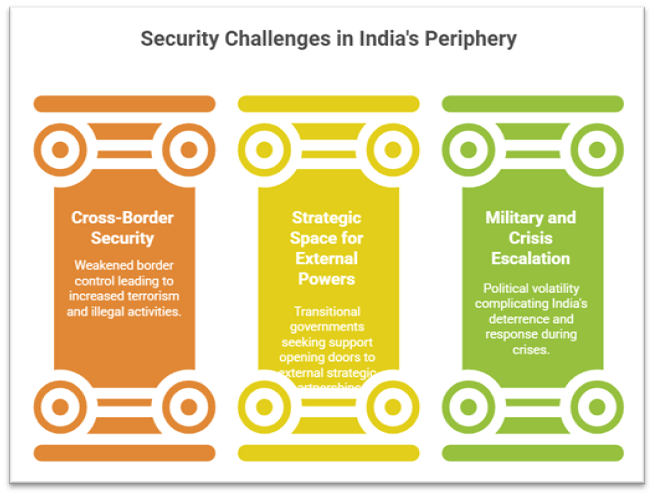
1. Cross-Border Security and Insurgency Risks
- Political uncertainty weakened institutional control over borders, increasing vulnerabilities related to terrorism, illegal migration and organised crime.
- EXAMPLE: The deterioration of cooperation with Bangladesh coincided with concerns over militant regrouping and reduced intelligence coordination in eastern India.
- In Nepal, governance instability complicated long-standing collaboration on managing open borders, impacting internal security in Bihar and Uttar Pradesh.
2. Strategic Space for Extra-Regional Powers
- Transitional governments, seeking regime security and economic support, became more open to external strategic partnerships, particularly with China.
- CASE STUDY: China’s intensified political engagement and infrastructure diplomacy in Nepal during the protest phase altered the traditional balance, challenging India’s security buffer in the Himalayas.
- This trend raises concerns of strategic encirclement, especially when neighbourhood instability intersects with great-power rivalry.
3. Military and Crisis Escalation Dynamics
- Political volatility in neighbouring states increases uncertainty during crises, complicating India’s deterrence and response calculations.
- EXAMPLE: India’s security posture after the Pahalgam attack underscored how fragile neighbourhood ties reduce diplomatic support during escalation scenarios.
- Weak neighbourhood consensus heightens risks of misperception, especially in a region with nuclear-armed adversaries.
III. Normative Credibility, Soft Power and Regional Order
1. Democracy, Minority Rights and Policy Consistency
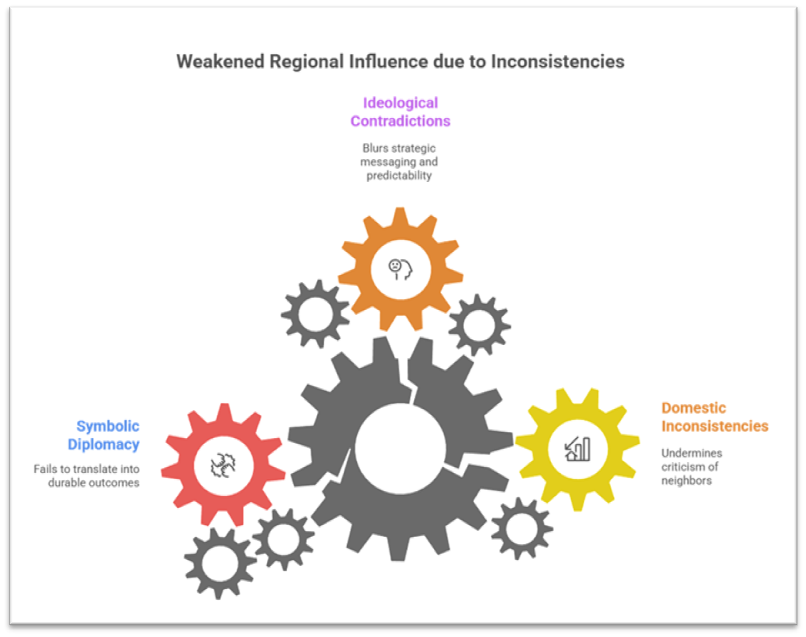
- India’s expressions of concern over democratic backsliding and minority safety in neighbouring states were undermined by perceived inconsistencies at home.
- EXAMPLE: Criticism of minority violence in Bangladesh lacked persuasive power when similar issues within India attracted international scrutiny.
- This inconsistency diluted India’s moral authority, a critical asset in neighbourhood diplomacy.
2. Managing Ideological Contradictions
- India’s pragmatic engagement with actors like the Taliban contrasted with its normative concerns about rising Islamism in neighbouring democracies.
- CASE STUDY: Engagement with Afghanistan’s de facto rulers weakened India’s ability to frame principled positions in Nepal and Bangladesh.
- Such contradictions blur India’s strategic messaging and reduce predictability for neighbouring states.
3. From Symbolism to Substance
- High-visibility diplomacy often failed to translate into durable outcomes during periods of political churn.
- EXAMPLE: Symbolic outreach and summitry did not prevent Bangladesh ties from reaching their lowest ebb by end-2025.
- This underscores the need for institutionalised, society-centric engagement rather than leader-centric diplomacy.
Conclusion:
- The political transitions in Bangladesh and Nepal during 2024–25 reveal that India’s Neighbourhood First policy, while conceptually sound, remains operationally fragile when confronted with domestic upheavals in neighbouring states. For regional security, unstable neighbours amplify risks of cross-border militancy, external power penetration and crisis miscalculation, directly affecting India’s strategic environment.
- Going forward, India must recalibrate the policy by broadening engagement beyond ruling elites, investing in people-to-people diplomacy, and embedding normative consistency into its external conduct. Strengthening early-warning political analysis, deepening sub-regional cooperation frameworks, and aligning development assistance with local legitimacy concerns can enhance resilience.
- In an increasingly transactional global order, a stable neighbourhood will depend not merely on proximity or power asymmetry, but on trust built through predictability, inclusiveness and principled pragmatism
- The political transitions in Bangladesh and Nepal during 2024–25 reveal that India’s Neighbourhood First policy, while conceptually sound, remains operationally fragile when confronted with domestic upheavals in neighbouring states. For regional security, unstable neighbours amplify risks of cross-border militancy, external power penetration and crisis miscalculation, directly affecting India’s strategic environment.
- Going forward, India must recalibrate the policy by broadening engagement beyond ruling elites, investing in people-to-people diplomacy, and embedding normative consistency into its external conduct. Strengthening early-warning political analysis, deepening sub-regional cooperation frameworks, and aligning development assistance with local legitimacy concerns can enhance resilience.
- In an increasingly transactional global order, a stable neighbourhood will depend not merely on proximity or power asymmetry, but on trust built through predictability, inclusiveness and principled pragmatism
Recap: