
National Panchayati Raj Day 2026: History, Significance, 73rd Amendment & Challenges
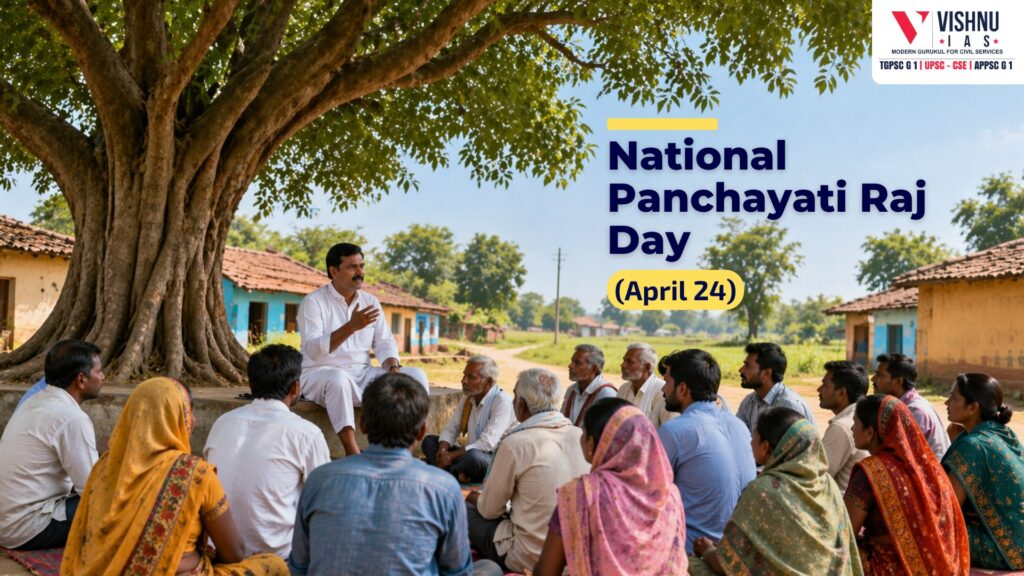
National Panchayati Raj Day (April 24) is observed every year since 2010 to commemorate the constitutional status granted to the Panchayati Raj system in India, marking a crucial step toward strengthening grassroots democracy.
Context
National Panchayati Raj Day has been observed every year on April 24 since 2010. It marks the historic day when the Panchayati Raj system was accorded constitutional status in India.
Historical Background
- Vision: The foundation lies in Mahatma Gandhi’s vision of Gram Swaraj (village self-governance).
- Balwant Rai Mehta Committee (1957): Recommended democratic decentralization and a three-tier system.
- First Launch: Formally launched on October 2, 1959, in Nagaur, Rajasthan, inaugurated by Jawaharlal Nehru.
Three-Tier Structure
- Gram Panchayat: Village level
- Panchayat Samiti: Block level
- Zila Parishad: District level
Constitutional Status
- Gram Panchayat: Village level
- Panchayat Samiti: Block level
- Zila Parishad: District level
Constitutional Status
The system received constitutional backing through the 73rd Constitutional Amendment Act (1992).
- Added Part IX (Articles 243–243O) to the Constitution.
- Mandatory elections every 5 years.
- Reservation for SCs, STs, and women (at least 33%).
- Established the State Finance Commission and State Election Commission.
Significance for Governance
- Deepening Democracy: Enables grassroots participation through Gram Sabhas.
- Inclusive Development: Empowers marginalized sections.
- Local Planning: Tailors development schemes to local needs.
- Accountability: Enhances transparency.
Contemporary Relevance
Panchayats implement flagship schemes like MGNREGA, PMAY-G, and the Jal Jeevan Mission. There is an increasing emphasis on e-Panchayats and digital governance.
Challenges
- Financial dependency on state governments.
- Limited administrative capacity.
- Political interference.
- Irregular Gram Sabha meetings.
Way Forward
- Strengthening fiscal autonomy.
- Capacity building and training of representatives.
- Promoting digital tools like e-Gram Swaraj.
- Ensuring regular and effective Gram Sabha participation.
Conclusion
- Strengthening fiscal autonomy.
- Capacity building and training of representatives.
- Promoting digital tools like e-Gram Swaraj.
- Ensuring regular and effective Gram Sabha participation.
Conclusion
National Panchayati Raj Day is a reminder of India’s commitment to grassroots democracy. Strengthening these institutions is essential for achieving inclusive development and fulfilling the vision of cooperative federalism.