
Introduction:
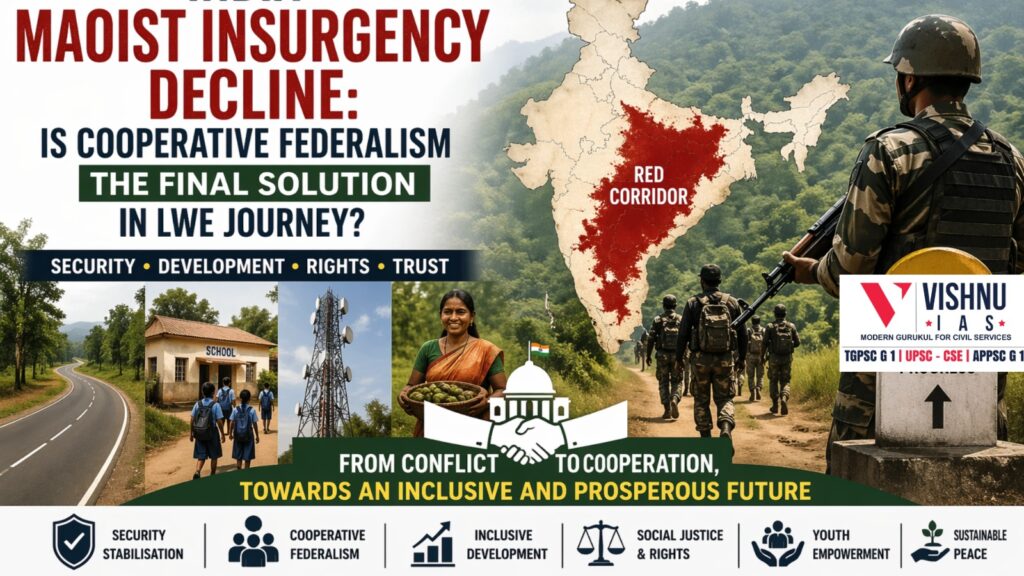
- Left Wing Extremism (LWE) refers to insurgent movements inspired by Maoist ideology, seeking to overthrow the state through armed struggle, historically concentrated in India’s “Red Corridor”. From being termed the “most serious internal security threat” in 2009, the trajectory has significantly altered, with violence declining by over 75% since its peak in 2010, alongside a sharp reduction in affected districts and casualties. The recent assertion that India is “free of Maoist insurgency” signals a decisive security achievement, but the deeper question lies in whether this marks the completion of the journey or merely a transition point toward cooperative federalism-led transformation.
Body:
1. From Counter-Insurgency to Security Stabilisation: The Necessary First Phase
a) Coordinated Security Architecture and Political Will
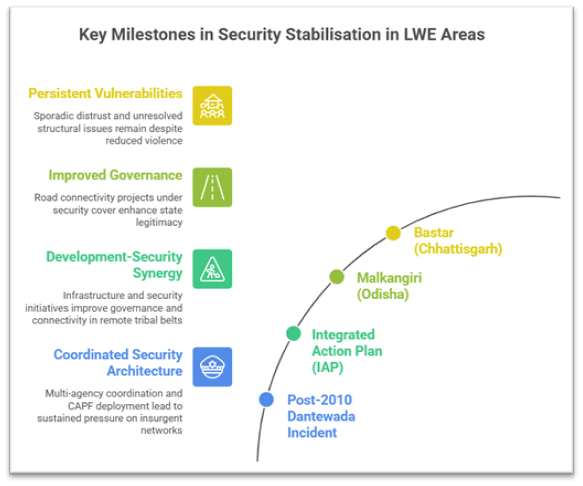
- Strengthening of multi-agency coordination between Centre and States through unified commands, intelligence sharing, and joint operations ensured sustained pressure on insurgent networks.
- Deployment of forces like Central Armed Police Forces (CAPFs) and modernization of state police improved territorial control.
- Example: The decline in major attacks post-2010 Dantewada incident reflects how consistent security operations dismantled leadership structures.
b) Development-Security Synergy in LWE Areas
- Initiatives like the Integrated Action Plan (IAP) combined infrastructure creation with security presence, enabling roads, schools, and telecom connectivity in remote tribal belts.
- Example: Districts like Malkangiri (Odisha) witnessed improved governance penetration after road connectivity projects under security cover.
- The expansion of banking, mobile networks, and PDS systems helped restore state legitimacy in previously inaccessible areas.
c) Decline of Violence but Persistence of Structural Vulnerabilities
- While incidents and casualties have reduced drastically, root causes such as land alienation, forest rights issues, and underdevelopment remain partially unresolved.
- Example: In parts of Bastar (Chhattisgarh), sporadic distrust persists despite reduced violence.
- This indicates that security success is necessary but not sufficient, requiring deeper institutional transformation.
2. Cooperative Federalism as the Core of Post-LWE Transformation
a) Joint Centre-State Governance Frameworks
- Effective transition demands cooperative federalism, where Centre and States jointly design region-specific transformation plans rather than uniform schemes.
- Example: The Aspirational Districts Programme uses real-time data monitoring and competitive federalism to improve outcomes in backward districts.
- Financial devolution through mechanisms like Finance Commission grants and Article 275(1) supports targeted tribal development.
b) Convergence of Schemes and Institutional Delivery
- The challenge lies not in lack of schemes but in convergence and last-mile delivery across sectors like health, education, and livelihoods.
- Example: Initiatives such as PM-JANMAN and Dharti Aaba Janjatiya Gram Utkarsh Abhiyan (DAJUGA) focus on saturation of basic services in tribal areas.
- Strengthening Panchayati Raj Institutions and local governance ensures continuity beyond episodic interventions.
c) Building Governance Credibility and Trust
- Transition requires moving from a security-centric state to a welfare and rights-based state, emphasizing justice, accountability, and empathy.
- Example: Community engagement models in Jungle Mahal (West Bengal) improved trust through sustained administrative presence.
- Ensuring humane policing, grievance redressal, and legal aid addresses historical alienation of tribal communities.

3. Inclusive Development and Human-Centric State: The Real “Final Mile”
a) Local Economic Transformation and Livelihood Security
- Sustainable peace depends on creating local value economies through forest produce processing, agroforestry, and MSMEs.
- Example: CASE STUDY – Saranda (Jharkhand): Transition from conflict zone to livelihood hub through mining regulation, forest rights, and skill programs.
- Promotion of eco-tourism and tribal enterprises ensures income generation close to home.
b) Social Justice, Rights, and Institutional Access
- Implementation of laws like the Forest Rights Act (FRA) and ensuring access to education, healthcare, and nutrition systems is critical.
- Example: CASE STUDY – Bastar Development Plan: Multi-sectoral interventions combining health, education, and infrastructure improved human development indicators.
- Addressing undertrial cases and legal exclusion strengthens the legitimacy of the justice system.
c) Youth Aspirations and Social Integration
- Harnessing youth potential through sports, education, and skilling transforms conflict-prone regions into opportunity zones.
- Example: CASE STUDY – Simdega (Jharkhand) & West Midnapore (West Bengal): Grassroots sports infrastructure produced national-level athletes, showcasing the role of sports as social capital.
- Expansion of residential schools, scholarships, and women-led SHGs integrates marginalized populations into mainstream development.

Conclusion:
- The decline of Maoist insurgency marks a critical inflection point rather than a definitive endpoint. While counter-insurgency coordination has ensured territorial and security control, the final mile lies in cooperative federalism-driven transformation, where governance becomes predictable, participatory, and people-centric.
- Evidence from districts witnessing improvements in health, education, and livelihoods indicators suggests that sustained state presence can convert security gains into durable peace. Moving forward, embedding dignity, justice, and economic opportunity into governance frameworks will be essential to ensure that former conflict zones emerge not as peripheries, but as integral contributors to India’s development trajectory.