
Mandatory Digital Systems in Welfare Delivery: Evaluating ABBA, Aadhaar and Geo-Tagging in India
Ensuring efficient and corruption-free welfare delivery remains a persistent administrative challenge in India, where leakages, absenteeism, and weak monitoring have historically undermined programme outcomes. Over the last decade, governments have increasingly adopted mandatory digital systems in welfare delivery such as Aadhaar-Based Biometric Authentication (ABBA), geo-tagging, digital attendance systems, and Facial Recognition Technology (FRT) as accountability tools.
These technologies are projected as enablers of transparency and real-time verification. However, their actual effectiveness remains contested, particularly when assessed against issues of exclusion, manipulation, data inaccuracies, and new forms of corruption.
Evaluating these mechanisms requires moving beyond narrow accountability metrics to a holistic focus on building responsibility-driven public service norms, as emphasised in contemporary governance scholarship.
1. Effectiveness and Limitations of Mandatory Digital Systems
1.1 Reduction in Certain Forms of Leakages and Errors
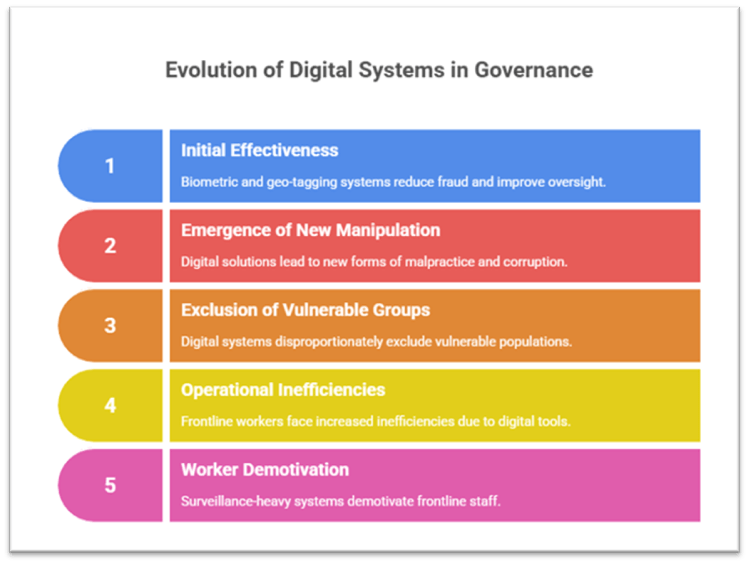
Biometric authentication systems were initially effective in limiting identity fraud, especially in schemes where ghost beneficiaries inflated beneficiary lists. For instance, ABBA helped correct beneficiary rolls in some PDS and pension systems by eliminating duplicate identities.
Geo-tagging and timestamped photographs improved surface-level oversight in programmes such as MGNREGS, where muster rolls were prone to manipulation.
Digital audit trails created deterrence, enabling administrators to investigate irregularities more quickly compared to manual systems, improving systemic transparency in several urban welfare platforms.
1.2 Emergence of New Forms of Manipulation and Continued Corruption
Digital solutions often shift the mode of malpractice rather than eliminate it. For instance, attendance systems in rural employment programmes witnessed inflated attendance through random or recycled photographs even after NMMS adoption.
Biometric failures became an opportunity for new corrupt practices, such as ration dealers claiming ABBA failure and diverting foodgrains while providing beneficiaries below-quota allocations.
Mandatory digital proof requirements in health and nutrition programmes incentivised superficial compliance, where workers prioritised uploading geo-tagged images over delivering actual services, undermining programme integrity.
1.3 Exclusion, Administrative Inefficiencies, and Worker Demotivation
Biometric or digital authentication disproportionately excluded vulnerable groups, such as the elderly, persons with disabilities, workers in remote areas with poor connectivity, and those engaged in migratory labour.
Operational inefficiencies increased, with frontline workers spending large portions of work time locating internet connectivity, managing cumbersome apps, or responding to algorithmic red flags generated due to GPS errors.
Surveillance-heavy systems demotivated frontline staff, as punitive mechanisms overshadowed recognition or trust. Instances of ANMs receiving notices due to GPS deviations illustrate how sincere workers were penalised despite intent.
2. Why Mandatory Digital Accountability Tools Fall Short
2.1 Treating Technology as a Substitute for Governance Capacity
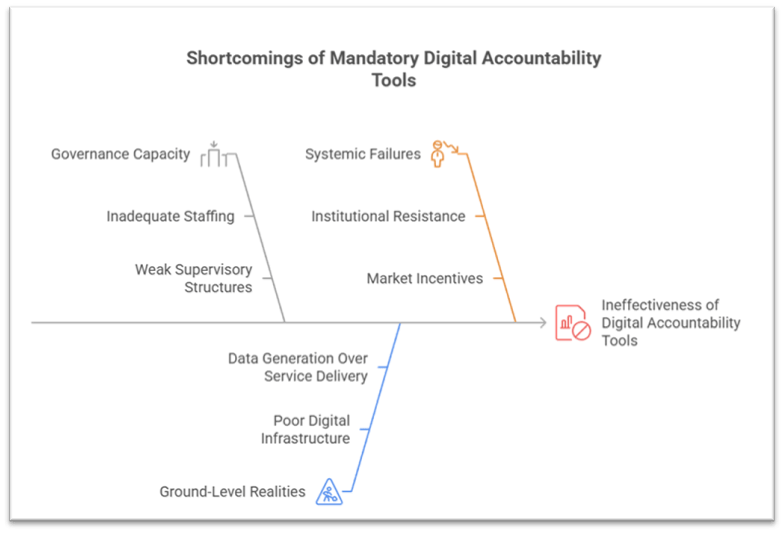
Technology cannot replace the need for adequate staffing, supervisory structures, and grievance redress mechanisms, which remain weak in many States.
Local malpractices often thrive due to collusion between multiple actors, which biometric attendance alone cannot address.
Overreliance on digital proof discourages contextual discretion, essential in welfare delivery, such as allowing others to collect rations for immobile beneficiaries.
2.2 Ignoring Ground-Level Realities and Work Conditions
Poor digital infrastructure in many regions limits system reliability, making mandatory compliance unreasonable for workers and beneficiaries.
Programmes prioritise data generation over service delivery, leading to the paradox where uploading proof becomes more important than performing actual work.
Privacy concerns and ethical issues arise when sensitive images (for example, breastfeeding mothers) are routinely uploaded without safeguards.
2.3 Cultivation of “Ignorance” Towards Systemic Failures
Administrative decisions often persist with digital tools despite documented failures, signalling institutional resistance to course correction.
Mandatory digital systems create the illusion of efficiency even when evidence shows continued inflation of records and distress to beneficiaries.
The persistence of such systems indicates that market incentives and procurement interests may influence decision-making, sidelining welfare-centric priorities.
3. Fostering Responsibility Rather Than Merely Enforcing Accountability
3.1 Strengthening Work Culture, Professional Autonomy, and Capacity Building
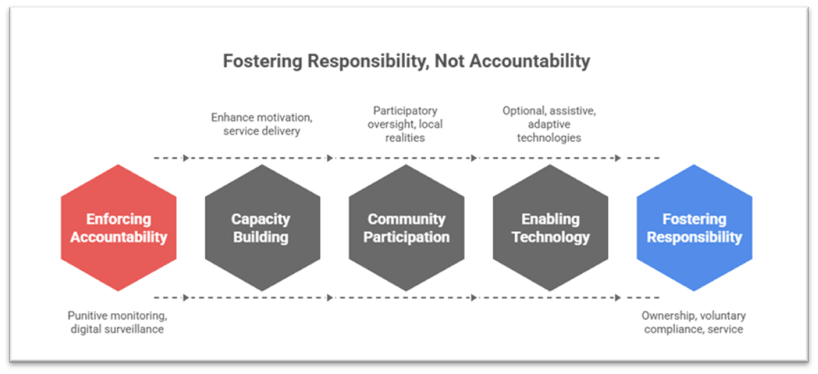
Capacity-building programmes for frontline workers enhance intrinsic motivation and service delivery standards more profoundly than punitive monitoring.
Recognition-based systems, such as performance-based community ratings or incentive-linked recognition for teachers, ANMs, and PDS staff, promote a culture of ownership.
Increasing staffing, reducing workload, and ensuring supportive supervision cultivates responsibility by aligning institutional conditions with service expectations.
3.2 Community Participation and Social Accountability Mechanisms
Social audits in MGNREGS demonstrate that community-led accountability produces more substantive improvements than digital surveillance alone.
Local grievance redress committees, beneficiary councils, and village-level monitoring groups ensure participatory oversight grounded in local realities.
Public disclosure norms such as wall writings for entitlements, muster rolls, and ration card allocations empower citizens to hold institutions responsible.
3.3 Designing Technology as an Enabler, Not an Enforcement Tool
Technologies should be optional, assistive, and adaptive, such as allowing offline authentication, multiple ID options, or backup mechanisms for those unable to comply.
Decentralised data systems with human oversight reduce the rigidity of algorithmic decisions and allow corrections based on contextual judgment.
User-centric platforms co-designed with frontline workers ensure practicality, reducing friction and demotivation and encouraging voluntary compliance with genuine service delivery.
Conclusion:
Digital systems such as ABBA, FRT, and geo-tagging have contributed to incremental improvements in identity verification and surface-level monitoring but have struggled to address deeper issues of corruption, absenteeism, and administrative culture. Evidence increasingly shows that technology-heavy mandates often produce new forms of exclusion, inefficiency, and superficial compliance without strengthening welfare delivery outcomes.
Moving forward, a balanced approach that combines trust-based administrative reforms, participatory accountability, and worker-friendly technological innovations offers a more sustainable pathway. Survey findings on public service motivation and global studies on welfare governance highlight that responsibility-driven systems outperform purely punitive accountability mechanisms.
India’s welfare governance will benefit from shifting the emphasis from compliance to genuine public-service responsibility, ensuring that technology supports — rather than replaces — human judgement and ethical commitment.
Recap: