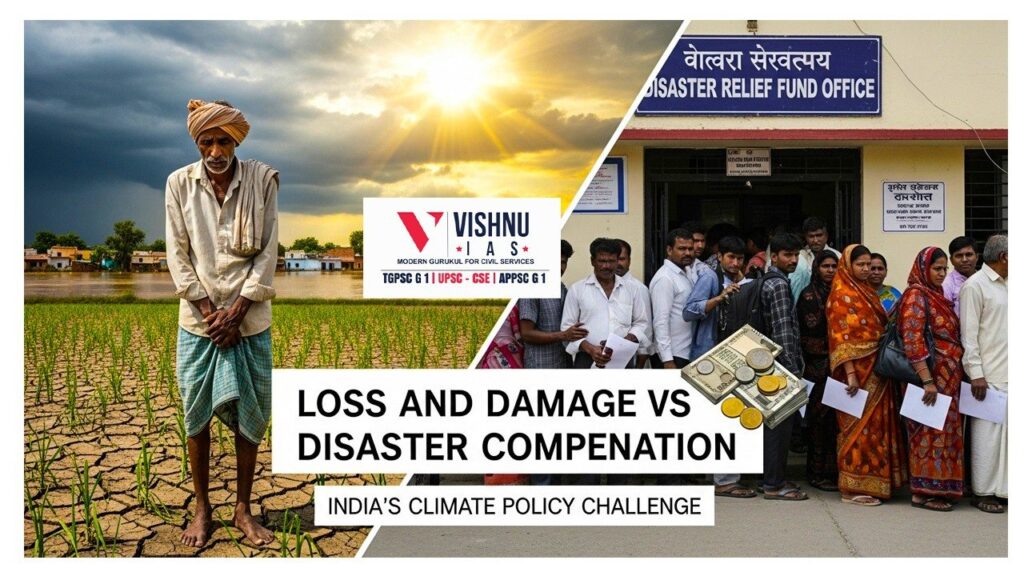
How Narrowing ‘Loss and Damage’ Hampers India’s Climate Policy Responses
Introduction
Loss and Damage refers to the irreversible and residual impacts of climate change that occur beyond the limits of adaptation, encompassing not only physical destruction but also loss of lives, livelihoods, ecosystems, cultural heritage, identity, and social cohesion. Internationally, it has emerged as a central pillar of climate justice, especially for vulnerable countries and communities facing slow-onset events such as sea-level rise, desertification, glacial retreat, and increasing heat stress.
However, in India, this concept often becomes administratively reduced to post-disaster compensation mechanisms, framed within existing disaster management vocabularies. This narrowing is consequential. Despite India witnessing a sharp rise in climate-induced extreme events—reflected in increasing frequency of heatwaves, floods, cyclones, and droughts—the policy response remains largely reactive.
The dilution of Loss and Damage into calculable, short-term relief undermines the country’s ability to address long-term climate risks, weakening governance, planning, and resilience-building at multiple levels.
Body
1. Conceptual and Governance Distortions Caused by Narrow Framing
a) Reduction of climate injustice to administrative relief
- The translation of Loss and Damage into nuksaan aaklan and haani purti confines climate impacts to quantifiable asset loss, sidelining non-economic losses such as cultural displacement, mental health trauma, and loss of commons.
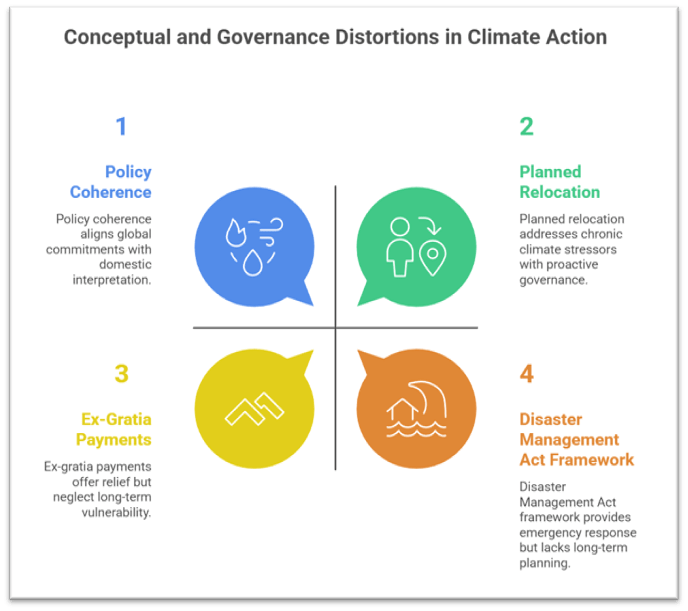
- This reinforces a relief-centric governance model, inherited from conventional disaster response frameworks, which is ill-equipped to handle chronic climate stressors.
- Example – Coastal erosion in Sundarbans: Repeated submergence of islands has led to permanent displacement and erosion of livelihoods, yet responses largely revolve around ex-gratia payments rather than planned relocation or livelihood transition.
b) Misalignment between global commitments and domestic interpretation
- While international negotiations treat Loss and Damage as a distinct pillar of climate action, domestically it is absorbed into disaster management structures, leading to policy incoherence.
- Dedicated international finance discussions fail to translate into new institutional pathways within national and State-level climate planning.
- Case Study – Climate-induced migration in Bihar: Seasonal flooding and riverbank erosion create cyclical displacement, but policy instruments remain limited to compensation, with no recognition of migration as a form of Loss and Damage.
c) Weak institutional accountability for irreversible losses
- Narrow definitions allow governments to declare administrative closure once compensation is disbursed, without addressing long-term vulnerability or cumulative losses.
- The absence of legal or policy recognition of irreversible loss reduces incentives for preventive planning.
- Government Initiative – Disaster Management Act framework: While robust for emergency response, it lacks provisions to account for slow-onset climate losses or intergenerational impacts.
2. Constraints on Climate Science Utilisation and Policy Design
a) Science–policy disconnect due to technocratic language
- India has made significant advances in climate science, including district-level climate projections and attribution studies, but these are rarely translated into actionable governance tools.
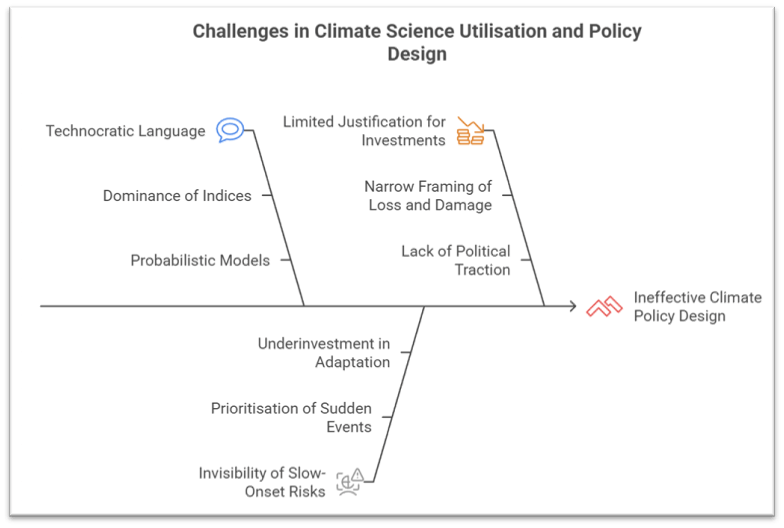
- The dominance of indices, probabilistic models, and technical jargon limits uptake by district administrators and frontline workers.
- Example – Heat vulnerability assessments: Despite detailed projections, many cities continue to respond with ad hoc measures, as scientific outputs are not aligned with operational decision-making.
b) Invisibility of slow-onset and compound risks
- Disaster compensation frameworks prioritise sudden-onset events, marginalising gradual processes such as groundwater depletion, soil salinisation, and biodiversity loss.
- This leads to underinvestment in anticipatory adaptation and ecosystem-based responses.
- Case Study – Deccan plateau drought cycles: Progressive decline in agricultural productivity and rural incomes remains inadequately addressed because impacts do not trigger disaster thresholds.
c) Limited justification for transformative investments
- When Loss and Damage is framed narrowly, climate finance is perceived as relief expenditure rather than developmental investment, constraining fiscal prioritisation.
- Long-term measures such as urban heat mitigation, resilient housing, and livelihood diversification struggle to gain political traction.
- Government Initiative – National Action Plan on Climate Change: While sectorally comprehensive, its effectiveness is diluted by weak integration with ground-level decision-making and communication.
3. Social, Behavioural, and Political Consequences of Communication Failure
a) Exclusion of lived realities from climate governance
- Climate advisories and risk communication often assume uniform capacity to respond, ignoring informal labour conditions, housing precarity, and social hierarchies.
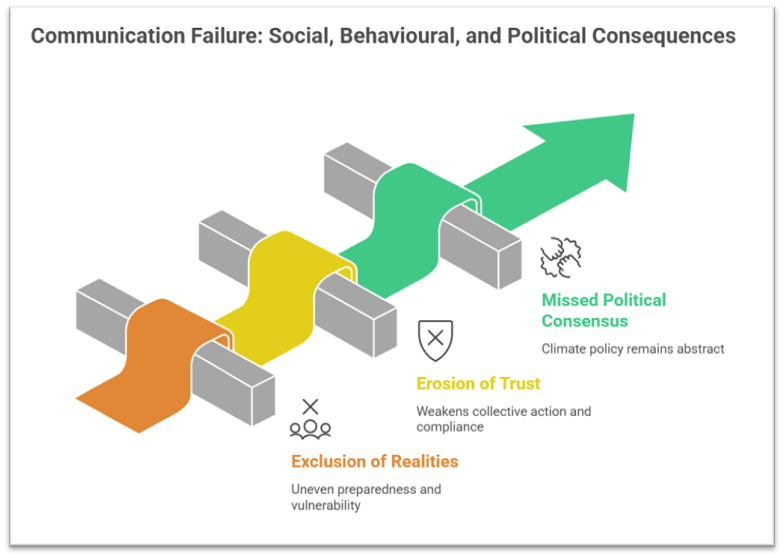
- This results in uneven preparedness and reinforces vulnerability.
- Example – Heat advisories for outdoor workers: Generic advisories fail to account for livelihood compulsions, reducing compliance and effectiveness.
b) Erosion of public trust and participation
- Complex dashboards and fragmented messaging reduce credibility, particularly when warnings do not align with local experience.
- Trust deficits weaken collective action and compliance during emergencies.
- Case Study – Odisha cyclone preparedness: Long-term investment in clear, consistent communication and community engagement transformed early warnings into trusted public signals, significantly reducing mortality.
c) Missed opportunity to build political consensus for climate action
- Without translating climate risks into everyday consequences—health outcomes, school disruptions, productivity losses—climate policy remains abstract.
- Narrow Loss and Damage narratives limit public understanding of climate change as a structural development challenge.
- Government Initiative – State Heat Action Plans: Where communication is localised and human-centric, these plans have demonstrated measurable reductions in heat-related mortality.
Conclusion:
The narrowing of Loss and Damage from a comprehensive framework addressing irreversible climate impacts to a limited model of disaster compensation constrains India’s climate response at conceptual, institutional, and societal levels. It weakens long-term planning, marginalises slow-onset risks, and perpetuates reactive governance.
Moving forward, India must adopt a broader, justice-oriented understanding of Loss and Damage, integrating it into climate planning, fiscal frameworks, and governance institutions. This requires human-centred climate communication, localisation of scientific knowledge, and recognition of non-economic losses within policy processes.
As climate risks intensify, evidence increasingly shows that investments in anticipatory action and trusted communication deliver disproportionately high returns in resilience and social stability. Strengthening this linkage can transform climate resilience from an administrative obligation into a shared developmental and democratic project.
Recap: