Labour Code Reforms and Demand-Led Growth: How Income Security Drives Economic Redistribution
Labour Code Reforms and Demand-Led Growth are increasingly interconnected in India’s evolving economic framework. Income security refers to the assurance of stable and predictable earnings along with access to social protection mechanisms such as provident fund, pension, gratuity, insurance, and minimum wages. In a country where nearly 90% of the workforce is engaged in informal employment, the challenge has historically been not merely job creation but ensuring quality employment with social security coverage.
The consolidation of 29 central labour laws into four codes — the Code on Wages (2019), the Code on Social Security (2020), the Industrial Relations Code (2020) and the Occupational Safety, Health and Working Conditions Code (2020) — represents a structural attempt to embed financial safeguards within employment relationships.
In this context, the proposition that enhanced income security can catalyse demand-led growth through redistribution from capital to labour merits a balanced and multidimensional examination.
I. Strengthening Income Security Through Structural Reforms
1. Reform of the Definition of “Wages” and Expansion of Social Security Base
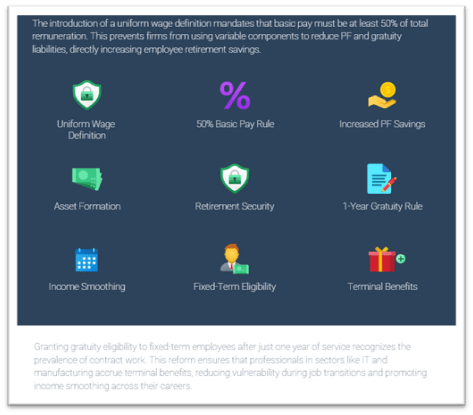
- The introduction of a uniform wage definition mandating that basic pay must constitute at least 50% of total remuneration prevents artificial structuring of salaries to reduce employer contributions toward Provident Fund (PF) and gratuity, thereby increasing long-term savings accumulation.
- Higher PF contributions lead to enhanced retirement corpus under schemes such as the Employees’ Provident Fund Organisation (EPFO) and pension coverage under the Employees’ Pension Scheme (EPS), strengthening life-cycle financial security.
- Example: In large IT and infrastructure firms where variable components previously dominated salary structures, recalibration has resulted in increased PF liabilities, translating into greater employee asset formation rather than short-term wage compression.
2. Inclusion of Fixed-Term Employees in Gratuity Framework
- Granting gratuity eligibility after one year of service to fixed-term employees recognizes the growing prevalence of contractualisation in modern labour markets.
- Earlier, contract workers exited employment without terminal benefits despite long productive contributions; this reform transforms short-term employment into a mechanism of capital accumulation and income smoothing.
- Real-Life Case Study: In sectors such as manufacturing and information technology services, where project-based employment is common, fixed-term professionals now accrue gratuity benefits, reducing vulnerability during inter-job transitions.
3. Recognition of Gig, Platform and Unorganised Workers
- The Code on Social Security extends legal recognition to gig and platform workers, enabling access to welfare schemes, insurance and contributory social protection mechanisms.
- Portability provisions address the long-standing exclusion of migrant labour, enabling benefits to travel across states and employers.
- Government Initiative: The e-Shram portal has registered crores of unorganised workers, creating a national database that facilitates targeted welfare delivery and integration into formal financial systems.
II. Income Redistribution and Demand-Led Growth Dynamics
1. Enhancement of Purchasing Power and Domestic Consumption
- When income flows toward workers rather than being retained as surplus capital, it tends to be spent on essential goods, housing, education, and healthcare, stimulating domestic demand.
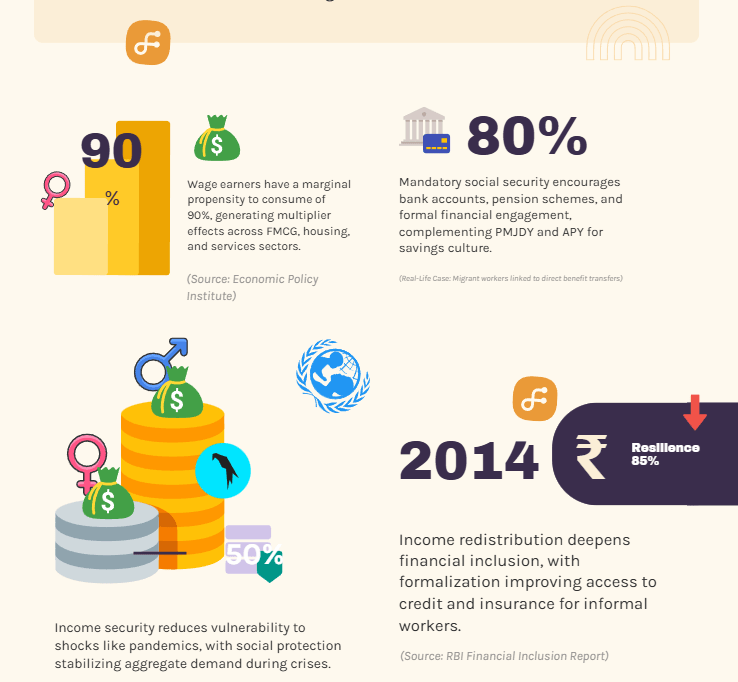
- The marginal propensity to consume among wage earners is significantly higher than among high-income shareholders, thereby generating multiplier effects across sectors such as FMCG, housing, and services.
- Example: Post-expansion of minimum wages in several states under the Code on Wages framework, consumption demand in rural and semi-urban markets has shown greater resilience during economic slowdowns.
2. Deepening Financial Inclusion and Formalisation
- Mandatory social security contributions encourage workers to open bank accounts, participate in pension schemes, and engage with formal financial institutions.
- This complements initiatives such as the Pradhan Mantri Jan Dhan Yojana (PMJDY) and the Atal Pension Yojana (APY), thereby reinforcing a culture of savings and risk mitigation.
- Real-Life Case Study: Migrant construction workers registered under welfare boards, when linked with direct benefit transfers and portable benefits, demonstrate improved access to credit and insurance products.
3. Macroeconomic Stability Through Reduced Vulnerability
- Enhanced income security reduces exposure to economic shocks, especially during crises such as pandemics or sectoral downturns.
- Social protection cushions prevent abrupt consumption collapse, thereby stabilising aggregate demand.
- Example: Workers covered under formal PF and insurance systems were relatively better positioned during the COVID-19 disruptions compared to informal workers lacking such buffers.
III. Critical Perspectives and Implementation Challenges
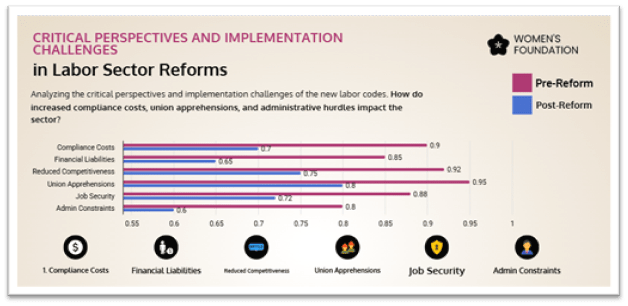
1. Concerns of Increased Compliance Costs
- Corporations, especially labour-intensive sectors, face increased financial liabilities due to higher PF contributions and gratuity payments.
- Industry bodies argue that rising labour costs may reduce competitiveness in export-oriented sectors such as textiles and electronics.
- Example: Large firms in IT and infrastructure sectors have reported substantial provisioning toward gratuity obligations following the new wage definition.
2. Trade Union Apprehensions and Industrial Relations
- Sections of trade unions contend that certain provisions of the Industrial Relations Code — such as higher thresholds for prior government approval for retrenchment — may dilute job security.
- The balance between flexibility for employers and protection for workers remains contested.
- Real-Life Case Study: Nationwide strike calls by trade unions reflect fears of potential misuse of flexibility provisions, even as the social security expansion offers tangible welfare gains.
3. Federal and Administrative Constraints
- Labour is a concurrent subject, and uniform implementation across states depends on timely notification of rules and administrative preparedness.
- Informal sector coverage requires robust identification, contribution collection mechanisms, and grievance redressal frameworks.
- Government Initiative: Integration of labour databases with digital platforms such as Shram Suvidha Portal aims to simplify compliance while enhancing transparency, but ground-level awareness remains uneven.
Conclusion:
The recent labour code reforms represent a structural recalibration of India’s labour governance framework, embedding social security, wage protection, and formalisation within employment relationships. By strengthening provident fund accumulation, extending gratuity coverage, and recognising gig and unorganised workers, the reforms enhance income security, which in turn stimulates demand-led growth through higher consumption and financial inclusion. In an economy where domestic demand constitutes a substantial share of GDP, redistributing economic value toward labour can reinforce growth sustainability while reducing inequality.
However, the success of this redistributive shift depends on effective implementation, balanced industrial relations, and cooperative federalism. Strengthening digital labour registries, ensuring transparent compliance mechanisms, and facilitating tripartite dialogue between government, employers, and workers will be critical.
Recap: