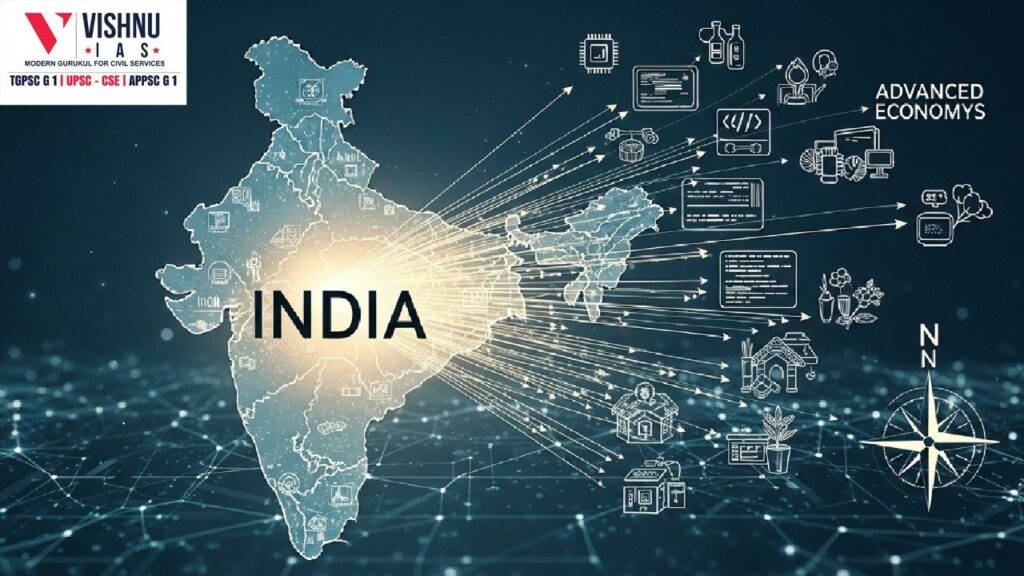
India’s Trade Diplomacy Shift: From Cautious Regionalism to Proactive Integration with Advanced Economies
India’s Trade Diplomacy Shift refers to the transformation in India’s global economic engagement from a strategy of cautious regionalism to proactive integration with advanced economies. Trade diplomacy refers to the use of trade agreements, negotiations, and economic partnerships as strategic instruments to promote national economic growth, market access, and geopolitical influence. India’s trade diplomacy has undergone a major transformation from a model of “cautious regionalism”, focused on developing economies, to “proactive integration” with advanced global markets.
This shift is reflected in the updated Foreign Trade Policy (FTP) 2023, which aims to increase India’s exports to $2 trillion by 2030, and in the steady rise of India’s total exports to $825.25 billion in 2025, marking a 6.05% annual growth, according to official trade reviews.
Further, the expansion of India’s Free Trade Agreement (FTA) coverage from around 22% of exports in 2019 to nearly 71% projected by 2026 illustrates a decisive structural change in India’s global economic engagement, aimed at strengthening supply chains, enhancing technological competitiveness, and reinforcing strategic autonomy.
I. Nature and Drivers of the Shift: From Cautious Regionalism to Proactive Integration
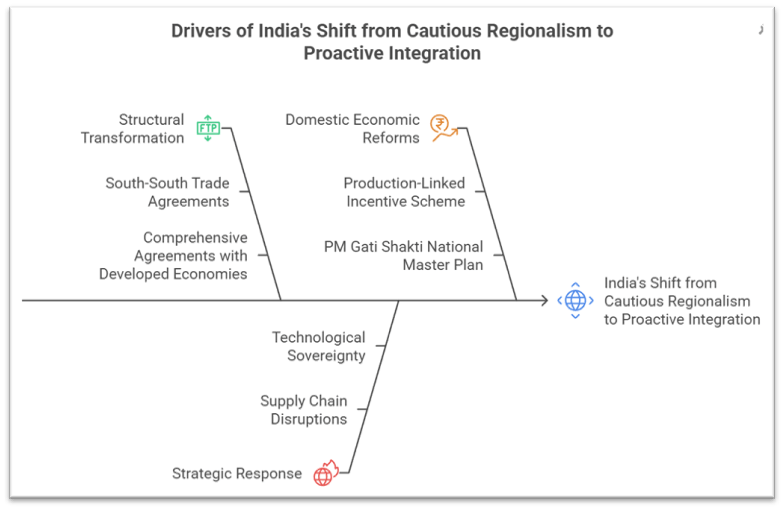
1. Structural Transformation in India’s FTA Approach
India earlier focused on South-South trade agreements, prioritizing developing economies such as ASEAN under the ASEAN-India FTA (2010) to protect domestic industries and avoid premature exposure to advanced competition. This cautious approach reflected concerns over trade deficits, domestic industrial vulnerability, and limited export competitiveness.
In contrast, India has now concluded comprehensive agreements with developed economies such as Australia under the India-Australia Economic Cooperation and Trade Agreement (ECTA) 2022, eliminating tariffs on over 85% of Australian goods and enabling duty-free access for Indian textiles, leather, and jewellery, demonstrating willingness to integrate with advanced economies.
Example: UAE-India Comprehensive Economic Partnership Agreement (CEPA), 2022 has significantly boosted bilateral trade, contributing to India-UAE trade surpassing $85 billion, strengthening India’s position in global logistics and re-export hubs like Dubai.
2. Strategic Response to Changing Global Economic and Geopolitical Realities
India’s shift reflects adaptation to emerging geopolitical realities such as supply chain disruptions caused by the COVID-19 pandemic and geopolitical tensions, which exposed risks of overdependence on single markets, particularly China.
The emphasis on agreements with technologically advanced economies supports India’s participation in emerging sectors such as semiconductors, renewable energy, artificial intelligence, and critical minerals, strengthening technological sovereignty.
Example: India-US Trade Framework Agreement (2026 interim arrangement) prioritizes collaboration in rare earth minerals and semiconductors, complementing domestic initiatives like the India Semiconductor Mission, which aims to build indigenous chip manufacturing capacity.
3. Alignment with Domestic Economic Reforms and Industrial Policy
Trade diplomacy now complements domestic initiatives such as the Production-Linked Incentive (PLI) Scheme, which allocates over ₹1.97 lakh crore to boost manufacturing in sectors like electronics, pharmaceuticals, and automobiles, enabling firms to compete globally.
Integration with global markets enhances returns on infrastructure investments such as the PM Gati Shakti National Master Plan, which improves logistics efficiency and reduces trade costs.
Example: Apple’s expansion of iPhone manufacturing in India under PLI has increased India’s electronics exports beyond $30 billion annually, showing how proactive trade integration supports manufacturing growth.
II. Economic and Strategic Implications of Proactive Integration
1. Enhanced Market Access and Export Competitiveness
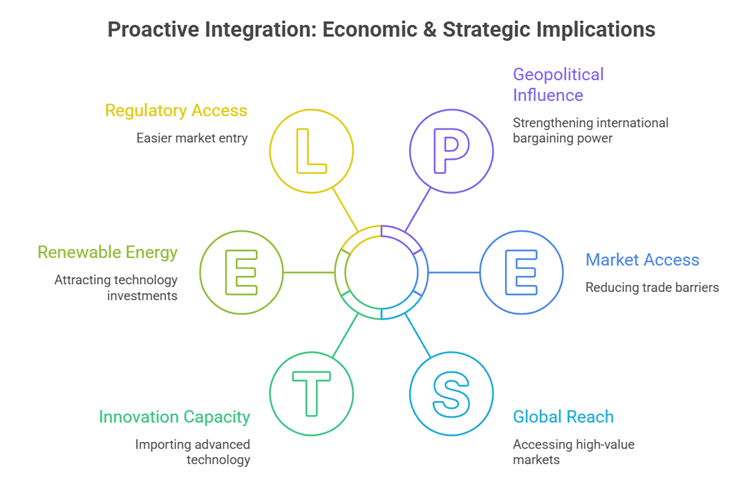
Trade agreements with advanced economies reduce tariffs and non-tariff barriers, enabling Indian exporters to access high-value markets with greater purchasing power, particularly in sectors such as pharmaceuticals, textiles, engineering goods, and services.
The India-EU trade agreement signed in 2026, covering nearly two billion people, reduces tariffs on over 90% of traded goods, improving India’s competitiveness against countries like Vietnam and Bangladesh in labour-intensive sectors.
Example: Indian pharmaceutical exports benefit from easier regulatory access to European markets, strengthening India’s position as the “pharmacy of the world,” supplying over 50% of global vaccine demand.
2. Integration into Global Value Chains (GVCs) and Technological Upgrading
Trade agreements facilitate the import of advanced machinery, intermediate goods, and technology, reducing production costs and improving productivity and innovation capacity.
This integration enables Indian firms to participate in fragmented global production systems, especially in electronics, automobiles, and renewable energy sectors.
Example: Tesla and semiconductor firms exploring manufacturing investments in India illustrate how trade openness attracts technology-intensive investments and strengthens India’s manufacturing ecosystem.
3. Strengthening Geopolitical Influence and Strategic Autonomy
Trade agreements serve as instruments of economic diplomacy, enhancing India’s bargaining power in international forums such as the World Trade Organization (WTO) and the G20, especially during India’s G20 Presidency in 2023, which emphasized supply chain resilience.
Diversification of trade partnerships reduces dependence on any single country, strengthening economic security and policy independence.
Example: India’s decision to opt out of the Regional Comprehensive Economic Partnership (RCEP) in 2019 while pursuing bilateral agreements demonstrates a calibrated approach to protect domestic industries while expanding global integration.
III. Challenges, Risks, and Policy Responses in India’s Proactive Trade Diplomacy
1. Domestic Industrial Vulnerability and Adjustment Challenges
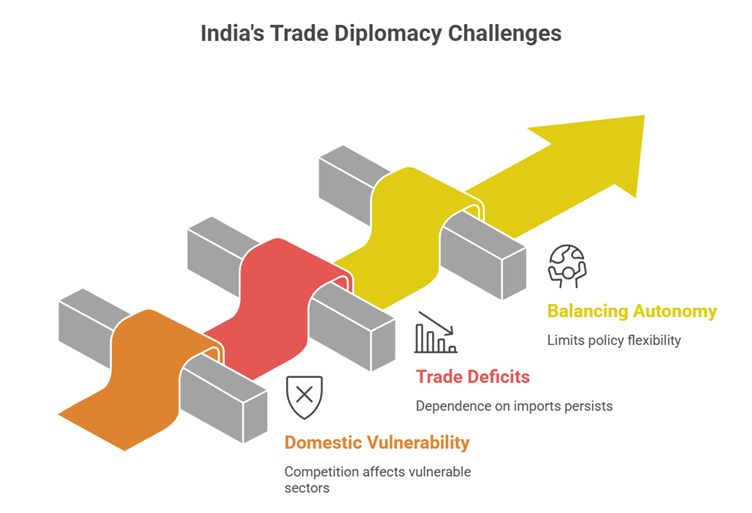
Exposure to competition from advanced economies may affect vulnerable sectors such as agriculture, dairy, and small-scale manufacturing due to differences in productivity and scale.
Example: Concerns raised by Indian dairy producers during trade negotiations with Australia highlight risks to domestic livelihoods if imports increase.
Government initiative: The Atmanirbhar Bharat Abhiyan supports domestic manufacturing through infrastructure investment and financial incentives to enhance competitiveness.
2. Persistent Trade Deficits and Structural Export Constraints
India continues to face trade deficits with major partners due to high dependence on imports of crude oil, electronics, and capital goods, highlighting structural weaknesses in domestic production capacity.
Improving export competitiveness requires addressing constraints such as logistics inefficiencies, regulatory complexity, and technological gaps.
Government initiative: The Remission of Duties and Taxes on Exported Products (RoDTEP) Scheme reduces tax burdens on exporters, enhancing global competitiveness.
3. Balancing Economic Integration with Strategic and Policy Autonomy
Deep trade agreements often involve commitments on intellectual property, investment protection, and digital trade, which may limit policy flexibility if not negotiated carefully.
India aims to maintain a balance between openness and sovereignty by pursuing calibrated liberalization, ensuring domestic industrial development alongside global integration.
Example: India’s digital trade policies emphasize data sovereignty while engaging in international digital trade agreements, reflecting strategic balancing.
Conclusion
India’s shift from cautious regionalism to proactive integration represents a structural transformation in its economic and diplomatic strategy, driven by the need to enhance export competitiveness, technological capability, and geopolitical influence. With exports reaching $825 billion and targeted to reach $2 trillion by 2030, trade diplomacy has become central to India’s aspiration of becoming a leading global economic power.
Moving forward, strengthening domestic manufacturing through initiatives such as PLI, infrastructure expansion, and skill development, while ensuring balanced and equitable trade agreements, will be crucial. By strategically integrating into global value chains and diversifying trade partnerships, India is well positioned to emerge as a resilient, competitive, and influential actor in the evolving global economic order.
Recap: