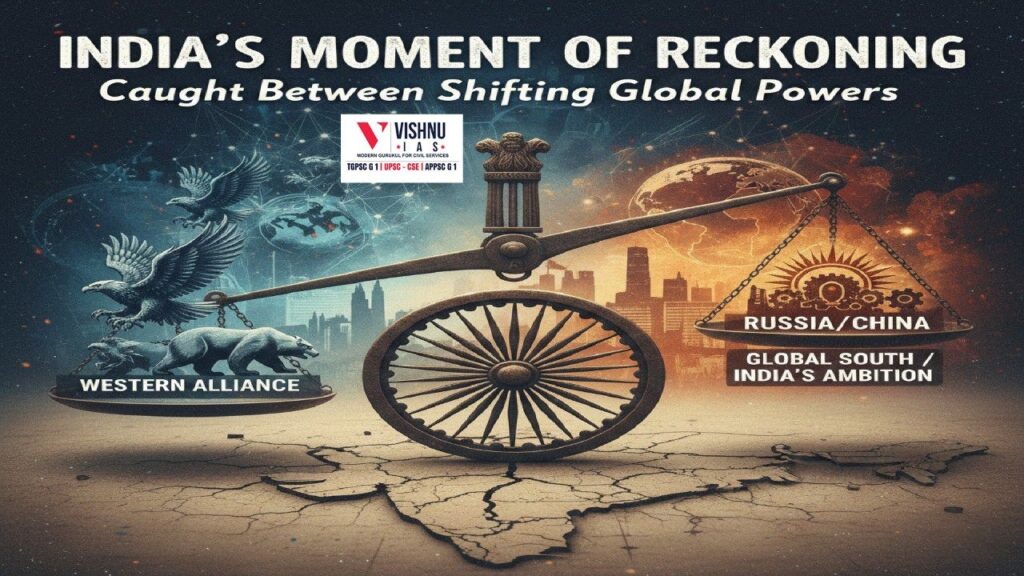
India’s Moment of Reckoning: Is It Becoming an Outlier in Global Politics?
Introduction:
- India’s strategic environment in the mid-2020s is marked by heightened regional volatility, sharpening great-power contestation, and a rise in non-traditional security threats, prompting many analysts to describe the present as a “moment of reckoning” for Indian foreign policy. The assertion that India risks appearing as an “outlier” in global affairs emerges from its limited participation in major peace negotiations, growing perception gaps with traditional partners, and the simultaneous breakdown of stability across South Asia.
- This coincides with a period in which India’s neighbourhood is experiencing its most severe churn since the early 1990s, while India’s diplomacy must navigate competing expectations in multipolar structures such as the G20, Quad, BRICS-Plus, and I2U2.
- India’s relative detachment from crises in West Asia, Europe, and the Indo-Pacific is contrasted against rising regional hostilities and revived internal security risks, amplifying concerns about diplomatic isolation.
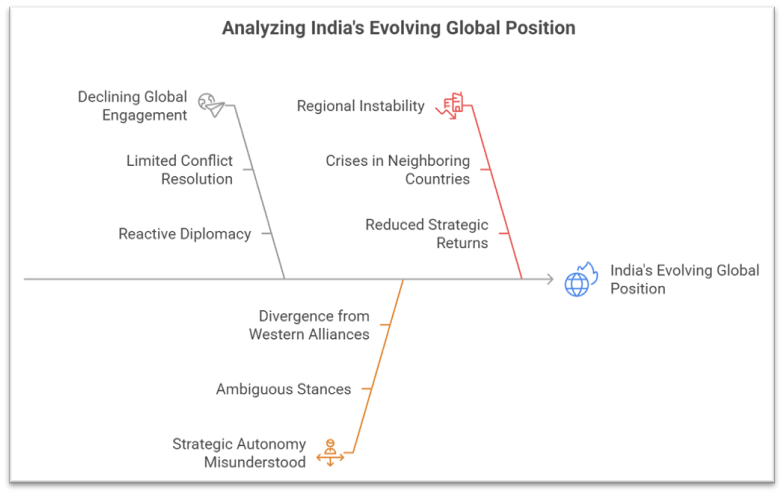
1. India’s Evolving Global Position: The “Outlier” Perception
a) Declining engagement in global conflict resolution
- India’s historically active role in peacekeeping, NAM diplomacy, and conflict mediation contrasts with recent limited participation in shaping outcomes in West Asia, Ukraine, the Red Sea crisis, or Pacific security debates.
- Absence from major diplomatic tracks has led observers to argue that India is now reactive rather than agenda-setting, even as it holds influence through platforms such as the G20 presidency outcomes, which advocated debt restructuring and digital public infrastructure.
- Examples such as India’s non-involvement in Gaza ceasefire talks and minimal engagement in the Ukraine peace summit(s) illustrate a shrinking diplomatic footprint at a time of heightened global instability.
b) Strategic autonomy misunderstood amid multipolarity
- India’s doctrine of multi-alignment sometimes appears ambiguous to partners expecting clearer stances, especially on issues like sanctions, energy trade, and supply chain coalitions.
- Divergence from positions taken by Western alliances on Russia, climate finance, and human rights produces a perception of India standing alone, even though India views this as safeguarding economic and energy security.
- Case study: India’s discounted oil imports strategy ensured inflation control domestically but generated friction with G7 narratives on sanction compliance.
c) Regional instability weakening India’s normative influence
- India previously positioned itself as South Asia’s anchor of stability, leveraging economic assistance, development partnerships, and security cooperation.
- Successive crises in Sri Lanka, Nepal, Myanmar, the Maldives, and Afghanistan have complicated India’s ability to project regional leadership.
- Government initiatives like Neighbourhood First, Humanitarian Assistance and Disaster Relief (HADR) operations, and Line of Credit programmes remain active, but the deterioration of political environments reduces India’s strategic returns.
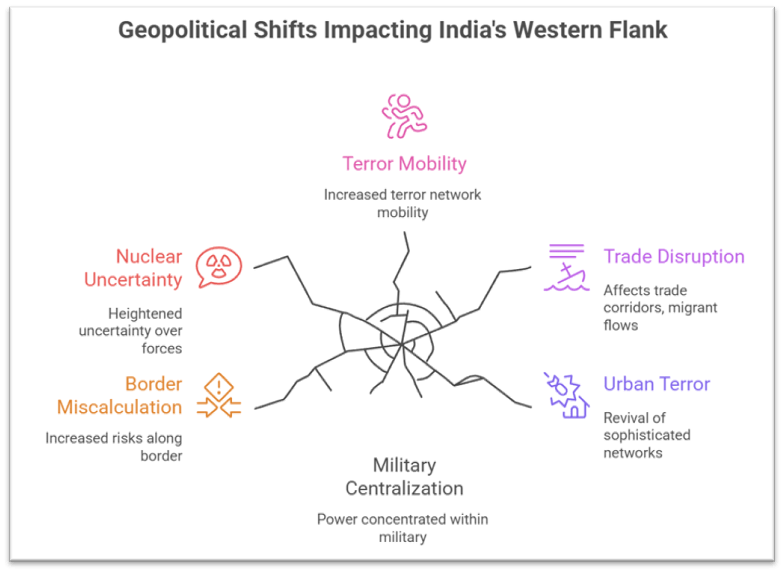
2. Geopolitical Shifts on the Western Flank: Escalation of Hostilities
a) Military centralisation and instability in Pakistan
- Pakistan’s internal shifts, including greater concentration of power within the military establishment, expand risks of miscalculation along the western border.
- The emergence of a centralised security command overseeing nuclear forces heightens uncertainty, especially amid public rhetoric calling for confrontation with India.
- Examples include earlier crises such as Kargil 1999 and the 2016 Uri–Balakot escalation, where military adventurism coincided with unstable civil-military equations.
b) Spillover risks from Afghanistan and West Asian turbulence
- Afghanistan’s humanitarian and security crisis has increased terror networks’ mobility across the region, fuelling concerns about infiltration attempts along India’s western frontier.
- West Asian instability—such as the Bab-al-Mandeb shipping disruptions, the Iran–Gulf rivalry, and the broader energy security backdrop—affects India’s dependence on the region for trade corridors and migrant flows.
- Government responses include strengthened border fencing, renewed counter-terror cooperation, and enhanced intelligence-sharing with Gulf partners.
c) Revival of sophisticated urban terror networks
- The emergence of new terror modules involving educated professionals, with logistical hubs stretching from Jammu & Kashmir to major NCR cities, marks a major qualitative change compared to earlier patterns dominated by externally trained operatives.
- Acquisition of large quantities of explosive materials and evasion of detection highlight systemic vulnerabilities.
- Past examples like the 2008 Mumbai attacks, 2016 Pathankot, and 2023 Rajouri incidents reveal the persistent nature of hybrid threats despite improved security frameworks such as the National Investigation Agency (NIA) and the Multi-Agency Centre (MAC).
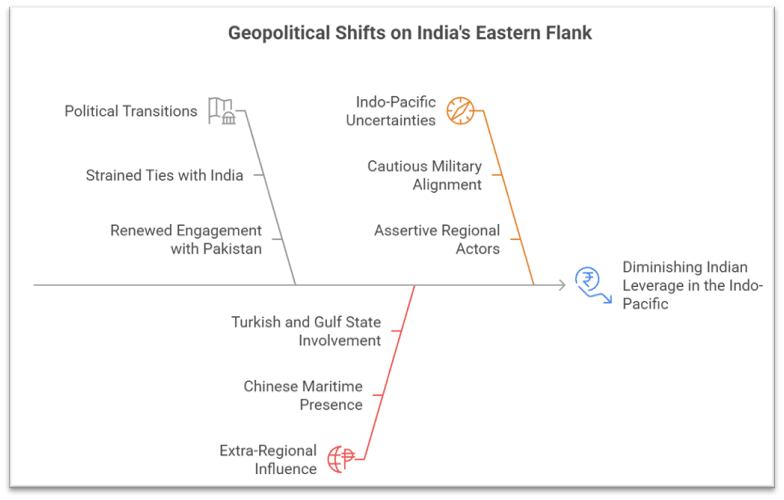
3. Geopolitical Shifts on the Eastern Flank: Emerging Fault Lines
a) Political transition and strategic drift in Bangladesh
- The emergence of an interim government with strained ties with India has altered the previously cooperative bilateral trajectory.
- Bangladesh’s renewed openness to engaging with Pakistan and external naval actors increases the strategic footprint of rival powers in the Bay of Bengal, a zone crucial for India’s eastern maritime security.
- India’s initiatives such as BBIN connectivity, BIMSTEC security cooperation, and coastal surveillance networks face reduced traction under the current circumstances.
b) Growing extra-regional influence in the Bay of Bengal and Southeast Asia
- Shifts in the Maldives, Myanmar, and Sri Lanka have opened avenues for Chinese, Turkish, and Gulf state maritime presence, limiting India’s traditional dominance.
- Increasing frequency of foreign naval visits, port calls, and dual-use infrastructure development challenge India’s ability to shape regional outcomes.
- Case study: The Hambantota port dynamics and Myanmar’s evolving military relationships demonstrate how strategic vacuum invites external actors.
c) Indo-Pacific uncertainties diminishing India’s leverage
- Despite being a founding member of the Quad, India remains cautious on overt military alignment, affecting its influence in shaping Indo-Pacific deterrence structures.
- In contrast, regional actors such as Japan, Australia, and ASEAN states take more assertive stances on maritime coercion.
- India continues efforts through mechanisms like Act East Policy, SAGAR doctrine, and defence agreements with Vietnam and Indonesia, but expectations for a more active leadership role remain unmet.
Conclusion:
- India’s so-called “moment of reckoning” arises from the convergence of regional hostility, global volatility, and internal security reconfigurations. While India is not diplomatically isolated, the perception of being an “outlier” reflects gaps between the scale of global crises and India’s calibrated, sometimes cautious approach.
- The geopolitical shifts on the western and eastern flanks—ranging from militarised politics in Pakistan to strategic drift in Bangladesh—compound this perception by constraining India’s regional manoeuvrability.
- Going forward, India can mitigate these risks through deeper neighbourhood engagement, stronger Indo-Pacific partnerships, investment in counter-terror capabilities, and proactive participation in global conflict-resolution processes.
- Leveraging its strengths in digital diplomacy, economic scale, demographic advantage, and development partnerships, India can reorient its external posture to regain strategic centrality in global affairs.
Recap:
1. India’s Evolving Global Position: The “Outlier” Perception
a) Declining engagement in global conflict resolution
- India’s historically active role in peacekeeping, NAM diplomacy, and conflict mediation contrasts with recent limited participation in shaping outcomes in West Asia, Ukraine, the Red Sea crisis, or Pacific security debates.
- Absence from major diplomatic tracks has led observers to argue that India is now reactive rather than agenda-setting, even as it holds influence through platforms such as the G20 presidency outcomes, which advocated debt restructuring and digital public infrastructure.
- Examples such as India’s non-involvement in Gaza ceasefire talks and minimal engagement in the Ukraine peace summit(s) illustrate a shrinking diplomatic footprint at a time of heightened global instability.
b) Strategic autonomy misunderstood amid multipolarity
- India’s doctrine of multi-alignment sometimes appears ambiguous to partners expecting clearer stances, especially on issues like sanctions, energy trade, and supply chain coalitions.
- Divergence from positions taken by Western alliances on Russia, climate finance, and human rights produces a perception of India standing alone, even though India views this as safeguarding economic and energy security.
- Case study: India’s discounted oil imports strategy ensured inflation control domestically but generated friction with G7 narratives on sanction compliance.
c) Regional instability weakening India’s normative influence
- India previously positioned itself as South Asia’s anchor of stability, leveraging economic assistance, development partnerships, and security cooperation.
- Successive crises in Sri Lanka, Nepal, Myanmar, the Maldives, and Afghanistan have complicated India’s ability to project regional leadership.
- Government initiatives like Neighbourhood First, Humanitarian Assistance and Disaster Relief (HADR) operations, and Line of Credit programmes remain active, but the deterioration of political environments reduces India’s strategic returns.
2. Geopolitical Shifts on the Western Flank: Escalation of Hostilities
a) Military centralisation and instability in Pakistan
- Pakistan’s internal shifts, including greater concentration of power within the military establishment, expand risks of miscalculation along the western border.
- The emergence of a centralised security command overseeing nuclear forces heightens uncertainty, especially amid public rhetoric calling for confrontation with India.
- Examples include earlier crises such as Kargil 1999 and the 2016 Uri–Balakot escalation, where military adventurism coincided with unstable civil-military equations.
b) Spillover risks from Afghanistan and West Asian turbulence
- Afghanistan’s humanitarian and security crisis has increased terror networks’ mobility across the region, fuelling concerns about infiltration attempts along India’s western frontier.
- West Asian instability—such as the Bab-al-Mandeb shipping disruptions, the Iran–Gulf rivalry, and the broader energy security backdrop—affects India’s dependence on the region for trade corridors and migrant flows.
- Government responses include strengthened border fencing, renewed counter-terror cooperation, and enhanced intelligence-sharing with Gulf partners.
c) Revival of sophisticated urban terror networks
- The emergence of new terror modules involving educated professionals, with logistical hubs stretching from Jammu & Kashmir to major NCR cities, marks a major qualitative change compared to earlier patterns dominated by externally trained operatives.
- Acquisition of large quantities of explosive materials and evasion of detection highlight systemic vulnerabilities.
- Past examples like the 2008 Mumbai attacks, 2016 Pathankot, and 2023 Rajouri incidents reveal the persistent nature of hybrid threats despite improved security frameworks such as the National Investigation Agency (NIA) and the Multi-Agency Centre (MAC).
3. Geopolitical Shifts on the Eastern Flank: Emerging Fault Lines
a) Political transition and strategic drift in Bangladesh
- The emergence of an interim government with strained ties with India has altered the previously cooperative bilateral trajectory.
- Bangladesh’s renewed openness to engaging with Pakistan and external naval actors increases the strategic footprint of rival powers in the Bay of Bengal, a zone crucial for India’s eastern maritime security.
- India’s initiatives such as BBIN connectivity, BIMSTEC security cooperation, and coastal surveillance networks face reduced traction under the current circumstances.
b) Growing extra-regional influence in the Bay of Bengal and Southeast Asia
- Shifts in the Maldives, Myanmar, and Sri Lanka have opened avenues for Chinese, Turkish, and Gulf state maritime presence, limiting India’s traditional dominance.
- Increasing frequency of foreign naval visits, port calls, and dual-use infrastructure development challenge India’s ability to shape regional outcomes.
- Case study: The Hambantota port dynamics and Myanmar’s evolving military relationships demonstrate how strategic vacuum invites external actors.
c) Indo-Pacific uncertainties diminishing India’s leverage
- Despite being a founding member of the Quad, India remains cautious on overt military alignment, affecting its influence in shaping Indo-Pacific deterrence structures.
- In contrast, regional actors such as Japan, Australia, and ASEAN states take more assertive stances on maritime coercion.
- India continues efforts through mechanisms like Act East Policy, SAGAR doctrine, and defence agreements with Vietnam and Indonesia, but expectations for a more active leadership role remain unmet.
Conclusion:
- India’s so-called “moment of reckoning” arises from the convergence of regional hostility, global volatility, and internal security reconfigurations. While India is not diplomatically isolated, the perception of being an “outlier” reflects gaps between the scale of global crises and India’s calibrated, sometimes cautious approach.
- The geopolitical shifts on the western and eastern flanks—ranging from militarised politics in Pakistan to strategic drift in Bangladesh—compound this perception by constraining India’s regional manoeuvrability.
- Going forward, India can mitigate these risks through deeper neighbourhood engagement, stronger Indo-Pacific partnerships, investment in counter-terror capabilities, and proactive participation in global conflict-resolution processes.
- Leveraging its strengths in digital diplomacy, economic scale, demographic advantage, and development partnerships, India can reorient its external posture to regain strategic centrality in global affairs.
Recap: