
Introduction
India’s LPG vulnerability highlights a deep structural imbalance in the country’s energy ecosystem rather than a temporary supply issue.
• Liquefied Petroleum Gas (LPG) is a clean-burning hydrocarbon fuel (mainly propane and butane) widely used for cooking, heating, and industrial applications. In India, LPG has become the primary cooking fuel, especially after large-scale clean energy transitions.
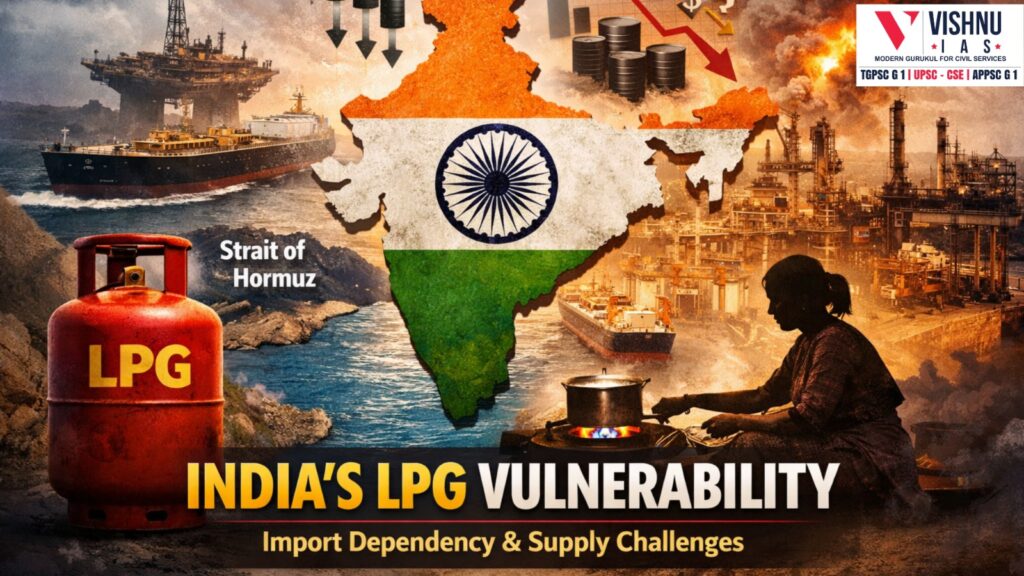
• However, India’s LPG ecosystem reveals a structural imbalance—with consumption far exceeding domestic production capacity. India consumes over 33 million tonnes annually, yet domestic output meets only about 40% of demand, forcing reliance on imports for nearly 60%, largely routed through the Strait of Hormuz, a geopolitically sensitive chokepoint.
• This dependence becomes critical because over 90% of LPG consumption is household-based, making demand highly inelastic and socially sensitive.
Body
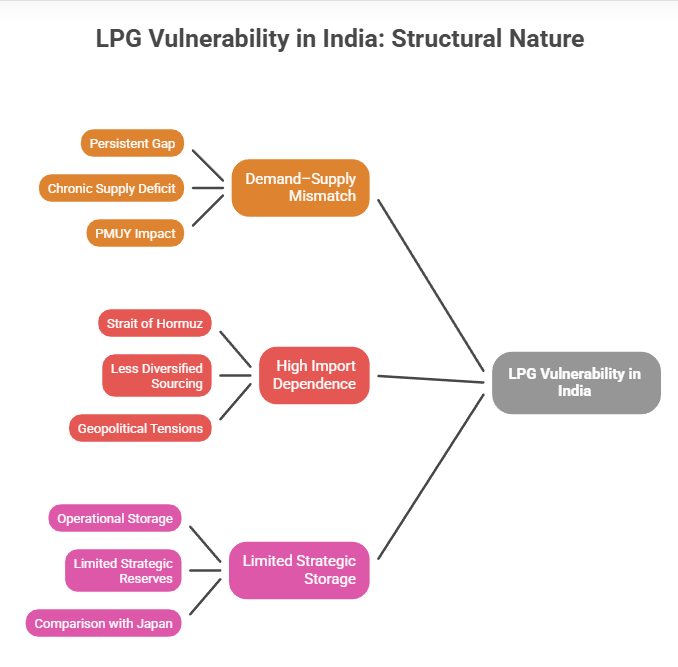
1. Structural Nature of LPG Vulnerability: Demand–Supply Mismatch
a) Persistent gap between domestic production and consumption
• India’s LPG demand has expanded rapidly due to welfare-driven energy transition policies like Pradhan Mantri Ujjwala Yojana, which significantly increased household LPG penetration, especially in rural areas.
• Domestic refining and gas fractionation capacities have not kept pace, leading to a chronic supply deficit, unlike temporary shortages caused by seasonal or logistical disruptions.
• Example: PMUY expanded LPG coverage to over 95% of households, but refill rates remain uneven, indicating dependence without full affordability or supply flexibility.
b) High import dependence with concentrated supply routes
• Around 90% of LPG imports transit through the Strait of Hormuz, making India vulnerable to geopolitical tensions in West Asia.
• Unlike crude oil (which has diversified sourcing and strategic reserves), LPG imports are less diversified, increasing systemic risk.
• Case Study: Strait of Hormuz disruptions – Periodic tensions involving Iran have demonstrated how supply routes can become chokepoints, affecting downstream availability in importing nations like India.
c) Limited strategic storage and buffer capacity
• India’s LPG storage is largely operational (tankage-based) rather than strategic (cavern-based reserves), providing only about 15 days of cover, with deep storage equivalent to barely 1–2 days of national demand.
• This is significantly lower compared to countries like Japan, which maintain over 100 days of LPG reserves, highlighting India’s vulnerability to prolonged disruptions.
• Example: Underground LPG caverns at Visakhapatnam and Mangaluru are still insufficient relative to demand scale.
2. Household-Centric Consumption: A Unique Structural Constraint
a) Dominance of domestic sector in LPG consumption
• In India, over 90% of LPG is consumed by households, unlike countries where LPG is widely used in petrochemicals, autogas, and industry.
• This creates inelastic demand, as cooking fuel cannot be easily curtailed or deferred, unlike industrial usage.
• Example: During supply shocks, industries can switch fuels, but households cannot easily replace LPG without affecting basic living standards.
b) Limited energy alternatives for households
• Despite electrification under Saubhagya Scheme, cooking energy transition remains incomplete due to issues like reliable power supply, affordability of induction stoves, and cultural preferences.
• Piped Natural Gas (PNG) networks are limited to urban clusters, leaving a vast rural population dependent on LPG cylinders.
• Case Study: Urban–Rural divide – Cities like Delhi and Mumbai have PNG access, while rural regions continue to depend almost exclusively on LPG or biomass.
c) Social and welfare implications of supply disruption
• LPG is directly linked to women’s health, indoor air quality, and gender equity, making it a politically and socially sensitive commodity.
• Any disruption affects not just energy security but also public welfare outcomes, increasing the stakes of import dependence.
• Example: PMUY beneficiaries often revert to biomass during price spikes or refill shortages, highlighting fragility in sustained usage.

3. Global Market Dynamics and Strategic Constraints
a) Tight global LPG market and competition
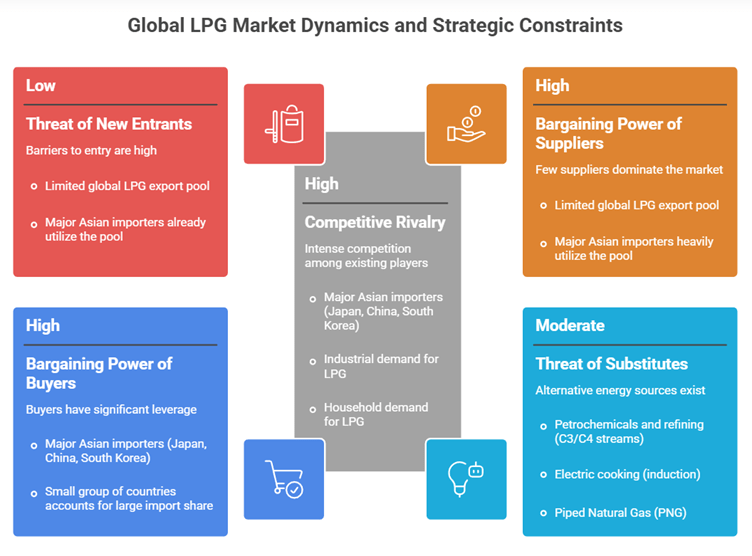
• The global LPG export pool is limited and already heavily utilized by major Asian importers like Japan, China, and South Korea, leaving little flexibility for diversion during crises.
• A small group of countries accounts for a large share of imports, creating intense competition during supply shocks.
• Example: East Asian economies have long-term contracts and diversified energy mixes, giving them a relative advantage over India.
b) Sectoral competition within domestic economy
• LPG is also used in petrochemicals and refining (C3/C4 streams), creating competition between industrial and household demand.
• Without clear prioritization, domestic LPG production may be diverted to higher-value industrial uses, exacerbating household vulnerability.
• Example: During disruptions, India has had to prioritize LPG allocation for cooking over petrochemical feedstock.
c) Inadequate diversification of energy mix
• Compared to countries like Japan, where electricity accounts for over half of residential energy use, India’s cooking energy mix remains heavily skewed toward LPG.
• Transition to electric cooking (induction) and expansion of PNG is still in early stages.
• Case Study: Japan’s model – Despite higher import dependence, diversified household energy sources and large reserves significantly reduce vulnerability.
Conclusion
• India’s LPG vulnerability is fundamentally a structural imbalance rooted in high demand, import concentration, and limited substitution options, rather than a temporary supply disruption. The challenge lies in reconciling energy access expansion with supply security and resilience.
• Moving forward, India must adopt a multi-pronged strategy: expanding strategic LPG reserves to at least 2–3 weeks of demand, prioritizing domestic LPG for household use, accelerating electric cooking adoption, and diversifying import sources and energy alternatives.
• With rising energy demand and geopolitical uncertainties, addressing this structural mismatch is essential to ensure sustainable and secure household energy access while maintaining broader economic stability.