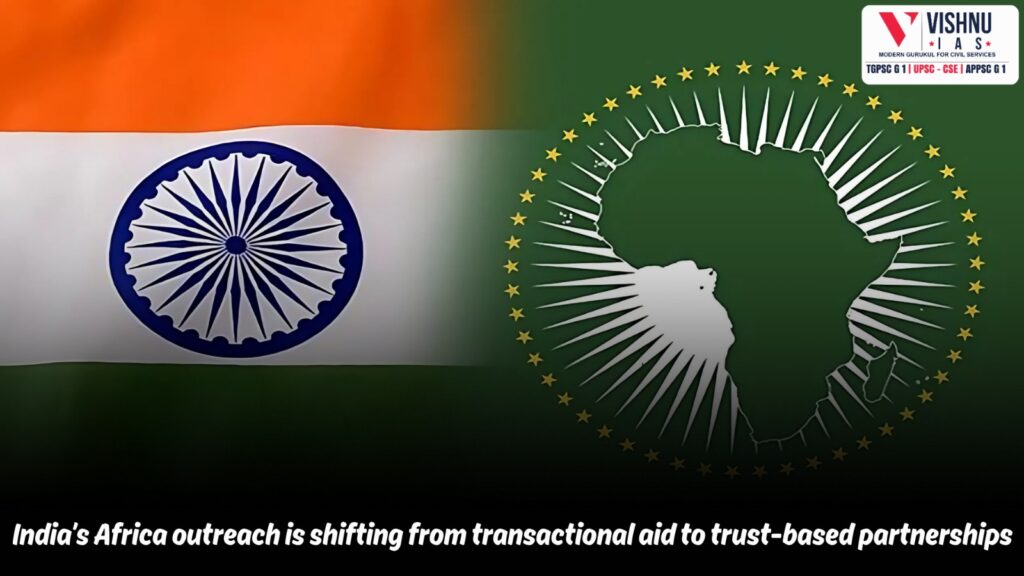
India’s Africa Outreach: From Transactional Aid to Trust-Based Partnerships
Introduction:
- India’s engagement with Africa has undergone a strategic transformation in the past two decades. While earlier relations were often confined to aid-driven, episodic interventions, today they are increasingly shaped by shared historical solidarities, pragmatic cooperation, and future-oriented knowledge partnerships.
- According to the MEA (2024), India’s development partnership with Africa amounts to over $12 billion, including Lines of Credit, grants, and capacity-building initiatives. At the same time, India is also Africa’s third-largest trading partner (2022: $98 billion bilateral trade, EXIM Bank Report), reflecting a shift from one-sided assistance to mutually beneficial frameworks.
- In this context, the statement that India’s Africa outreach is shifting from transactional aid to trust-based partnerships is both timely and significant.
Anchoring Partnerships in Shared Histories and Solidarity
- Anti-Colonial and Liberation Struggles: Shared legacy of anti-colonial struggles builds historical solidarity. Example: India hosted SWAPO’s first diplomatic office; Lt. Gen. Diwan Prem Chand led UN peacekeeping during Namibia’s independence transition.
- South-South Cooperation Narrative: India positions itself as part of the Global South through IBSA, BRICS, and UNCTAD 2023 emphasis on South-South cooperation.
- Developmental Partnerships Beyond Conditional Aid: Demand-driven projects like the Pan-African e-Network (2009–17) demonstrate inclusivity and local ownership.
Expanding Present-Day Pragmatic Cooperation
- Trade and Investment Ties: India-Africa trade rose from $7 billion (2001) to $98 billion (2022). Example: Duty-Free Tariff Preference Scheme (DFTP, 2008).
- Capacity-Building and Skill Development: ITEC trained 50,000 African professionals; India-Namibia Centre of Excellence in IT at NUST strengthens youth skills.
- Energy and Infrastructure Collaboration: ONGC Videsh in Mozambique; ISA with 34 African members fosters renewable energy ties.
- Health and Development Cooperation: India provides 50% of Africa’s generic drugs; Vaccine Maitri supported 42 nations during COVID-19.
Laying Foundations for Future-Oriented Knowledge Partnerships
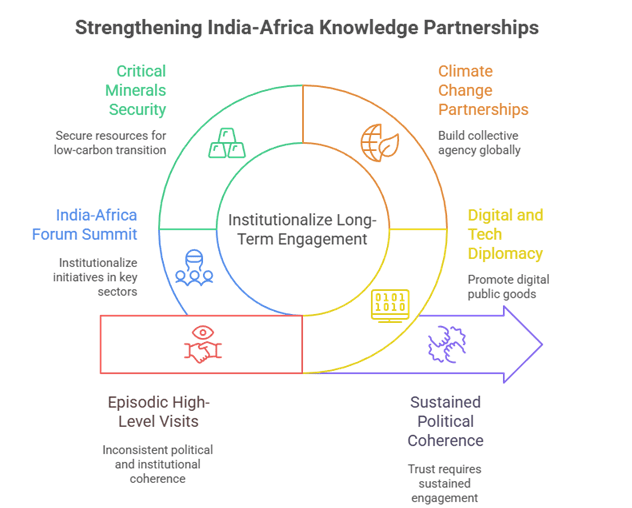
- Digital and Tech Diplomacy: Namibia adopting UPI in 2024 makes it Africa’s first fintech replication of India’s model.
- Climate Change and Sustainability Partnerships: Collaboration in CDRI and Global Biofuels Alliance strengthens resilience.
- Critical Minerals and Energy Security: Africa’s 30% global reserves, e.g., Namibia’s uranium, could support India’s transition, though implementation gaps remain.
- Institutionalising Long-Term Engagement: IAFS IV offers scope to institutionalise cooperation in education, trade, and climate resilience.
Conclusion:
India’s Africa outreach is no longer confined to transactional donor–recipient models but increasingly rests on trust, mutual respect, and shared aspirations. From anti-colonial solidarity to digital public goods and green energy transitions, India positions itself as a reliable Global South partner distinct from Western conditionalities.
Going forward, institutionalising platforms like IAFS, expanding UPI-scale innovations, and deepening critical mineral cooperation will be crucial. Africa’s projected 4% GDP growth (AfDB, 2024) provides India with an opportunity to co-create durable, future-oriented partnerships based on trust and respect for African agency.
Recap: