
India’s Security and Political Approach to Left-Wing Extremism | Comparison with Global Counter-Insurgency Models
Introduction
Left-Wing Extremism (LWE), popularly known as the Naxalite/Maoist movement, is defined as an armed insurgency seeking to overthrow the Indian state through armed revolution, drawing inspiration from Marxist-Leninist-Maoist ideology. At its peak in the mid-2000s, LWE affected over 223 districts across 20 States, earning the description of the “single biggest internal security threat” (PM Manmohan Singh, 2006). However, according to the Ministry of Home Affairs (MHA) 2024 Annual Report, violent incidents have declined by over 77% since 2010, with only 45 districts now significantly affected. Evaluating India’s security and political approach to Left-Wing Extremism requires comparison with global counter-insurgency models (such as the U.S. in Iraq-Afghanistan, Colombia against FARC, and Sri Lanka against LTTE) to understand strengths, weaknesses, and lessons learned.
Security Approach in India vs. Global Counter-Insurgency
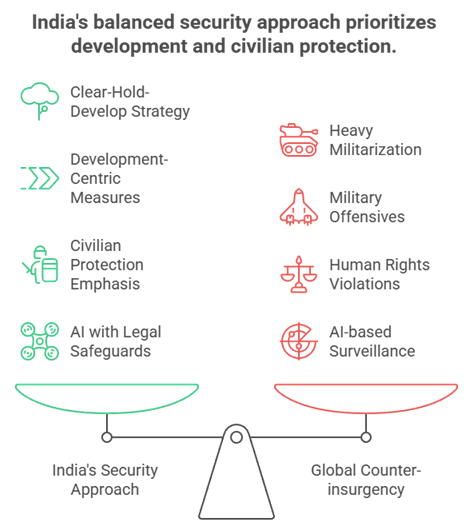
- Use of Security Forces and Intelligence: India adopted a “Clear-Hold-Develop” strategy using CRPF, CoBRA, Greyhounds, and State police, with intelligence-driven targeting (e.g., Operation SAMADHAN-Prahar). In contrast, the U.S. relied on heavy militarization in Iraq and Afghanistan, often alienating locals.
- Development-Centric Security Measures: India integrates security with development schemes like SRE and SIS, alongside road projects. This mirrors Colombia’s “Plan Colombia,” which combined military and development strategies.
- Civilian Protection Mechanisms: India emphasizes minimum collateral damage, unlike Sri Lanka’s militarized anti-LTTE approach that drew human rights criticism.
- Technology and AI-based Surveillance: India is advancing in AI and drones for tracking insurgents, inspired by U.S. and Israeli models, but with legal safeguards.
Political and Governance Measures vs. Global Models
- Negotiation and Dialogue: India attempted talks (e.g., Andhra Pradesh, 2004) with limited success, unlike Colombia’s peace deal with FARC (2016).
- Tribal Rights and Land Reforms: Implementation of FRA 2006 and PESA 1996 empowers tribal communities, reducing insurgent appeal, similar to Bolivia’s indigenous empowerment policies.
- Welfare and Development Schemes: Initiatives like the Aspirational Districts Programme (2018) uplift LWE-affected districts. Unlike Afghanistan’s U.S.-backed projects, India’s focus on governance and community ownership shows better outcomes.
- Legal and Administrative Measures: Laws like UAPA (1967) balance security needs with judicial oversight, unlike U.S. Patriot Act excesses.
Challenges, Criticisms, and Lessons
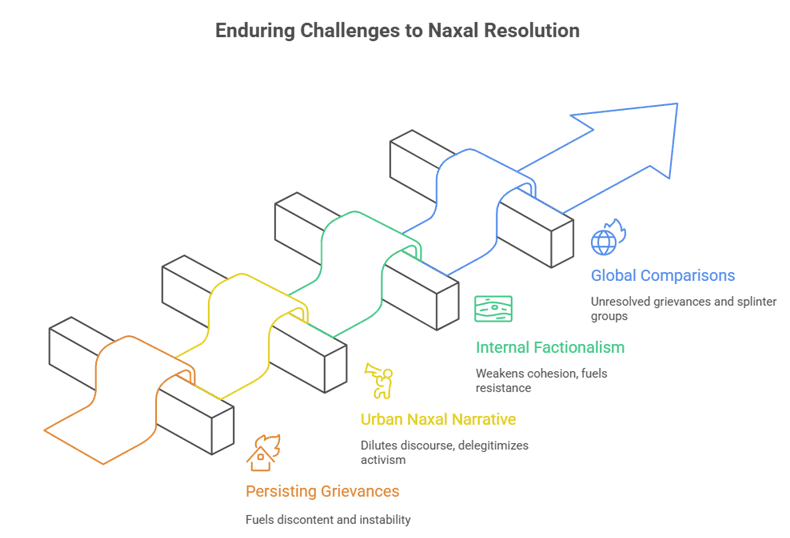
Despite progress, unresolved issues like land alienation, displacement due to mining, and tribal grievances continue. While Maoist strongholds have weakened, areas like Sukma and Dantewada remain vulnerable. Misuse of the “urban Naxal” narrative risks undermining civil discourse. Global models highlight that security-heavy approaches (Sri Lanka) or negotiation-heavy approaches (Colombia) alone are insufficient.
Conclusion:
India’s security and political approach to Left-Wing Extremism reflects a measured balance between security and socio-political accommodation. Violent incidents have declined by 77% since 2010, but sustainable peace requires deeper tribal empowerment, infrastructure, livelihood opportunities, and rights-respecting AI-driven security. If India can combine these elements effectively, it may evolve as a globally relevant counter-insurgency model that balances security with justice and inclusive development.
Recap: