India Leading the Global South: Challenges Amidst Shifting Geopolitical Alliances
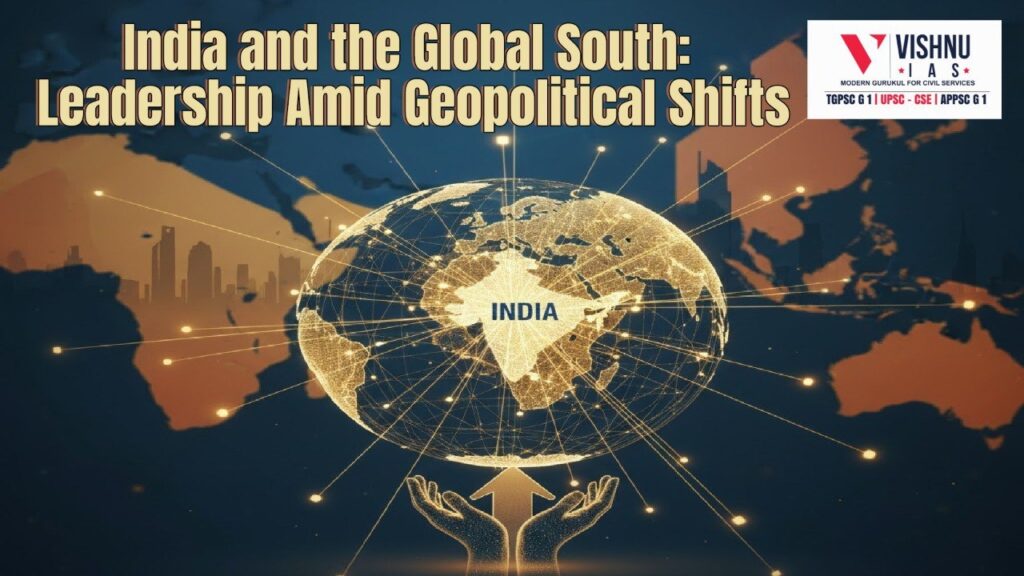
India leading the Global South must reconcile domestic constraints, regional credibility and great-power competition while navigating shifting geopolitical alliances to convert ambitions into effective leadership.
Introduction:
- The term Global South broadly refers to nations in Asia, Africa and Latin America which share legacies of colonialism, development deficits and a desire for greater representation in global governance.
- According to an analytical brief, around 500 developing countries fall under this conception, and these nations face common structural challenges such as external shocks, limited resources and weak institutional capacity.
- In recent years, the world has experienced a marked shift in the international order — from bipolarity to multipolarity, from relatively stable multilateralism to fragmentation, and from predictable alliances to more fluid alignments.
- In this setting, India — with a population of about 1.4 billion, the fourth‐largest economy and a democratic system — aspires to lead the Global South. Yet that ambition collides with shifting geopolitics, growing competition and internal constraints.
Body:
• 1. Global and Institutional Leadership
1.1 Voice and agenda‐setting for the Global South
- India has sought to amplify the concerns of developing countries by such vehicles as the “Voice of the Global South” and by pushing for changes in multilateral institutions. For example, India successfully backed the admission of the African Union as a full member of the G20.
- However, India’s leadership ambition is constrained by its own institutional capacity, the diversity of Global South interests (Latin America, Africa, South Asia do not always align), and by the fact that India’s domestic realities sometimes undermine its external claims.
- Example: While India speaks for South–South cooperation, critics argue that its engagement is still more symbolic than structural — e.g., development assistance programmes exist, but the scale and coordination are limited.
1.2 Reforming global governance and multilateralism
- India promotes a reform agenda: fairer economic practices, resilient supply chains, South–South trade and technology collaborations. For instance, in 2025 Jaishankar listed these as key building blocks.
- The challenge: The traditional multilateral architecture is under strain (e.g., UN, WTO). Many Global South countries are sceptical of commitments, given earlier unmet promises. India must navigate this credibility gap.
- Example: India champions local‐currency trade with Global South partners (a BRICS/India initiative) but China’s deeper financial footprints and established infrastructure projects mean India remains a challenger rather than leader.
o 1.3 Soft power, development cooperation and normative leadership
- India has substantial soft‐power assets: democratic credentials, civilisational heritage, diaspora links. In development cooperation, India uses lines of credit, capacity‐building (e.g., ITEC), digital diplomacy (Unified Payments Interface in Africa) to enhance its profile.
- But challenge: Soft power alone is insufficient without matching economic and strategic leverage. Also, domestic issues are noted by Global South peers and can erode India’s moral credibility.
- Case Study: India’s digital payments cooperation with Namibia (2025) via UPI — a creative move in South–South cooperation. Yet the scale is modest relative to China’s infrastructure footprint.
• 2. Strategic and Geopolitical Competition
o 2.1 Competition with China for influence in the Global South
- A key challenge is that China has deep and longstanding ties across Africa, Latin America, Asia through infrastructure finance (Belt and Road Initiative), multilateral organisations and direct investments.
- India must therefore differentiate itself and offer alternatives. But financial muscle, scale and speed of deployment remain inferior, limiting India’s margin for leadership.
- Example: In Africa, while India has ramped up naval exercises and diplomacy, China’s trade and investment volumes vastly exceed India’s — thus India is challenged to lead the ‘Global South axis’.
o 2.2 Unstable alliances and shifting global power blocs
- The global order is transitioning: The US, China, Russia, Middle‐East powers are jockeying for advantage. Traditional alliances are fluid (e.g., US re‐shaping ties under President Donald Trump; China–Russia collaboration; Middle East new alignments). India’s foreign policy establishment finds itself under pressure to adapt rapidly.
- This makes India’s attempt to ‘lead’ the Global South tricky: If India is seen as aligning too closely with one power, it may lose credibility among non‐aligned Global South states.
- Example: India’s stance on the Ukraine conflict and Gaza war has been cautious; yet many Global South states expect more bold leadership.
o 2.3 Security and strategic autonomy versus leadership burden
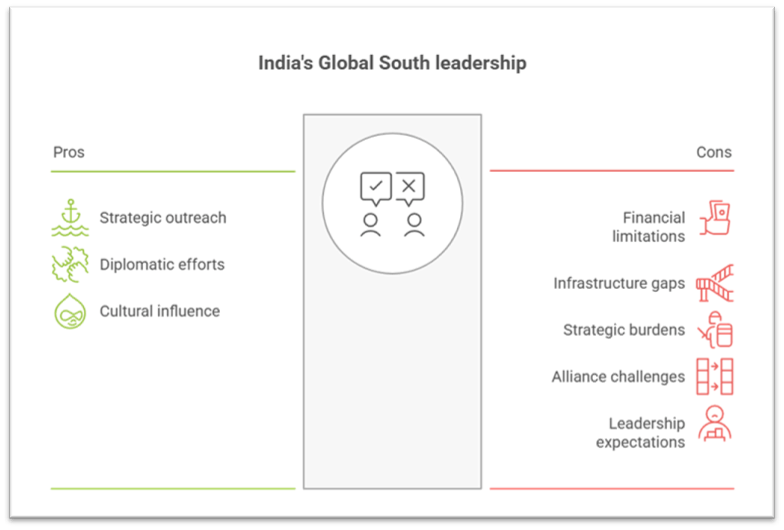
- Leadership of the Global South implies strategic responsibilities: security contributions, crisis response, maritime presence, regional diplomacy. India’s strategic environment (border tensions with China, Pakistan, instability in neighbourhood) places heavy burdens on it.
- India’s defence and strategic resources are stretched. Domestic priorities and infrastructure gaps limit scope of global security leadership.
- Case Study: India’s largest‐ever naval exercise with African countries in April 2025 highlights its strategic outreach — yet analysts noted India’s influence in Africa remains significantly lower than China’s.
• 3. Neighbourhood and Regional Credibility
o 3.1 South Asia dynamics and India’s neighbourhood perception
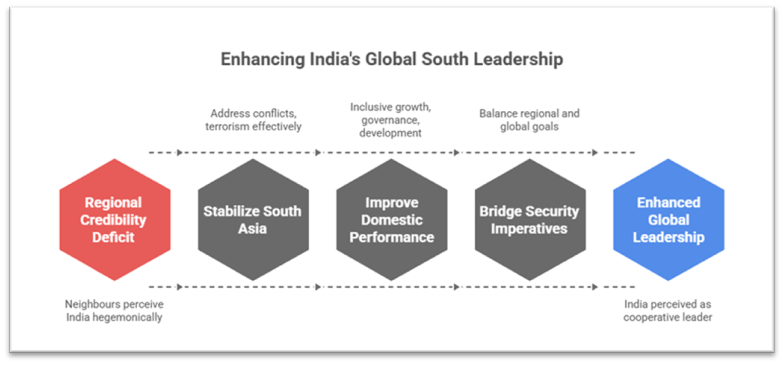
- The immediate neighbourhood is key to India’s claim to Global South leadership — if India cannot stabilise and lead in its region, its global leadership credentials suffer. Issues: Sri Lanka, Nepal, Bangladesh, Maldives, Pakistan.
- Challenge: Some neighbours perceive India’s role as hegemonic rather than cooperative, leading to trust deficits.
- Example: In Bangladesh anti-India sentiment has grown; in Nepal India was seen as a bystander during political upheavals.
o 3.2 Domestic contradictions and development legitimacy
- Global leadership for the South requires domestic performance: inclusive growth, democratic governance and social development. India grapples with internal challenges: high inequality, regional disparities, governance deficits.
- If India’s domestic model is questioned, Global South peers may view India as aspirational but not exemplary.
- Case Study: Reports have pointed to the gap between India’s ambition (Viksit Bharat by 2047) and its internal socio-economic realities.
o 3.3 Bridging neighbourhood security and global leadership imperatives
- India must calibrate its regional priorities with its global leadership ambition. For example, stabilising South Asia (Afghanistan-Pakistan conflict, cross-border terrorism) demands attention and resources, which may detract from global outreach.
- Conversely, failing to manage neighbourhood challenges undermines global credibility.
- Example: India’s diplomatic approach to China is described as “patching over differences” after the 2020 Galwan standoff — this raises questions about India’s capacity to lead facing a major competitor in its own region.
Conclusion:
- India’s aspiration to lead the Global South is underpinned by strong structural advantages — demographic weight, democratic credentials, economic ambitions and geographic reach. Yet it faces a complex set of challenges: institutional bottlenecks, intense great‐power competition (especially with China), constraints in carrying strategic burden, and credibility issues at home and with its neighbourhood.
- According to recent analysis, the financing gap for the Sustainable Development Goals has widened for the Global South, estimated at about US $4.2 trillion, with annual shortfall of around US $500 billion.
- India, by stepping into that gap credibly, can convert its leadership ambition into tangible influence. In sum, India’s future as a leader of the Global South is promising, but dependent on its ability to adapt to new geopolitical realities, strengthen its global institutions, and build trust both within the Global South and in its immediate region.
• 1. Global and Institutional Leadership
1.1 Voice and agenda‐setting for the Global South
- India has sought to amplify the concerns of developing countries by such vehicles as the “Voice of the Global South” and by pushing for changes in multilateral institutions. For example, India successfully backed the admission of the African Union as a full member of the G20.
- However, India’s leadership ambition is constrained by its own institutional capacity, the diversity of Global South interests (Latin America, Africa, South Asia do not always align), and by the fact that India’s domestic realities sometimes undermine its external claims.
- Example: While India speaks for South–South cooperation, critics argue that its engagement is still more symbolic than structural — e.g., development assistance programmes exist, but the scale and coordination are limited.
1.2 Reforming global governance and multilateralism
- India promotes a reform agenda: fairer economic practices, resilient supply chains, South–South trade and technology collaborations. For instance, in 2025 Jaishankar listed these as key building blocks.
- The challenge: The traditional multilateral architecture is under strain (e.g., UN, WTO). Many Global South countries are sceptical of commitments, given earlier unmet promises. India must navigate this credibility gap.
- Example: India champions local‐currency trade with Global South partners (a BRICS/India initiative) but China’s deeper financial footprints and established infrastructure projects mean India remains a challenger rather than leader.
o 1.3 Soft power, development cooperation and normative leadership
- India has substantial soft‐power assets: democratic credentials, civilisational heritage, diaspora links. In development cooperation, India uses lines of credit, capacity‐building (e.g., ITEC), digital diplomacy (Unified Payments Interface in Africa) to enhance its profile.
- But challenge: Soft power alone is insufficient without matching economic and strategic leverage. Also, domestic issues are noted by Global South peers and can erode India’s moral credibility.
- Case Study: India’s digital payments cooperation with Namibia (2025) via UPI — a creative move in South–South cooperation. Yet the scale is modest relative to China’s infrastructure footprint.
• 2. Strategic and Geopolitical Competition
o 2.1 Competition with China for influence in the Global South
- A key challenge is that China has deep and longstanding ties across Africa, Latin America, Asia through infrastructure finance (Belt and Road Initiative), multilateral organisations and direct investments.
- India must therefore differentiate itself and offer alternatives. But financial muscle, scale and speed of deployment remain inferior, limiting India’s margin for leadership.
- Example: In Africa, while India has ramped up naval exercises and diplomacy, China’s trade and investment volumes vastly exceed India’s — thus India is challenged to lead the ‘Global South axis’.
o 2.2 Unstable alliances and shifting global power blocs
- The global order is transitioning: The US, China, Russia, Middle‐East powers are jockeying for advantage. Traditional alliances are fluid (e.g., US re‐shaping ties under President Donald Trump; China–Russia collaboration; Middle East new alignments). India’s foreign policy establishment finds itself under pressure to adapt rapidly.
- This makes India’s attempt to ‘lead’ the Global South tricky: If India is seen as aligning too closely with one power, it may lose credibility among non‐aligned Global South states.
- Example: India’s stance on the Ukraine conflict and Gaza war has been cautious; yet many Global South states expect more bold leadership.
o 2.3 Security and strategic autonomy versus leadership burden
- Leadership of the Global South implies strategic responsibilities: security contributions, crisis response, maritime presence, regional diplomacy. India’s strategic environment (border tensions with China, Pakistan, instability in neighbourhood) places heavy burdens on it.
- India’s defence and strategic resources are stretched. Domestic priorities and infrastructure gaps limit scope of global security leadership.
- Case Study: India’s largest‐ever naval exercise with African countries in April 2025 highlights its strategic outreach — yet analysts noted India’s influence in Africa remains significantly lower than China’s.
• 3. Neighbourhood and Regional Credibility
o 3.1 South Asia dynamics and India’s neighbourhood perception
- The immediate neighbourhood is key to India’s claim to Global South leadership — if India cannot stabilise and lead in its region, its global leadership credentials suffer. Issues: Sri Lanka, Nepal, Bangladesh, Maldives, Pakistan.
- Challenge: Some neighbours perceive India’s role as hegemonic rather than cooperative, leading to trust deficits.
- Example: In Bangladesh anti-India sentiment has grown; in Nepal India was seen as a bystander during political upheavals.
o 3.2 Domestic contradictions and development legitimacy
- Global leadership for the South requires domestic performance: inclusive growth, democratic governance and social development. India grapples with internal challenges: high inequality, regional disparities, governance deficits.
- If India’s domestic model is questioned, Global South peers may view India as aspirational but not exemplary.
- Case Study: Reports have pointed to the gap between India’s ambition (Viksit Bharat by 2047) and its internal socio-economic realities.
o 3.3 Bridging neighbourhood security and global leadership imperatives
- India must calibrate its regional priorities with its global leadership ambition. For example, stabilising South Asia (Afghanistan-Pakistan conflict, cross-border terrorism) demands attention and resources, which may detract from global outreach.
- Conversely, failing to manage neighbourhood challenges undermines global credibility.
- Example: India’s diplomatic approach to China is described as “patching over differences” after the 2020 Galwan standoff — this raises questions about India’s capacity to lead facing a major competitor in its own region.
Conclusion:
- India’s aspiration to lead the Global South is underpinned by strong structural advantages — demographic weight, democratic credentials, economic ambitions and geographic reach. Yet it faces a complex set of challenges: institutional bottlenecks, intense great‐power competition (especially with China), constraints in carrying strategic burden, and credibility issues at home and with its neighbourhood.
- According to recent analysis, the financing gap for the Sustainable Development Goals has widened for the Global South, estimated at about US $4.2 trillion, with annual shortfall of around US $500 billion.
- India, by stepping into that gap credibly, can convert its leadership ambition into tangible influence. In sum, India’s future as a leader of the Global South is promising, but dependent on its ability to adapt to new geopolitical realities, strengthen its global institutions, and build trust both within the Global South and in its immediate region.
Recap: