India Fisheries Sector Competitiveness Enhanced Through Eco-Labelling and Value Addition
India’s fisheries and aquaculture sector, contributing more than 17.5 million tonnes of aquatic food in 2022–23 and ranking as the second-largest aquaculture producer globally, has emerged as a critical pillar for nutrition, livelihoods, exports, and coastal development. Enhancing India fisheries sector competitiveness requires aligning with global standards, as international markets increasingly demand sustainably sourced, traceable, and value-added seafood. Eco-labelling, which certifies sustainable fishing and aquaculture practices, and value addition, which moves products up the value chain, are key strategies to achieve this goal.
1. Eco-labelling as a Catalyst for Global Market Access
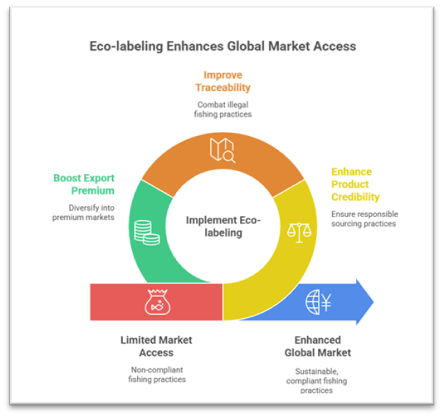
1.1 Enhancing Product Credibility and Sustainability Assurance
- Eco-labelling frameworks, such as Marine Stewardship Council (MSC), Aquaculture Stewardship Council (ASC), and national certification initiatives, provide assurance that fish are sourced through responsible and environmentally compliant practices. Countries like Vietnam have enhanced shrimp exports significantly after adopting ASC certification, demonstrating its market advantage.
- India’s adoption of the Guidelines for Sustainable Aquaculture and expansion of Ecosystem Approach to Fisheries Management strengthens eligibility for global sustainability labels, enabling compliance with stringent EU and U.S. import standards.
- The Bay of Bengal Large Marine Ecosystem (BOBLME) initiative, promoting science-based stock assessments and management, supports eco-label-compatible practices and reduces the risk of trade restrictions.
1.2 Improving Traceability and Combating IUU Fishing
- Eco-labels mandate end-to-end traceability, from catch to export, strengthening India’s fight against Illegal, Unreported, and Unregulated (IUU) fishing, a major factor influencing global market acceptance.
- Initiatives such as vessel transponders, digitised Catch Documentation Schemes, and Matsya Setu applications improve monitoring, enabling India to meet the traceability norms required by markets like the EU.
- Case study: Kerala’s Thoothoor tuna fishery, which adopted community-based monitoring, shows how traceability reforms help align traditional fisheries with global certification norms.
1.3 Boosting Export Premium and Diversifying Markets
- Eco-labelled seafood commands higher prices and finds easier entry into premium markets. Countries with strong eco-label penetration, such as Norway and Chile, derive substantial export gains through sustainable branding.
- India’s focus on sustainable aquaculture under PMMSY and the ongoing GEF-supported climate-resilient aquaculture project in Andhra Pradesh positions the country to secure export premiums, especially in shrimp and seabass.
- Certification opens access to organic, ethical, and climate-smart product segments, diversifying markets beyond traditional buyers and reducing dependence on a few destination countries.
2. Value Addition as a Driver of Export Diversification and Income Gains
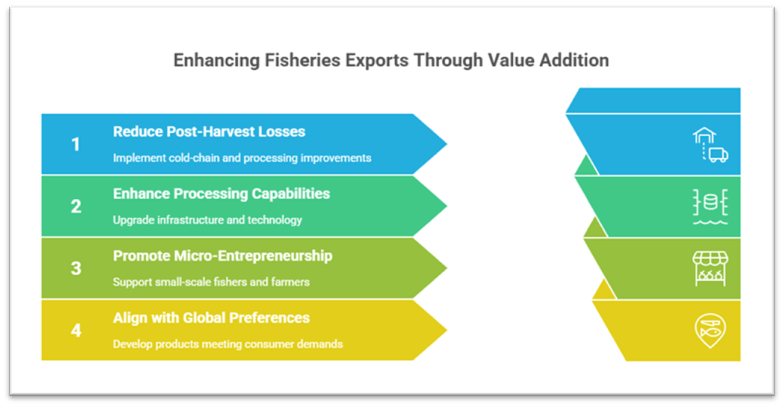
2.1 Strengthening Processing Capabilities and Reducing Post-Harvest Losses
- More than 20–25% of fisheries post-harvest losses occur due to limited cold-chain, poor handling, and inadequate processing infrastructure. Value addition mitigates these losses by converting raw products to fillets, canned items, ready-to-eat (RTE) and ready-to-cook (RTC) foods.
- The government’s focus on modern fishing harbours, including pilots at Vanakbara and Jakhau, and establishing integrated post-harvest centres, enhances quality control and export readiness.
- Case example: Odisha’s Paradip and Digha processing clusters significantly increased shrimp value-added exports after upgrading cold-chain and processing units.
2.2 Enhancing Income for Small-Scale Fishers and Aquaculture Farmers
- Value addition creates opportunities for micro-entrepreneurship, including fish pickling, drying, hygienic fish vending, and nutraceutical production.
- Programs such as Matsya Seva Kendras and Kisan Credit Cards for fishers promote financial inclusion, enabling communities to invest in processing and marketing.
- Women-led self-help groups in Tamil Nadu, processing dried fish and RTC products, illustrate how value addition uplifts incomes and integrates smallholders into export value chains.
2.3 Aligning with Global Consumer Preferences
- Global consumers increasingly prefer high-protein, low-carbon, sustainably packaged, and convenience seafood. Value-added products align with these demands and boost acceptance.
- India’s diversification into surimi-based products, collagen extracts, bioactive peptides, and fortified fish products places its seafood sector in the growing global nutraceutical and functional foods market.
- Countries like Thailand, which export primarily value-added seafood, demonstrate how product innovation can multiply export value without proportionate increases in production.
3. Integrating Sustainability, Technology, and Governance to Boost Competitiveness
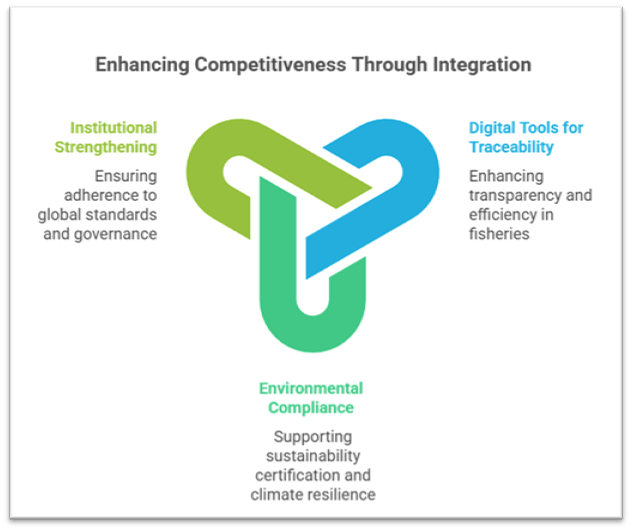
3.1 Digital Tools for Traceability and Market Linkages
- Blockchain-based supply chain pilots, QR-coded fish products, and digital fish catch records enhance transparency, essential for eco-labelling compliance.
- Platforms like e-NAM for fisheries, Fisheries Management Information System, and AI-assisted disease monitoring improve efficiency and reduce quality risks.
- Case example: Andhra Pradesh’s digital traceability pilot in shrimp farming, which links farmers directly to exporters, demonstrates reduced rejection rates and better price realization.
3.2 Ensuring Environmental Compliance and Climate Resilience
- Adoption of climate-resilient aquaculture models, such as biofloc, integrated multi-trophic aquaculture (IMTA), and low-water-use systems, supports sustainability certification.
- Programs like the Climate-Resilient Coastal Fishermen Villages Initiative help communities adapt to sea-level rise, extreme weather, and salinity changes, ensuring long-term production stability.
- Mangrove restoration and marine spatial planning initiatives, as seen in Gujarat and Andhra Pradesh, improve ecosystem health, supporting certifiable sustainable fisheries.
3.3 Institutional Strengthening for Global Export Standards
- Stronger governance through the Coastal Aquaculture Authority, MPEDA, and National Fisheries Development Board ensures adherence to hygiene, environmental standards, and global protocols.
- The draft National Fisheries Policy emphasises sustainability, blue economy principles, and value-chain strengthening, aligning India with global regulatory expectations.
- International collaborations, including FAO-supported training on Monitoring, Control, and Surveillance (MCS) and ecosystem-based fishery management, prepare India for the next generation of global sustainability standards.
Conclusion:
India’s transition toward eco-labelled, traceable, and value-added seafood is central to enhancing its global fisheries competitiveness. As global consumers prioritize sustainability and high-quality processed products, India’s scale, biodiversity, and technological progress provide a strong foundation for leadership.
Strengthening certification systems, upgrading harbours, expanding climate-resilient aquaculture, and deepening digital traceability will enable India to capture higher export premiums while safeguarding aquatic ecosystems. With global aquatic food demand projected to rise sharply over the next decade, India’s commitment to sustainable value-added growth can ensure resilient livelihoods, stronger foreign exchange earnings, and a future-ready Blue Economy anchored in ecological stewardship and market excellence.
Recap: