
Introduction:
- Electric mobility transition refers to the systemic shift from internal combustion engine (ICE)-based transport to electric propulsion systems, aimed at reducing fossil fuel dependence, urban air pollution, and transport-sector emissions.
- For India where the transport sector contributes nearly 13–14% of total energy-related CO₂ emissions and crude imports account for over 85% of oil demand electric mobility is both an energy security imperative and a climate necessity.
- However, as India targets 30% EV penetration by 2030 and progressively deeper decarbonisation by 2070, the central challenge is no longer merely manufacturing vehicles, but ensuring grid readiness—the ability of the electricity ecosystem to supply adequate, affordable, reliable and clean power to support large-scale vehicle electrification.
Body:
1. Structural Challenges in Aligning Power Infrastructure with Electric Mobility
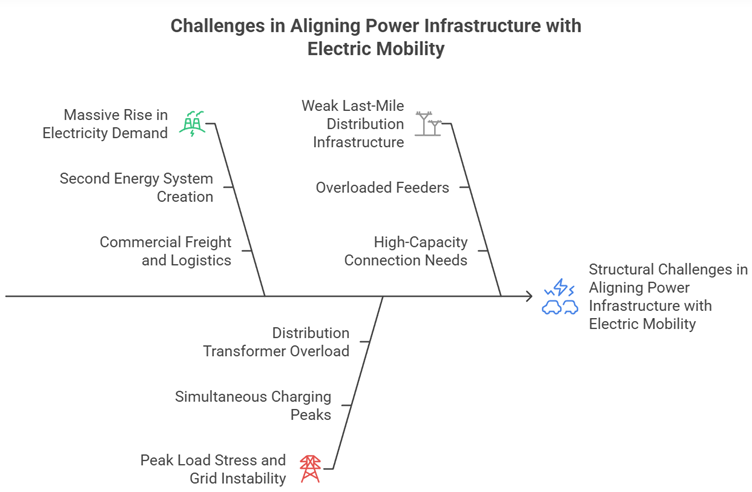
a) Massive rise in electricity demand and generation burden
- Large-scale transport electrification implies the creation of a “second energy system”, with full fleet conversion potentially adding 900–1100 TWh annually, equivalent to building nearly one-third of India’s present power generation capacity again.
- While electric two-wheelers dominate adoption due to low-cost entry and urban convenience, their electricity burden remains relatively modest; the real demand surge will emerge from commercial freight, buses, and logistics fleets, which are highly energy-intensive.
- Example: Electrification of heavy trucks on industrial corridors such as Delhi–Mumbai Industrial Corridor (DMIC) could sharply increase local electricity demand, requiring dedicated transmission planning.
b) Peak load stress and grid instability risks
- Electricity systems are strained not by annual consumption alone but by simultaneous charging peaks, especially during evening residential demand windows.
- Unmanaged charging could lead to distribution transformer overload, voltage fluctuations, and higher retail tariffs for all consumers.
- Case Study: California’s EV growth demonstrated how clustered residential charging created local transformer failures, prompting smart-charging reforms—an early warning relevant for Indian metros.
c) Weak last-mile distribution infrastructure
- Many urban and peri-urban distribution companies (DISCOMs) already face overloaded feeders, outdated substations, and chronic financial losses.
- EV charging—especially fast charging—requires high-capacity connections, which current urban infrastructure often cannot support.
- Government Initiative: The Revamped Distribution Sector Scheme (RDSS) aims to modernize feeders and reduce AT&C losses, but explicit EV-readiness benchmarks remain limited.
2. Institutional and Technological Gaps in the Transition
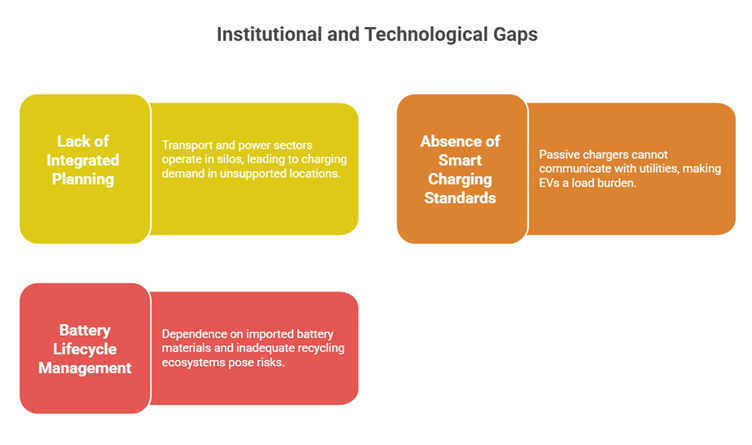
a) Lack of integrated transport–power planning
- EV deployment policy is often framed by transport ministries, while grid planning remains under the power sector, creating institutional silos.
- Without integrated modelling, charging demand may emerge in locations where generation and transmission support is absent.
- Example: National highway charging corridors may expand faster than nearby substations or grid redundancy systems.
b) Absence of universal smart charging standards
- Most chargers installed today are passive devices, unable to communicate with utilities or respond to grid signals.
- Without Vehicle-to-Grid (V2G) and smart metering integration, EVs become a load burden rather than a flexible grid asset.
- Government Initiative: Under the National Smart Grid Mission, smart meter rollout has accelerated, but charger-grid interoperability standards need stronger enforcement.
c) Battery lifecycle and resource management constraints
- India’s EV transition depends heavily on imported lithium, cobalt, nickel, creating a new strategic dependence.
- Millions of batteries reaching end-of-life could create major waste and environmental risks if recycling ecosystems lag.
- Case Study: China’s closed-loop EV battery recycling ecosystem demonstrates how circular economy design can reduce import dependence and environmental stress.
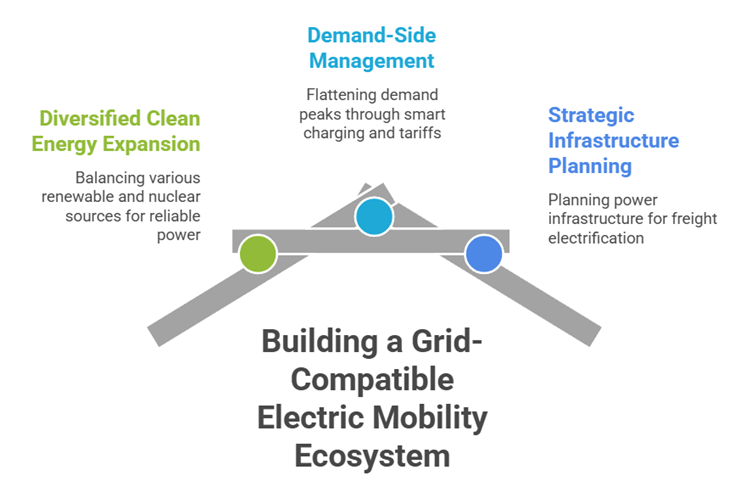
3. Pathways to Build a Grid-Compatible Electric Mobility Ecosystem
a) Diversified clean energy expansion
- EV benefits materialize only when the grid becomes cleaner; otherwise, oil dependence is replaced by coal dependence.
- A balanced mix of solar, wind, hydro storage, gas peaking, and nuclear baseload is necessary for both scale and reliability.
- Example: India’s growing solar capacity above 100 GW provides daytime charging opportunities, especially for workplace and depot charging.
b) Demand-side management and smart charging architecture
- Time-of-use tariffs, solar-hour charging incentives, and battery swapping can flatten demand peaks and improve asset utilization.
- Freight depots and bus terminals can deploy behind-the-meter storage systems to reduce grid stress.
- Government Initiative: Several states such as Delhi, Karnataka and Maharashtra have introduced differentiated EV tariffs, an important first step toward load management.
c) Strategic infrastructure planning for freight electrification
- The deepest infrastructure challenge lies not in personal mobility but in electrifying logistics and supply chains.
- Dedicated power planning is required for Golden Quadrilateral highways, industrial clusters, and Dedicated Freight Corridors.
- Case Study: Europe’s pilot electric road systems (ERS) for freight corridors show how transport infrastructure and power planning can be integrated from inception
Conclusion:
- India’s electric mobility shift is no longer a question of whether, but how sustainably and equitably it can be executed. Vehicle adoption may be consumer-led, but its long-term success will be determined by grid preparedness, institutional coordination, and clean energy depth.
- If India aligns EV deployment with smarter grids, resilient distribution systems, and diversified low-carbon generation, it can simultaneously reduce oil imports, strengthen energy sovereignty, and accelerate its net-zero 2070 pathway transforming mobility from a transport reform into a broader national energy transition.