How Digital Exclusion Weakens Universal Social Protection in India’s Labour Policy Framework
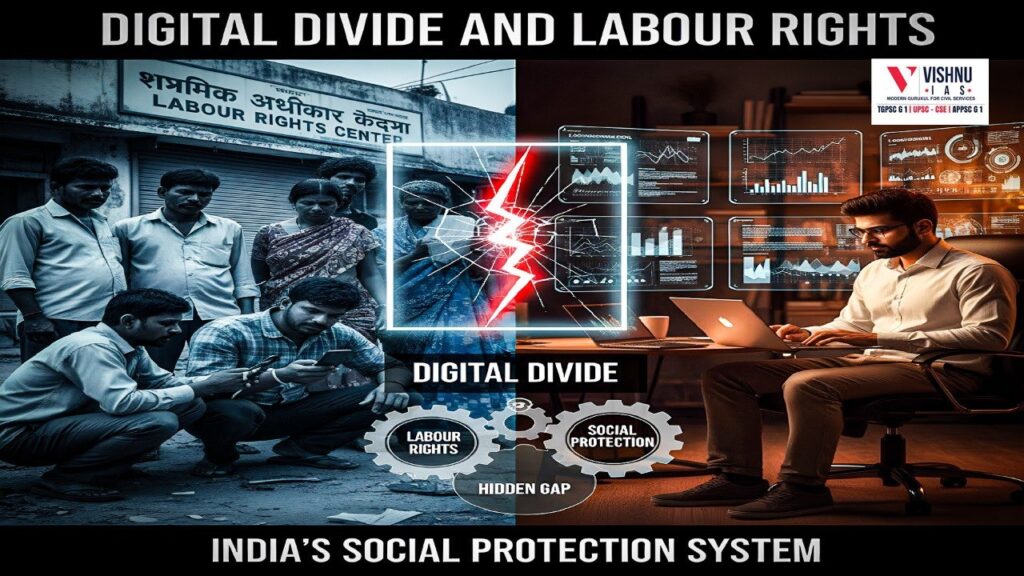
In India, universal social protection in India means ensuring that all workers—whether in formal or informal employment—have access to essential benefits such as health care, pension, maternity leave, accident insurance and unemployment support. However, this promise is increasingly undermined by two interconnected challenges: digital exclusion and weak enforcement mechanisms. Despite the existence of comprehensive labour codes and welfare schemes, gaps in technology access and inadequate regulatory implementation prevent millions of informal and migrant workers from realising their rights.
Introduction
In India, universal social protection means ensuring that all workers—whether in formal or informal employment—have access to benefits such as health care, pension, maternity leave, accident insurance and unemployment support. However, the promise of such protection is undermined by two inter-linked problems: digital exclusion and weak enforcement mechanisms.
According to recent data, more than 90 per cent of India’s workforce remains informal. The digital divide is substantial—one study noted that about 36 per cent of migrant women workers faced biometric authentication failures in health-care access. On the enforcement front, research shows that although there are comprehensive labour codes and laws, their implementation in the unorganised sector remains inconsistent and weak. This combination means that the lofty goals of social security are not being realised for vast sections of India’s working poor.
1. Digital Exclusion and Its Impact on Social Protection Access
1.1 Disparities in Access to Digital Infrastructure
- A digital divide persists: as per the India Inequality Report 2022, large segments of rural areas and women lack reliable internet or digital literacy, limiting their ability to access digitally-delivered welfare schemes.
- One study documented that for 200 migrant women workers interviewed, 36 per cent faced authentication failures using biometric systems in hospital visits.
- The Policy Brief on Digital Technology and Gender (2025) shows that women’s access to mobile phones and internet remains significantly lower—thus digital-based welfare delivery risks excluding them.
1.2 Implications for Informal and Vulnerable Workers
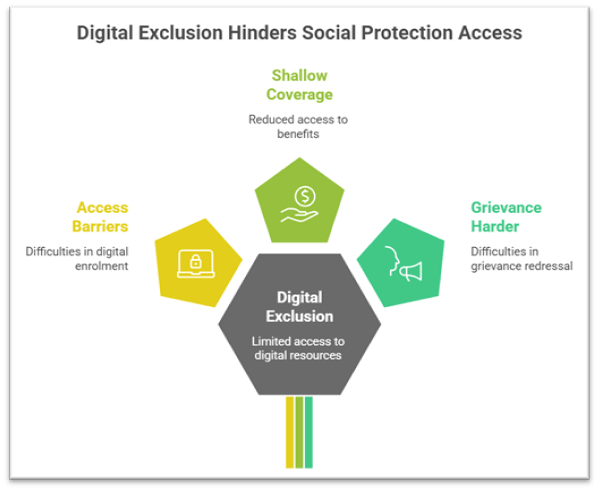
- Informal sector workers (constituting ~71.8 per cent of non-agricultural workforce) face barriers in digital enrolment and benefit access due to low literacy, lack of identity documents and absence of stable employer-worker relationship.
- For example, gig and platform workers are outside traditional employer-employee relationships, and digital portals may assume stable employment or identity proof—leading to exclusion.
- The shift toward digital-first delivery of social protection (e.g., biometric authentication, digital IDs) without adequate offline alternatives means workers with poor digital access get left behind.
1.3 How Digital Exclusion Weakens the Promise of Universal Coverage
- Digital exclusion can create a twin gap: even when laws or schemes exist on paper, the physically unable or digitally excluded cannot register or claim benefits, making coverage “shallow” rather than meaningful.
- The promise of portable social protection (health, pension, maternity) hinges on digital enrolment, but if large numbers remain excluded, universality is undermined.
- Digital-only systems also make grievance redressal harder for low-literacy workers, reducing actual access and accountability.
2. Weak Enforcement Mechanisms Undermining Legal Protections
2.1 Gaps in Implementation of Labour-Social Protection Laws
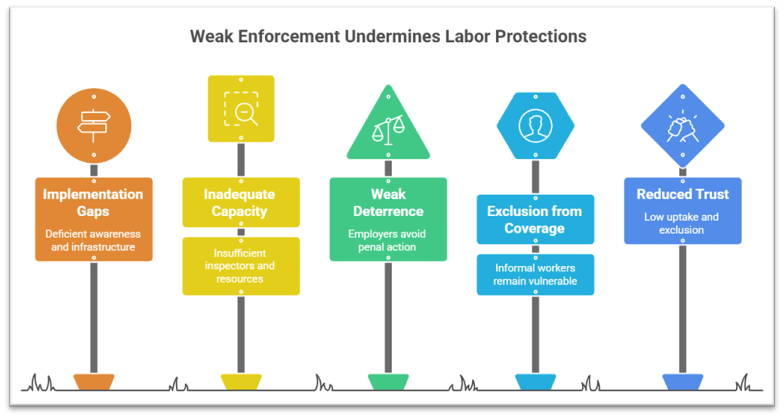
- While India has consolidated labour laws into four codes (Wages, Industrial Relations, Social Security, Occupational Safety) with the aim of simplification, their impact in the unorganised sector remains limited because of deficient awareness, weak infrastructure and fewer inspections.
- Studies highlight that in many workplaces, especially informal ones, there is minimal registration, non-payment of social security contributions (like provident fund or ESI), and contract labour is treated like daily wage without rights.
- Enforcement depends heavily on state-level labour departments, whose capacity (inspectors, resources) is inadequate. Research emphasises that despite laws, compliance is weak.
2.2 Consequences for Social Protection Access and Labour Rights
- Without enforcement, workers may be promised benefits (health insurance, pension) but in practice be excluded—employers may avoid contributions, mis-classify workers (daily wages vs regular), and workers are unable to claim entitlements.
- The informal workforce remains outside formal social security nets: according to digital-public-infrastructure research, informality means high vulnerability to exclusion from benefits.
- Enforcement gap also weakens deterrence: employers may not fear inspection or penal action, making the law less effective as a protective mechanism.
2.3 Impact on the Promise of Universality
- Universal social protection implies coverage for all, but if large segments (especially informal, unorganised, migrant, contract workers) are excluded due to enforcement failure, universality is nominal rather than actual.
- The lack of offline access, weak grievance mechanisms, and poor enforcement of contribution-obligation reduce trust among workers, leading to low uptake and exclusion.
- In sum, even with schemes existing and digital portals built, without strong enforcement the pathway from law to delivery remains blocked.
3. Interplay of Digital Exclusion and Enforcement Weakness in Policy Context
3.1 Policy Architecture and Ambitions
- Government policy aims for “future-ready” social protection: portable accounts merging pension, health, accident, life insurance across sectors; digital IDs and dashboards are central to this vision.
- But the strategy assumes a level of digital literacy, stable employment, and effective regulatory oversight—which many workers lack.
- For example: the initiative to merge social security schemes (PF, ESI, state boards) via digital platforms is promising, but without offline modes and enforcement of employer contributions, coverage remains superficial.
3.2 How the Two Factors Combine to Undermine Delivery
- Digital portals may be built and the law may require contributions, but if a worker lacks digital access and the employer evades contributions because of weak inspection, the worker falls through the net.
- Consider a daily-wage worker in an unorganised seafood unit: if the company re-classifies workers as “daily” to avoid Provident Fund contributions, even though digital enrolment may be possible, the actual contribution and benefit do not materialise.
- Digital exclusion also reduces visibility: fewer enrolled workers means fewer data tracked on dashboards, which weakens enforcement triggers and reduces regulatory pressure.
3.3 Practical Reform Needs and Scheme Linkages
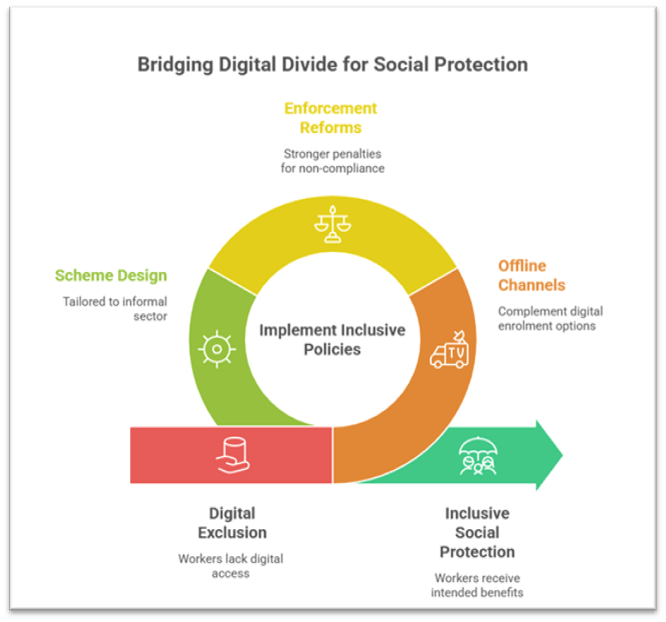
- Offline channels must complement digital enrolment so that workers lacking devices, literacy or connectivity are not excluded.
- Enforcement reforms: more inspectors, stronger penalties for non-compliance, making contribution and registration mandatory and effectively monitored.
- Schemes must be designed with informal sector realities in mind: lower literacies, informal employment, frequent job-changes, mobile workers. Policies like the Code on Social Security, 2020 and the Code on Occupational Safety, Health and Working Conditions, 2020 need implementation protocols tailored to digital-excluded populations.
Conclusion:
In conclusion, while India has made commendable strides in expanding social protection coverage—recently reporting roughly 64 per cent of the population under at least one social protection benefit—the twin bottlenecks of digital exclusion and weak enforcement threaten the realisation of universal protection in right earnest.
Without ensuring that workers, especially in the informal and digital-excluded segments, can access digital systems and benefit from robust enforcement of statutory obligations, the promise risks becoming symbolic. The way forward lies in bridging the digital divide, strengthening inspection and compliance mechanisms, and ensuring offline access alongside digital portals. Only then can India move from broad coverage figures to meaningful, dignified access for all workers—regardless of their employment form or digital connectivity.