How Competitive Federalism Transformed the Investment Landscape of Indian States
Competitive federalism refers to a system where the constituent units of a federation—such as States in India—compete among themselves to attract investment, improve governance, and enhance service delivery. It contrasts with cooperative federalism, which emphasizes coordination and joint decision-making.
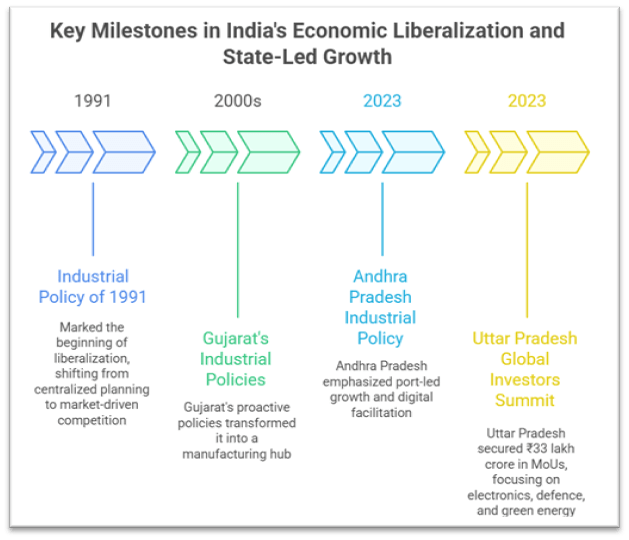
Following the 1991 liberalization, the dismantling of the “Licence-Permit-Quota Raj” shifted the power to attract investment from New Delhi to State capitals. States began competing based on governance efficiency, policy stability, and infrastructure quality. According to the NITI Aayog’s India Innovation Index (2023), States such as Karnataka, Tamil Nadu, and Gujarat rank at the top due to innovation-friendly ecosystems. As per DPIIT data (2024), India attracted over USD 70 billion in FDI, with more than 60% concentrated in the top five States, showing how subnational competition has transformed the investment landscape of Indian states.
Transformation of Federal Dynamics and Investment Paradigm
Shift from Centralized Planning to Market-Driven Competition
- Before 1991, investment decisions were centrally controlled through industrial licensing, where Delhi decided what, how much, and where to produce.
- Liberalization and reforms, including the Industrial Policy of 1991 and GST, decentralized economic decision-making and empowered States to become competitive growth engines.
- Example: Gujarat’s proactive industrial policies since the 2000s have turned it into a manufacturing hub, attracting large projects such as the Vedanta–Foxconn semiconductor unit and renewable energy parks.
Emergence of State-Led Policy Innovation and Ease of Doing Business
- The Business Reforms Action Plan (BRAP) and Startup Rankings institutionalized competition, compelling States to streamline regulations and digitalize services.
- Example: Andhra Pradesh and Telangana pioneered single-window clearance systems, while Madhya Pradesh and Odisha digitized land and labour approvals to attract industries.
- Case in Point: The Andhra Pradesh Industrial Development Policy (2023–27) emphasizes port-led growth and digital facilitation, enabling global investments in AI data centres and logistics hubs.
From Patronage to Persuasion-Based Governance
- Chief Ministers now compete globally by presenting data-driven pitches to investors instead of seeking central patronage.
- Example: The Uttar Pradesh Global Investors Summit (2023) secured MoUs worth ₹33 lakh crore, focusing on electronics, defence, and green energy.
- This marks a shift toward a persuasion-based governance model, where credibility, not connections, determines success.
Impact on Technological and Manufacturing Sectors
Rise of Technology Clusters and Digital Infrastructure
- State-level policy innovation has created new digital and AI ecosystems across India.
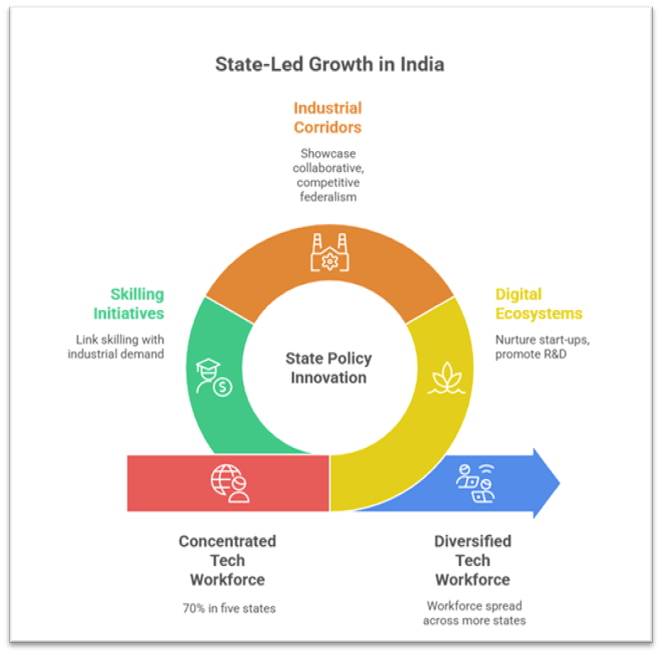
- Example: Karnataka’s Beyond Bengaluru initiative and Telangana’s T-Hub nurture start-ups and promote R&D in Tier-2 cities.
- The establishment of Google’s AI data centre in Andhra Pradesh and Amazon Web Services’ cloud region in Hyderabad exemplifies growing investor trust in State governance capacity.
Manufacturing Competitiveness and Industrial Corridors
- Competitive federalism has driven sectoral specialization: Tamil Nadu (automobiles), Gujarat (petrochemicals), Maharashtra (electronics), and Odisha (metals).
- The Delhi–Mumbai Industrial Corridor (DMIC) and Chennai–Bengaluru Industrial Corridor (CBIC) showcase collaborative yet competitive federalism.
- Example: States competed vigorously for Foxconn–Vedanta and Micron semiconductor projects, reflecting the strategic nature of State-led industrial competition.
Skilling and Labour Market Synergies
- Human capital development has become central to State competitiveness.
- Example: The Tamil Nadu Skill Development Mission and Telangana Academy for Skill and Knowledge (TASK) link skilling with industrial demand.
- Case Study: Odisha’s Skill Development Authority and Gujarat’s ITI network have directly supported local manufacturing expansion.
- As per the NASSCOM Tech Report (2024), nearly 70% of India’s technology workforce is concentrated in five innovation-driven States.
Challenges and the Path to Sustainable Competition
Risk of Fiscal Populism and Uneven Development
- Competition may degenerate into a race to the bottom, where States overextend subsidies or offer unsustainable incentives.
- Example: Concerns over “extravagant subsidies” offered to attract semiconductor investments underline fiscal vulnerability.
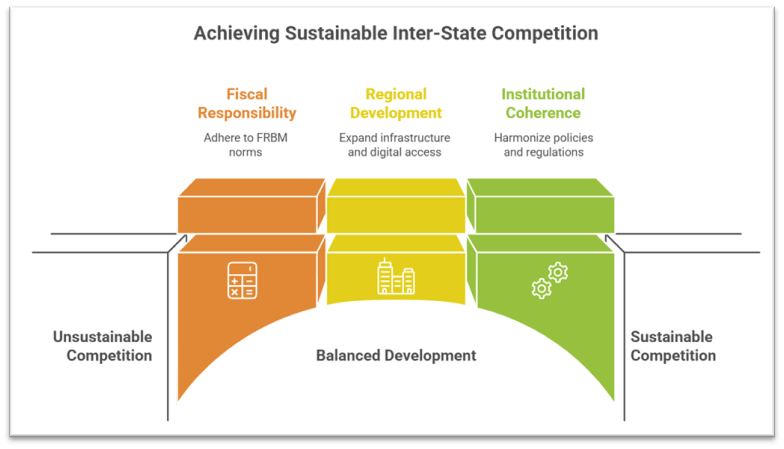
- States must balance competitiveness with FRBM norms to ensure long-term sustainability.
Need for Balanced Regional Development
- Investments remain clustered in a few high-performing States, deepening inter-State disparities.
- The Aspirational Districts Programme seeks to build governance capacity and investment-readiness in lagging regions.
- Expanding PM Gati Shakti infrastructure and promoting Digital India initiatives in Tier-2 and Tier-3 cities can democratize industrial growth.
Institutional and Regulatory Coherence
- Competition must be complemented by institutional coordination and policy harmonization between the Centre and States.
- Example: The National Industrial Corridor Development Programme promotes standardization in logistics, clearances, and environmental norms across States.
- Stable policies, transparent land acquisition processes, and environmental compliance frameworks can make competition more credible and less chaotic.
Conclusion:
India’s journey from a permission-based economy to a persuasion-based economy marks a paradigm shift in federal relations. Competitive federalism has transformed India’s States into entrepreneurial entities that actively shape national economic outcomes.
Today, Andhra Pradesh’s AI investments, Tamil Nadu’s EV hubs, Gujarat’s semiconductor push, and Karnataka’s tech leadership collectively showcase a maturing economic federalism. For the future, ensuring sustainable, skill-driven, and innovation-led competition—supported by fiscal discipline and policy coherence—will be vital. If States continue to compete through competence rather than concessions, India could emerge as a federation of opportunity, capable of harnessing its demographic dividend and achieving the USD 5 trillion economy target by the end of this decade.
Recap: