Global Climate Governance Reform: The Need for a UN Climate Change Council
However, despite this norm-setting, several reports highlight that the current institutional framework is struggling to translate commitments into implementation and accountability. Thus, proposals such as creating a UN Climate Change Council aim to reform global climate governance by improving coordination, enabling timely decision-making, ensuring equity, and accelerating finance mobilization.
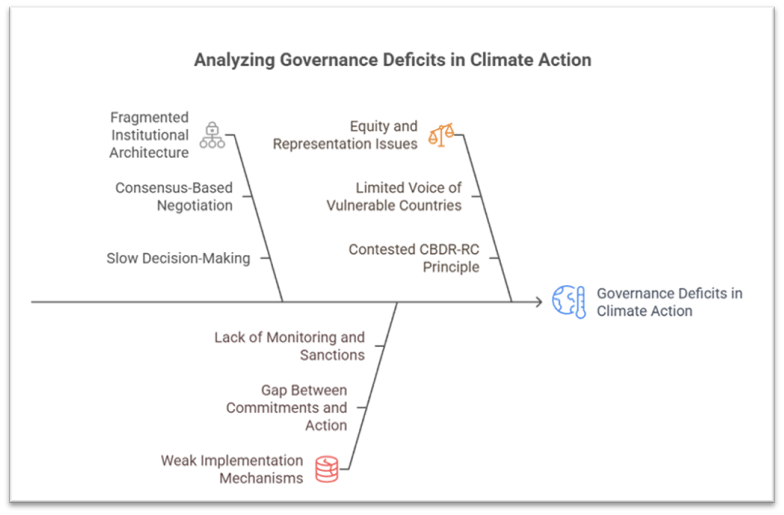
1. Governance & Accountability Deficits
1.1 Fragmented Institutional Architecture
- The primary framework is the United Nations Framework Convention on Climate Change (UNFCCC) and its COP (Conference of Parties) process, under which the Paris Agreement was adopted.
- However, its consensus-based negotiating mode, slow decision-making, and multiplicity of ancillary mechanisms (like NDCs, adaptation funds, Article 6 market rules) have led to institutional inertia.
- Case study: Climate campaign groups have urged ending the consensus rule in UN climate talks, arguing that the current process “has reached breaking point”.
- For India: when large emitters delay or under-deliver, weaker governance structures limit how smaller or developing countries (including India) can hold others accountable.
1.2 Weak Implementation and Verification Mechanisms
- Many countries submit Nationally Determined Contributions (NDCs), but there is a gap between commitments and actual action (emissions, adaptation, finance).
- Example: According to UN data, action must already be in decline across all sectors to stay on the 1.5 °C pathway.
- The governance shortfall lies in the absence of a strong body to monitor implementation, sanction non-delivery, or systematically coordinate among actors.
- For India: A stronger international governance body could help access finance more reliably and ensure that commitments from advanced economies are honoured, aiding domestic transitions such as through the National Green Hydrogen Mission or the PM KUSUM Scheme.
1.3 Equity, Representation, and Differentiated Responsibilities
- The principle of “common but differentiated responsibilities and respective capabilities” (CBDR-RC) remains central but contested. Many Global South countries argue that current structures favour powerful states.
- The institutional deficit: limited voice of vulnerable countries, sub-national actors, and civil society in decision-making, and no robust enforcement of differentiated obligations.
- For India: Reform means stronger recognition of its dual role: development plus decarbonisation. It could also help India mobilise climate finance and technology transfer from richer countries more effectively.
2. Finance, Resources, and Technology Transfers
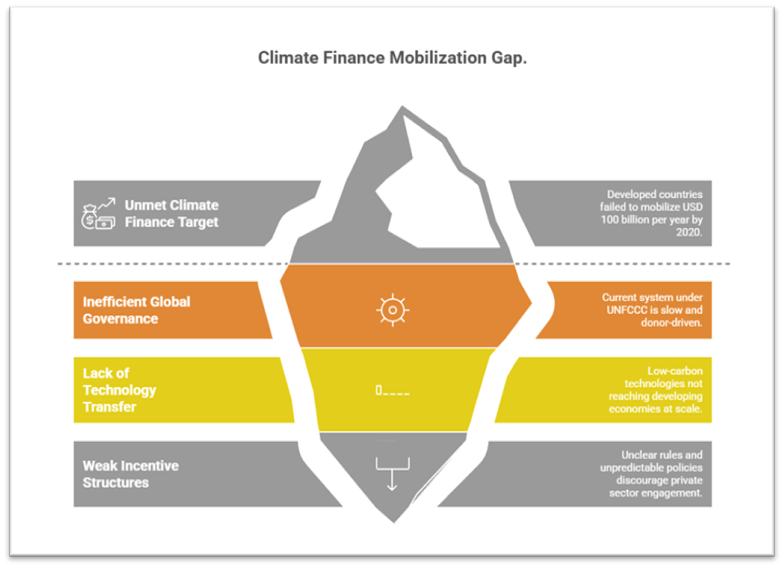
2.1 Climate Finance Mobilization Gap
- Developed countries committed (through the UNFCCC) to mobilize USD 100 billion per year by 2020 for mitigation and adaptation in developing countries — a target still unmet.
- A strong global governance body could streamline finance flows, increase transparency, and allocate funding more efficiently. The proposed Council would coordinate key actors and expedite finance.
- From India’s perspective: Access to predictable finance would support large-scale deployment of renewables, green hydrogen, and adaptation in vulnerable states (e.g., Odisha, Andhra Pradesh).
2.2 Technology Transfer and Enabling Frameworks
- The challenge is not just money but technology: how to get low-carbon technologies to developing economies at scale, and adapt them to local contexts.
- The current system under UNFCCC is slow and donor-driven. A reformed governance model could foster faster diffusion and joint R&D partnerships.
- Example: India’s push for green hydrogen via National Green Hydrogen Mission would benefit from a global mechanism that instils technology hubs, knowledge exchange, and investment guarantees.
2.3 Incentive Structures and Private Sector Engagement
- A global governance reform can incentivise private finance (banks, corporates, investors) by setting clearer rules, reducing risk, and strengthening predictable policy frameworks.
- Example: Investment funds rewarding forest-conservation (e.g., proposed “forest facility”) show how private finances can align with climate goals. A global council could amplify this.
- For India: Private capital is crucial for scaling solar, storage, and grid integration; a global body sanctioning standardised frameworks can attract more investment into India’s clean-energy transition.
3. Implementation, Integration, and Dynamic Responsiveness
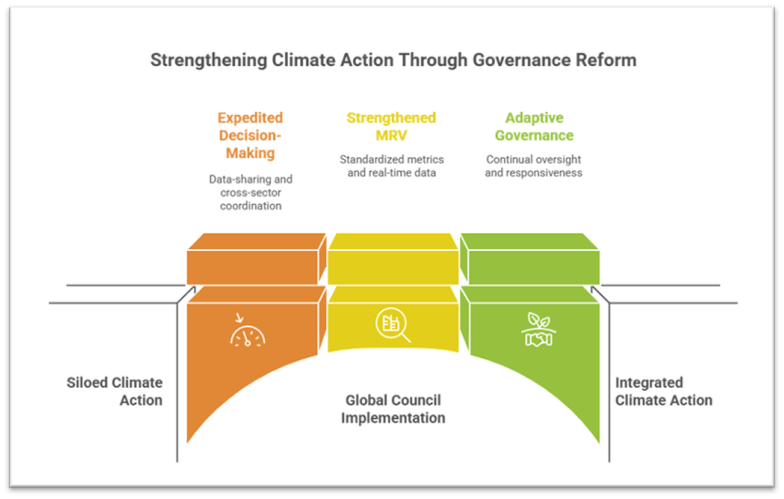
3.1 Faster Decision-Making and Cross-Sector Integration
- Climate action needs integration with development, trade, energy, biodiversity, and health. Global institutions remain siloed.
- The proposed Council is argued to have the capability for expedited decision-making, data-sharing, coordination across sectors and actors.
- For India: Energy transition, adaptation in coastal states, agricultural resilience all require coordinated policymaking — international governance reform can help align global policy support with national priorities.
3.2 Monitoring, Reporting, Verification (MRV), and Transparency
- The credibility of commitments depends on reliable MRV. Current frameworks have weaknesses: inconsistent data, reporting delays, weak link to enforcement.
- A reformed governance mechanism could strengthen MRV, create standardised metrics, facilitate real-time data sharing, and enhance transparency.
- For India: A stronger global MRV regime could validate and mobilise international support for emission-reduction and adaptation efforts, and help benchmark progress relative to peers.
3.3 Adaptive Governance for Evolving Climate Challenges
- The climate system is dynamic with tipping points, non-linear changes, and technological disruptions; governance systems must also adapt rapidly.
- Many analyses argue the current UNFCCC regime lacks agility. A global council could serve as a standing governance architecture, rather than episodic COP-driven negotiations.
- For India: As climate impacts intensify (monsoon shifts, glacial melt, coastal erosion), a global adaptive governance mechanism would support rapid deployment of climate-resilient infrastructure, backed by international cooperation and learning.
Conclusion:
In sum, the case for reforming global climate governance through proposals such as the UN Climate Change Council arises from urgent need to bridge the gap between commitments and delivery, mobilise finance, technology, and private capital at scale, and create dynamic, integrated, and transparent governance mechanisms capable of responding to the accelerating climate crisis.
With global warming nearing or already breaching thresholds (the goal of limiting to 1.5 °C is under severe pressure), the window for effective action is narrowing. By establishing a re-engineered governance body, the international system can better ensure that ambition is matched by implementation; that equitable access to resources and technology is guaranteed; and that governance becomes more than negotiations—it becomes sustained action.
For India and other developing economies, such reform holds the promise of enhanced support, clearer pathways, and stronger institutional backing for their climate transition. Going forward, the way ahead lies in securing broad international consensus for the reform, defining the mandate and scope of the new body, establishing robust accountability, and ensuring that it complements rather than duplicates existing frameworks.
Recap: